

Asia starts to price in stranded assets, although significant uncertainties remain

Wong Pei Ting
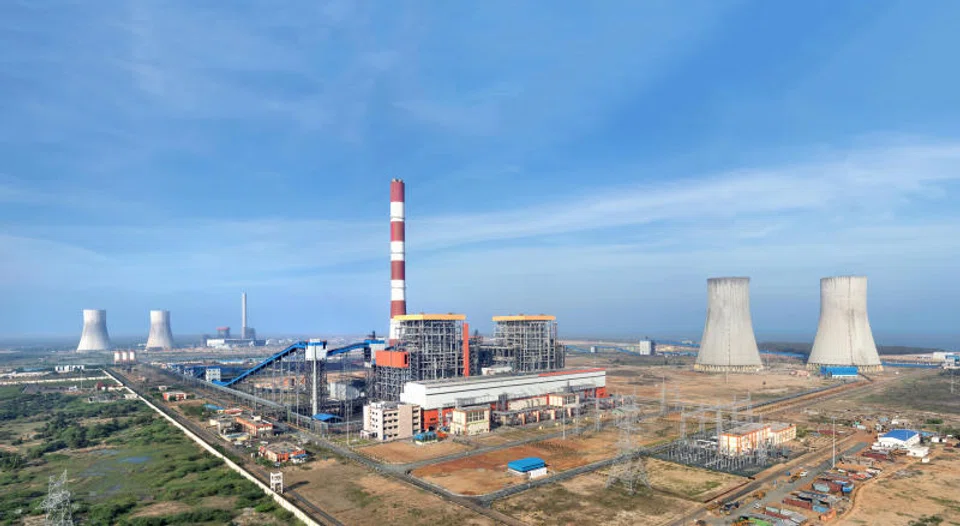
SEMBCORP Industries sold its India-based coal power unit earlier this month at no impairment cost, much to the relief of chief financial officer Eugene Cheng.
Cheng, who described a “lack of liquidity” in global financing markets for coal assets, knew how fortunate he was. Analysts told The Business Times that capital markets and insurers are beginning to price in the risk of asset stranding, spurred by changes in the market and regulatory environments.
Pricing is more advanced in sectors where stranding risk is already well established, like for coal.
Luke Ware, who leads corporate risk and broking for Asia at insurance advisor company WTW, said companies have been paying an average of 30 to 40 per cent in rate increases on every insurance renewal for their coal plants, regardless of whether they have had incidents or not. This came as about 60 per cent of the insurance market has stopped underwriting coal-fired power plants altogether, leading to a fast-shrinking insurance capacity for such assets.
Ware said the average insurance capacity in Asia for coal power plants has more than halved to about US$400 million to US$500 million today, compared to US$1 billion to US$1.2 billion 3 years ago. In the next 2 to 3 years, Ware foresees capacity further falling to only about US$200 million to US$300 million.
In real estate, RHB research analyst Vijay Natarajan has started to notice non-energy efficient or “browner” buildings in Europe being leased or sold at a 10 to 20 per cent discount compared to their green-certified counterparts. The brown discount is a result of shrinking pools of potential tenant and buyer pools for such properties, he said. The gap “will only widen in my view given the directions regulations and policies are moving,” he added.
“That’s why we are seeing a lot more Reits (real estate investment trusts) pushing in the direction of environmental, social and governance (ESG), especially in green certification of the building,” Natarajan said.
Simon Garing, chief executive officer of Cromwell European Reit’s manager, told The Business Times that efforts and investments to improve the energy efficiency of each asset — as a response to tenant-customers’ growing demands — lay behind the Reit’s recent record-high 95.4 per cent portfolio occupancy rate.
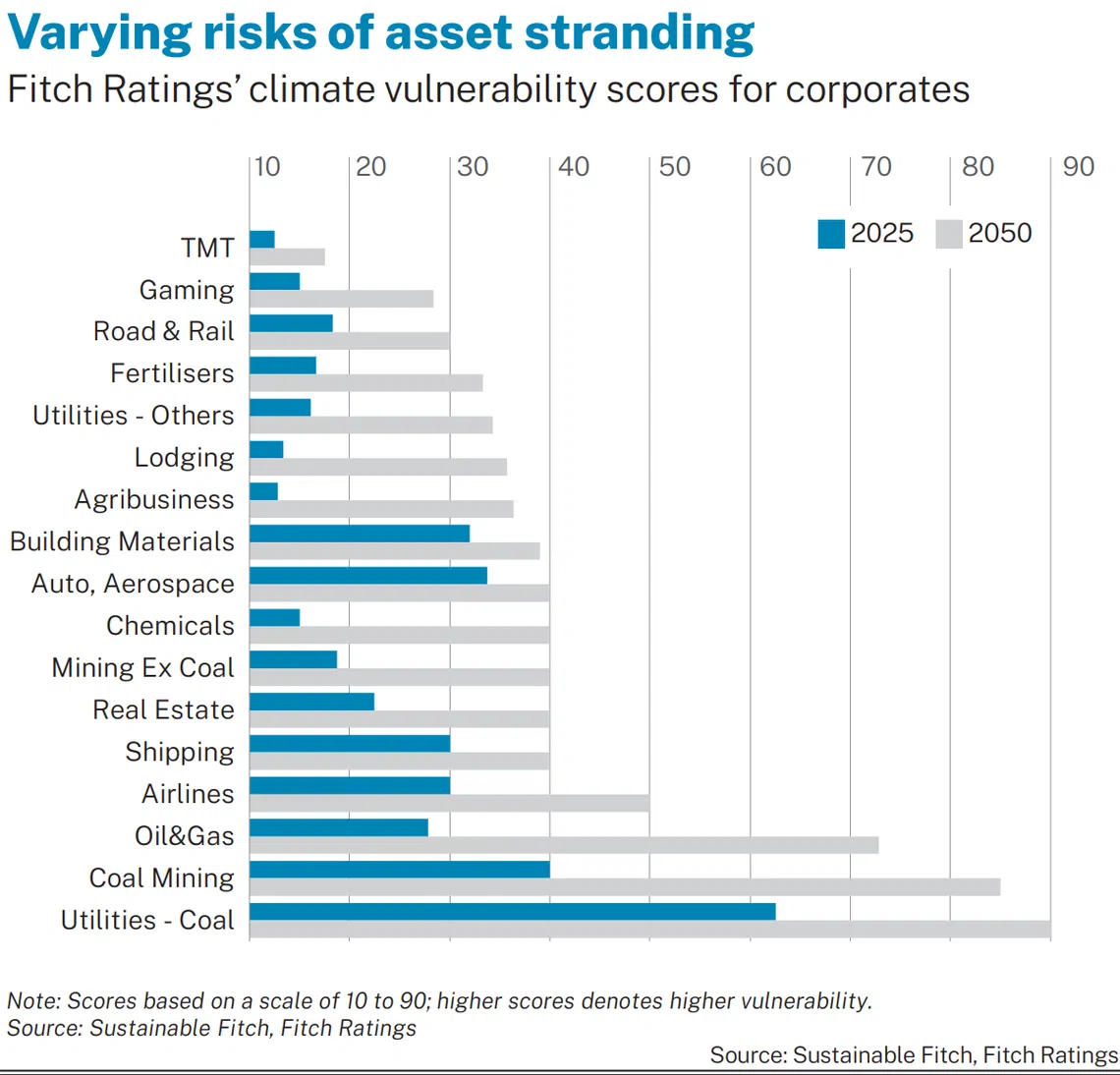
Soon to be priced in
Beyond the more obvious sectors, stranded-asset pricing is still developing.
Jigar Shah, who heads sustainability research at Maybank Investment Banking Group, said the risk is “not yet getting priced” due to the lack of reliable data and quantification. But he expects concerns to “become quite dominant” in as soon as 2 years as central banks, asset owners and managers begin stress testing exercises.
In July, the European Central Bank (ECB) urged banks to better integrate climate risk stress tests into their internal capital adequacy assessment processes after its own stress test was inconclusive on the transition losses that might befall the banks it oversees. The exercise led 41 banks to report aggregate losses of 70 billion euros, but the central bank said the amount may “significantly understate” the actual transition risk, noting the banks’ “preliminary” data and modelling capacity.
How much of the European experience will carry over to South-east Asia is still up in the air. Some believe this region might get it worse.
Nneka Chike-Obi, Sustainable Fitch’s Asia-Pacific head of ESG research, highlighted that fossil fuel infrastructure is relatively younger in Asia versus in Europe and North America, where decommissioning assets that are closer to end-of-life is a less costly endeavour.
UBS Global Wealth Management’s sustainable investing strategist Stephanie Choi said stranding risk is especially high in archipelago countries, where infrastructure bottlenecks existed even without accounting for rising climate risk.
South-east Asia is known to be more vulnerable to water scarcity as well, she said, adding that GermanWatch’s climate risk index places 3 out of the top 10 countries with the highest climate risk globally in the region. They are Myanmar, the Philippines and Thailand.
The risk is “underappreciated” today, Choi said, as it hinges on longer-term tail events that are viewed on decades-long basis, while most financial analytical models project only 2 to 3 years forward. “It is therefore a challenge to capture or accurately provision for potential impact,” she said.
To complicate matters, it is not easy to identify stranded assets. Choi said the judgement is highly dependent on market dynamics and the specific asset or liability profiles of various industries, as she mused that there was a time when tar sands looked like they would become stranded assets before the global energy squeeze gave it renewed fervour this year.
“Asset values rarely go from high to zero overnight, so there are always trading opportunities in and out,” Choi concluded.
Shivanan Sivarajah, MUFG’s head of project finance for Asia, said that while most international banks have already agreed to not finance new pure play coal-fired power projects, the industry is “treading more lightly” when it comes to other fossil fuel industries. This will be the case as long as traditional power markets continue to be critical in ensuring Asia meets its day-to-day power demands and its short and medium term economic growth potential, he said.
OCBC’s credit research team said devaluation trends at a company level or sector level can be difficult to quantify and extrapolate, as emissions-intensive industries can also undergo transformations in their facilities towards a low-carbon future. The energy and chemicals sector in Singapore, for one, is upgrading to more energy-efficient equipment, and transitioning toward lower-carbon fuels, bio-based fuels, renewables and sustainable chemicals.
Hopes of being bailed out
Other moving parts include the recent inclusion of gas and nuclear in the EU Taxonomy as transition fuels, which Chike-Obi said is “supportive” for credit issuers with such assets. It raises the likelihood of these assets being able to operate to the end of their typical life, as opposed to being decommissioned or becoming financially unviable early.
HSBC global head of ESG research Chan Wai-Shin said assets at risk of being stranded “can be given life support if absolutely necessary” as their status is contingent on a mix of reasons spanning policy, finance, economics and public perception.
“Write-offs and revaluations are balance sheet items – they tend to be cashless, and so affect the value of an asset. This might impact how much investors are willing to pay for companies owning such assets,” he said.
“At the same time, the energy requirements of a country or region need to be met by other means and are affected by policy and incentives – something that governments have more control over.”
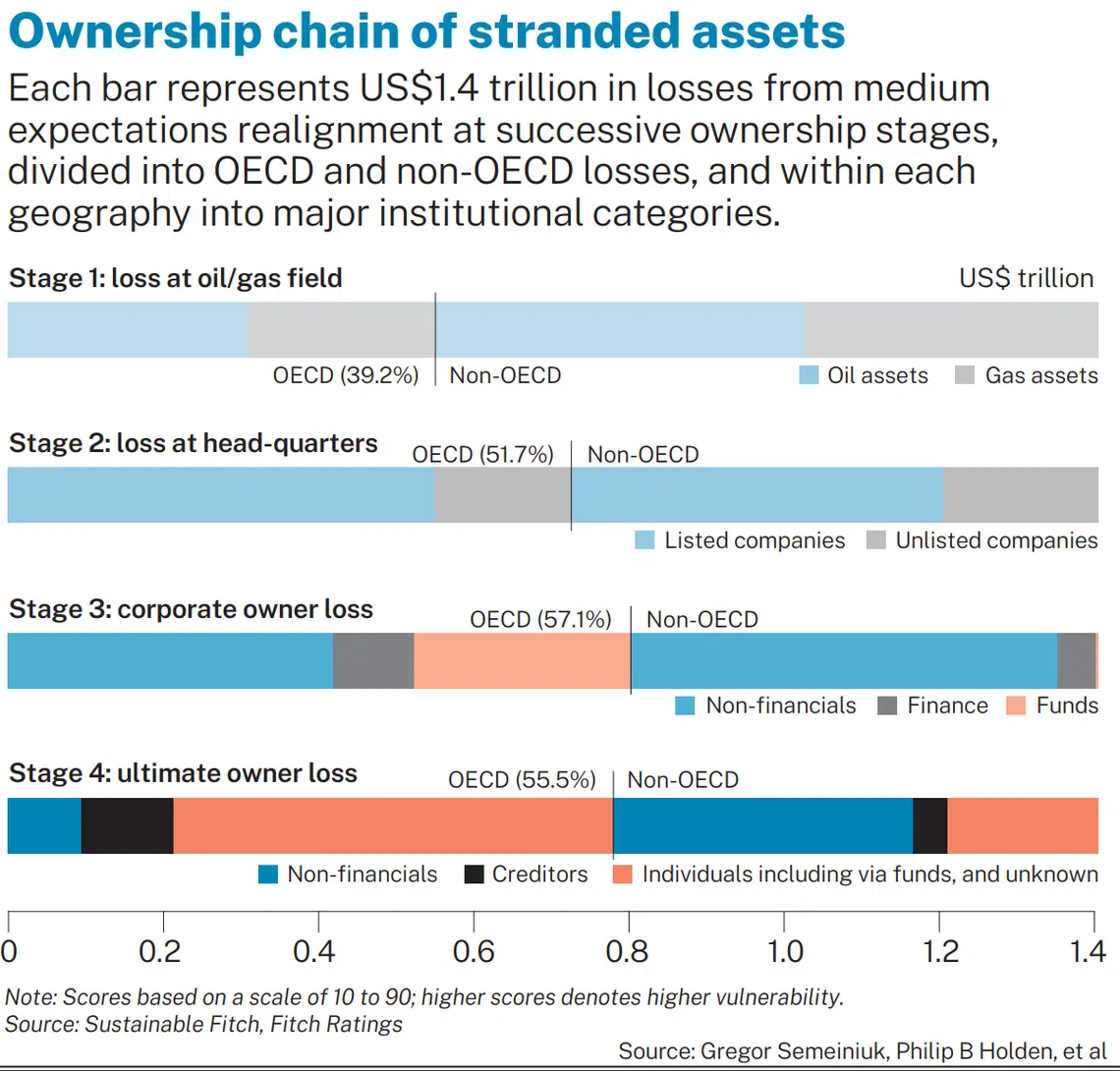
This possibility was discussed at length in a Nature paper published in June, which found that most of the market risk falls on private investors, overwhelmingly in Organisation for Economic Co-operation and Development (OECD) countries, including substantial exposure through pension funds and financial markets.
This group is likely to lobby governments for support, which could perversely create a moral hazard that supports continued investments in high-risk activities with a view of being bailed out.






