Asian exchanges play key role in providing global investors with diversification: SGX chief
Loh Boon Chye expects product innovation for derivatives to move towards multi-jurisdictional operations

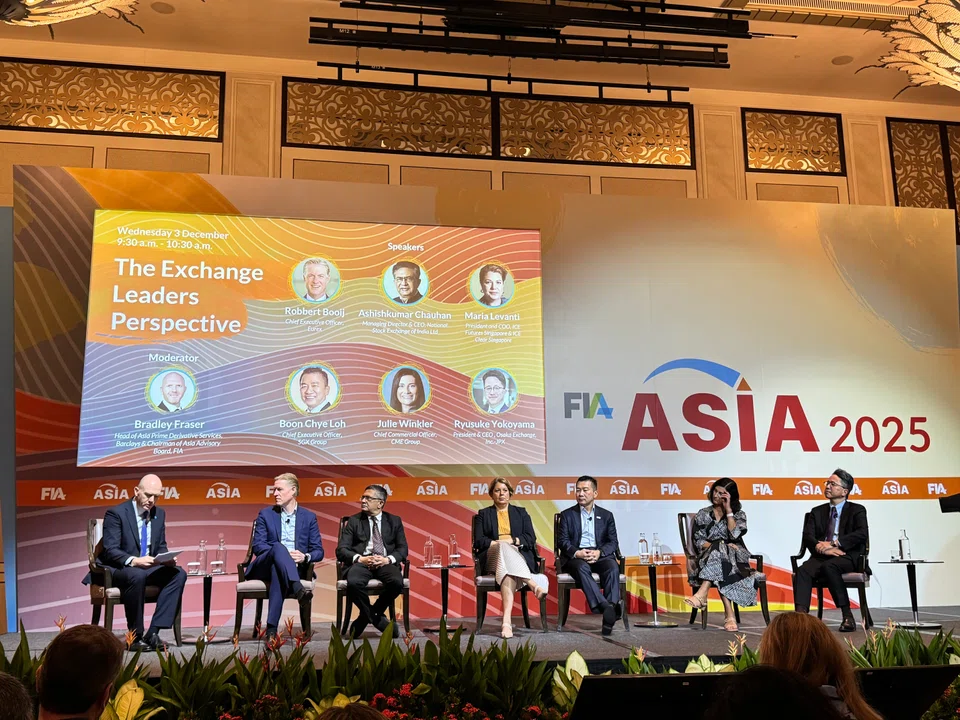
[SINGAPORE] The chief executive officer of the Singapore Exchange (SGX) on Wednesday (Dec 3) cited the dual-listing framework with Nasdaq and the launch of institutional-grade crypto perpetual futures as examples of how the bourse is advancing product innovation.
Loh Boon Chye, speaking on a panel with five other global exchange leaders at the Futures Industry Association (FIA) Asia Derivatives Conference, said that the definition of product innovation has evolved beyond novelty or speed.
“It is about value equity, filling a market gap and, obviously, solving problems for customers... It is clearly about functionality, growing the market, unlocking access.”
SGX reported a 17 per cent rise in derivatives trading volume this year, against the 7.9 per cent growth in global derivatives markets.
Examples of product innovation in the derivative space included SGX’s partnerships with the National Stock Exchange of India and New Zealand’s Exchange (NZX).
Under the tie-up with NZX, dairy contracts were consolidated onto a single platform, doubling both trading volumes and the number of clearing members, Loh noted.
He also cited SGX’s recent launch of institutional crypto perpetuals – derivatives designed to meet institutional demand for “transparency, price discovery and clear products for cryptocurrency”.
Separately, Loh noted that SGX and Nasdaq recently unveiled a joint Global Listing Board, which enables regional companies to list simultaneously in Singapore and on Nasdaq using a single prospectus. He said this reduces friction for issuers and addresses evolving market needs.
He said he expects product innovation for derivatives to move towards multi-jurisdictional operations, both in clearing and product development, to broaden market depth and serve the wider ecosystem more effectively.
SEE ALSO



The SGX chief’s remarks were in response to questions from panel moderator Bradley Fraser, who heads Asia prime derivative services at Barclays and chairs the FIA Asia advisory board.
He had asked Loh if product innovation remained relevant and how SGX defined it, and also whether Asian exchanges could preserve local market development while competing with US markets.
Loh acknowledged that the US is still the largest, most capital-rich market, but added that Asian economies and exchanges are highly relevant.
Regional bourses are growing at different paces, with some operating in young, fast-growing populations and others facing ageing demographics, creating significant market opportunities, he said.
“Even in currency derivatives, our liquidity is now spread almost equally between the Asian and US time zones, which is relevant for global investors,” he pointed out.
He added that exchanges in Asia, in providing global investors with diversification, facilitate risk management, such as by distributing liquidity across time zones and cross-market monitoring.
“Exchanges, in particular, have to be of utmost relevance in our domain, because that is what will provide global investors with diversification.”
On the evolving boundaries between exchanges, brokers and technology platforms, he observed that collaboration is increasingly important.
In the SGX’s commodities markets, for example, partnerships with ecosystem brokers have significantly expanded trading volumes and the role of technology platforms in enabling products like crypto perpetuals.
He also pointed out that cross-border collaboration between exchanges is allowing retail investors to access each other’s equities via depository receipts.
Making greater use of AI
At the conference held at St Regis Singapore, Lim Tuang Lee of the Monetary Authority of Singapore’s capital markets division said in a keynote address that exchanges and market infrastructures are using artificial intelligence (AI) to enhance transaction processing, automation and market surveillance.
This comes as global derivatives markets continue to expand, which could mitigate risks through increased portfolio diversification, risk management and market stability.
He noted that it was encouraging that the FIA has worked with market participants to update best practices for automated trading, risk controls and system safeguards to address risks from existing and emerging technologies, including AI.
“Now it is clear that technology will transform markets and how they operate, both front and back, and what do these technological trends mean for financial supervisors?”
MAS, on its part, takes a technology-neutral approach to guide it in its mission, he said.
“MAS seeks to enable a trusted and innovative capital market ecosystem through facilitating innovation, sharpening its supervision capability, and shaping the path forward to partnership with ecosystem partners.”
He said the central bank partners with the industry to facilitate experimentation with innovative models while monitoring emerging risks through the MAS FinTech Regulatory Sandbox.
One recent example is a market-maker trading model tested by a financial institution, which executed trades using a set-pricing algorithm rather than traditional pricing methods.
Decoding Asia newsletter: your guide to navigating Asia in a new global order. Sign up here to get Decoding Asia newsletter. Delivered to your inbox. Free.
Copyright SPH Media. All rights reserved.