Asian investors expected to grow gold investments: survey

Increasing number of regional asset owners see gold as ‘core asset’ for the long term

Mia Pei
Published Wed, Jun 26, 2024 · 12:01 AM
    • One of the most cited barriers that hinder gold investment is a lack of an established model to measure gold’s intrinsic value.
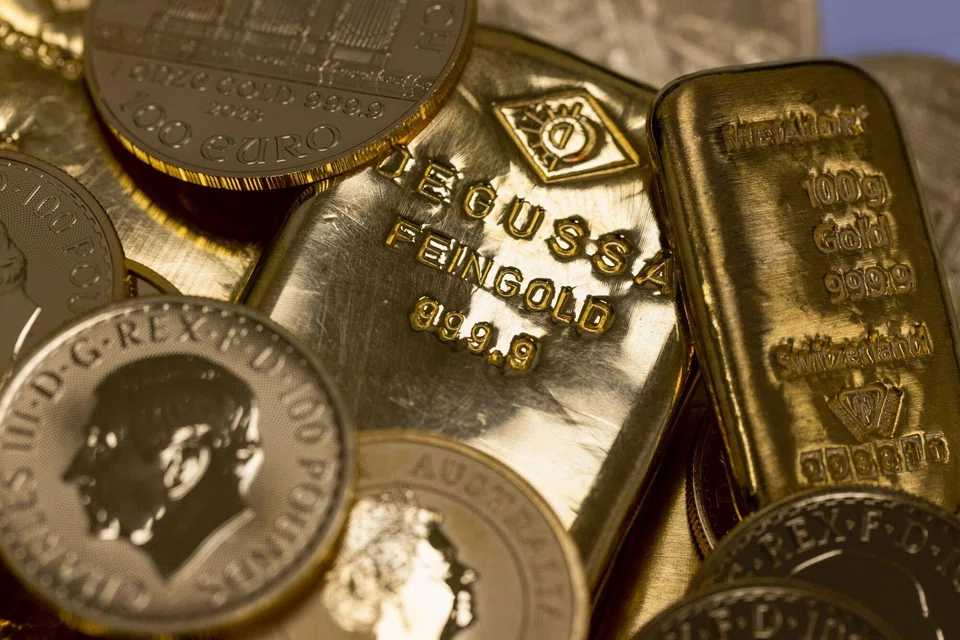
    • One of the most cited barriers that hinder gold investment is a lack of an established model to measure gold’s intrinsic value. PHOTO: BLOOMBERG

    MORE investors across Asia-Pacific are treating gold as a core asset in their portfolios, according to a survey by State Street Global Advisors (SSGA) and the World Gold Council (WGC).

    The Gold Perceptions Survey released on Wednesday (Jun 26) found that some 27 per cent of asset owners in Apac expected to increase their gold investments within the next 12 to 18 months – higher than the 21 per cent in North America.

    This suggests an increasing number of asset owners in the region using gold as a core asset for long-term investment, said Robin Tsui, Apac gold strategist at SSGA.

    In line with the survey findings, he observed that more investors in Asia, especially in Singapore, have been more open to discussing gold as an asset class in the past six months.

    There has also been an increase in the region in using gold exchange-traded funds as a way to track gold prices, he added.

    Tsui described this as a “tremendous” growth opportunity for the gold investment market in Apac.

    The survey interviewed 850 consultants, financial advisers and institutions globally, including 63 based in Apac. All the Apac asset owners surveyed have over US$1 billion in investable assets, with about 51 per cent managing more than US$5 billion.

    About 76 per cent of the asset owners in both Apac and globally have gold investments, the survey found.

    Among the Apac investors with gold exposure, 46 per cent have allocated between 1 per cent and 4.9 per cent of their assets to gold, while 8 per cent have allocated 5 per cent or more of their assets to gold.

    “Some Apac investors own substantial proportions of gold within the portfolio and a much higher proportion stands out at the extreme,” said John Reade, WGC’s chief market strategist for Europe and Asia, referring to a significant portion of investors allocating 3 per cent or more of their assets into gold.

    Reade said this finding showed that Apac investors, when investing in gold, have recognised an appropriate weighting of gold in their portfolios.

    “The work we have done… suggests a weighting in gold of anywhere between 4 per cent for a heavy fixed income-dominated portfolio (and) up to close to 10 per cent for a portfolio that has much more equity allocation,” he added.

    Lack of valuation framework hinders investment

    Reade noted a low and negative correlation between gold and many financial asset indices over time, showing that gold provides a hedge in times of major market declines, systemic risk and geopolitical volatility.

    “Gold as a proven diversifier especially in times of financial turmoil and economic uncertainty was the top reason for Apac asset owners to invest in gold,” he said.

    Tsui added: “Since 2008, gold has performed strongly during months when the Fed funds rate was cut. We believe the anticipated dovish monetary policy stance by the Fed in the second half of the year will continue to support gold performance.”

    Meanwhile, the survey found that one of the most cited barriers that hinder gold investment is the lack of an established model to measure gold’s intrinsic value.

    “This is a common challenge we find around the world – probably one of the biggest barriers to gold investment,” said Reade. He added that WGC has been working on constructing a long term valuation framework for gold.

    The 24 per cent of investors who have not invested in gold at all presents a bigger challenge across all the regions, as more efforts are needed to make the case for the precious yellow metal, Reade noted. “That’s where our work will probably bear fruit in the very long term.”