

Asian markets dive as oil prices spike, Ukraine crisis rattles investors
Worries rising over developing supply crunch on news of potential embargo of Russian oil and as Opec+ keeps supply tight

Singapore
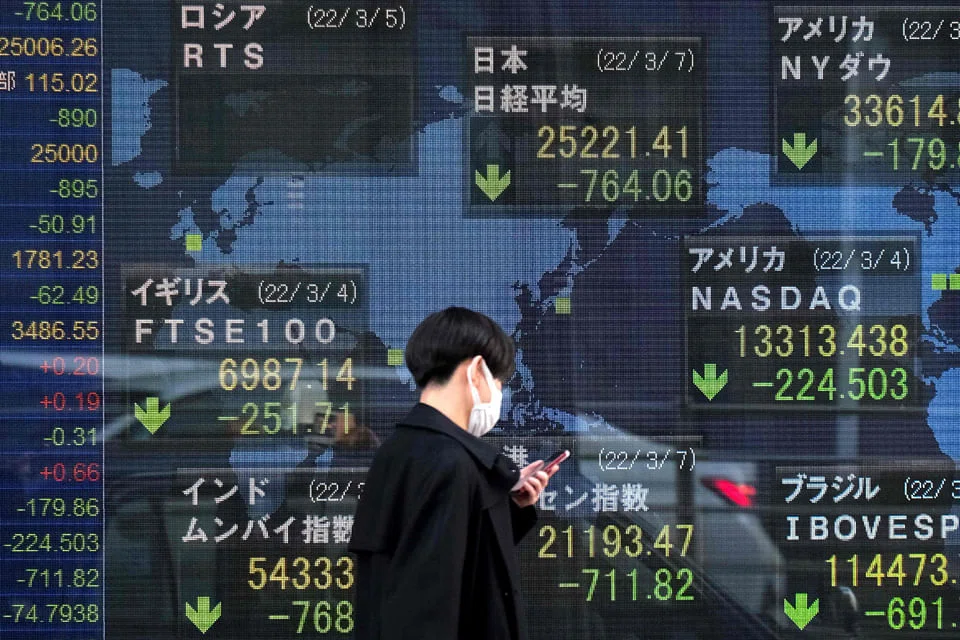
FINANCIAL markets in Asia tumbled on Monday (Mar 7) amid a rally in crude oil prices which was stoked by reports that the US Congress is exploring an embargo of oil imports from Russia, one of the world's largest oil suppliers.
Fears of a supply crunch, as well as escalating tensions between Ukraine and Russia, pushed benchmark Brent prices to as high as US$137.59 during Monday's trading session, while West Texas Intermediate Crude touched US$129.77.
Supply is also being kept relatively tight by the Opec+ (Organization of the Petroleum Exporting Countries and allies), which agreed to only a modest supply increase despite strict sanctions imposed against Russia.
Around the world, traders and countries are increasingly worried about the developing supply crunch that looms over the crude oil market.
Oanda senior market analyst Jeffrey Halley further noted that Russians themselves also gave the US some "hefty last-minute demands" in the small print of the almost-finished Iran nuclear deal.
It was a sea of red across the region, with no market escaping unscathed. The benchmark Straits Times Index slipped 1.2 per cent or 38.96 points to finish Monday at 3,187.82, as decliners surged past advancers 355 to 207.
Halley said the Singapore market has relatively outperformed its peers as the STI is heavy with the likes of banks, utilities and property. "(These) are more defensive style equities in this sort of market," he said.
Elsewhere in Asia, the Nikkei 225 in Japan lost 2.9 per cent; Hong Kong's Hang Seng Index slipped 3.9 per cent, while Malaysia's KLCI lost 2 per cent. The Kospi in South Korea fell 2.3 per cent, and the Jakarta Composite Index declined 0.9 per cent.
Over in China, the SSE Composite Index slipped 2.2 per cent, while Australia's ASX/200 lost 1 per cent.
Stephen Innes, managing partner at SPI Asset Management, said it will be tough to "calculate a top" for oil prices in the current scenario.
"Russian oil will find its way to the Chinese market, lessening demand from the Middle East while simultaneously factoring in demand destruction is a wild card at best," he said. "Still, you don't cut off the world's second-largest oil supplier and expect speculators and buyers to sit and idle."
Looking ahead, investors should brace themselves for a rough time as the crude oil industry's dynamics hang in the balance.
The higher volatility in the oil market presents a "clear and present threat to the global recovery", warned Vishnu Varathan, head of economics and strategy at Mizuho Bank.
"The spectre of stagflation has gone from a worrying whisper to a shrill alarm that the world may be on the brink of a crisis ... And this certainly warrants policy exceptions all around, the least convincing of which may be monetary policy concessions to cushion growth."
In his view, the main policy response could be to tackle the geopolitical supply shock. There might also be increasing pressure on Opec+ oil producers to not only quickly restore output, but also compensate for Russian shortfall.
READ MORE:
SGX suspends trading of PJSC Gazprom GDR on Russia sanctions
War stokes rally in SGX's oil, commodity stocks
Confusion, but not panic, reigns in global finance in Russia's wake
Stakes rise as Putin says war in Ukraine will continue
President Biden shifts to the political centre
Russia's war on Ukraine: Drawing first lessons and considering the outlook
TRENDING NOW

China Investment Corp, PGIM’s 50% stake in Nex mall up for sale; asking about S$1.2 billion

Higher rates, weaker spending: Is the Philippines entering stagflation?
Singapore tech stocks plunge as Nasdaq bloodbath spills into region
OCBC wealth clients turn defensive amid market volatility as Q3 profit rises 3%

