Asian markets up on Fed's massive bond-buying programme
 Add BT as a preferred source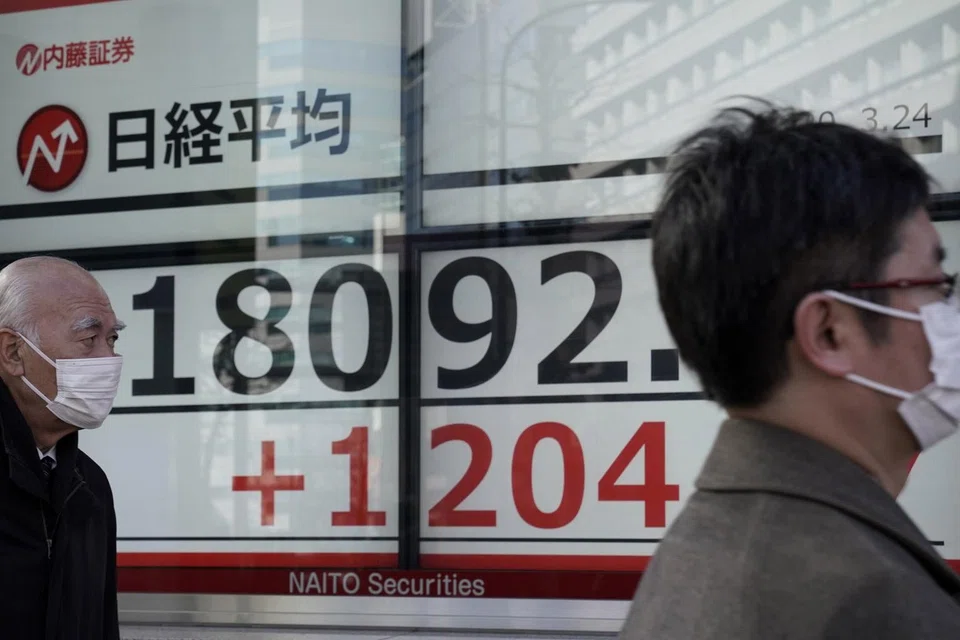
Hong Kong
The US Federal Reserve's unprecedented bond-buying programme has thrown a lifeline to Asian equities as the dollar's reversal eased concerns over capital flight from the region and fuelled risk appetite.
The MSCI Asia Pacific Index rallied as much as 4.8 per cent as of 3.58 pm in Hong Kong on Tuesday, set for the most since October 2008. South Korea stocks jumped 8.6 per cent after the nation doubled its emergency funds, while Japan's blue-chip measure Nikkei 225 rose 7.1 per cent, the most since 2016. Hong Kong's Hang Seng Index closed 4.5 per cent higher.
It was a sharp contrast to a sea of red for Asian equities on Monday that saw record losses for India and New Zealand benchmarks after announcements on nationwide lockdowns. The Fed's unlimited quantitative easing prompted traders to return to risk assets, sending almost all Asia-Pacific currencies including the Australia dollar and the South Korean won jumping.
"The Fed's latest round of stimulus is a gamechanger," said Edward Moya, a senior market analyst at Oanda.
Most risk assets rose on Tuesday and the dollar snapped a 10-day rally. Spreads on dollar notes in Asia tightened for the first time in 10 days after the Fed action, but remain near Monday's eight-year high.
"A drop in the US dollar helped a lot," said Steven Leung, an executive director at UOB Kay Hian (Hong Kong) Ltd. "It will also help ease pressure on the region's capital outflow."
Meanwhile investors are still waiting for the passage of the largest stimulus bill in US history to fight the economic fallout of the coronavirus. Futures contracts on the S&P 500 added 5.1 per cent in late Asian afternoon, hitting exchange-enforced bands that prevent further gains, reflecting speculation that Congress would eventually pass a spending package.
Yet some market veterans including Mark Mobius warned that volatility can continue in Asian equities.
"As the economic impact of the shutdowns around the world begin to work their way through the economics we can expect more volatility," he said. "Our research indicates that the average length of a bear market is a little less than two years." BLOOMBERG
Decoding Asia newsletter: your guide to navigating Asia in a new global order. Sign up here to get Decoding Asia newsletter. Delivered to your inbox. Free.
Share with us your feedback on BT's products and services