Asian markets get ‘breather’ with US Fed’s rate cut pause
Singapore banks and Reits to benefit from steady rates, say observers

[SINGAPORE] The US Federal Reserve’s decision to hold off on interest rate cuts gives Asian markets “a breather” and more room for certainty, said market observers.
In Singapore, banks and real estate investment trusts (Reits) are expected to be the “biggest winners” of steady interest rates, although other sectors such as shipping and industrials are unlikely to see growth without a big stimulus push.
The pause in US interest rates are unlikely to have an impact on Singapore’s corporate and sovereign bonds, said industry observers.
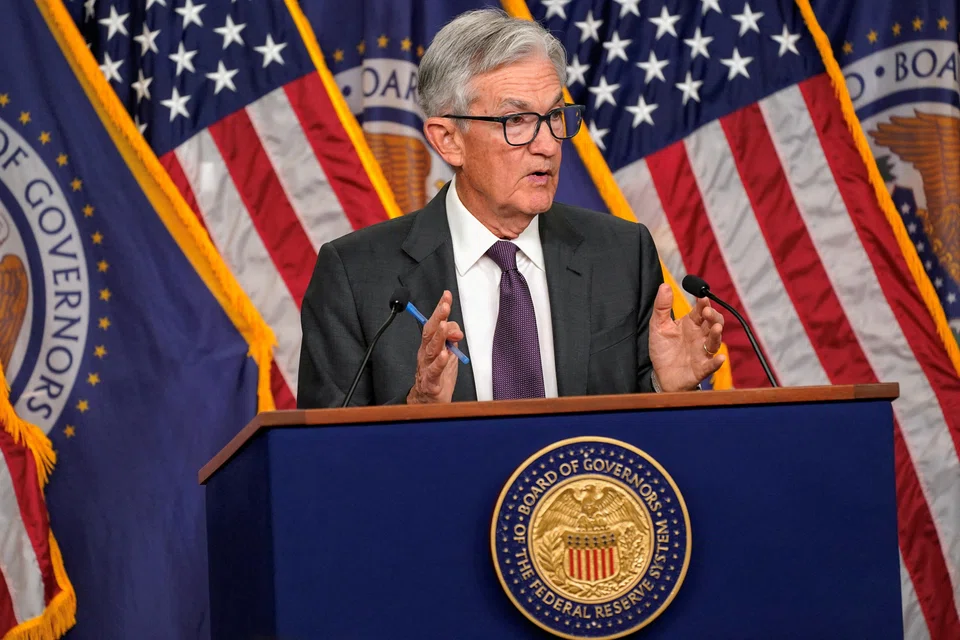
The US Federal Reserve paused interest rate cuts again on Wednesday (Mar 19), with its policymakers voting to hold the US central bank’s key lending rate at between 4.25 and 4.5 per cent.
The Fed noted an increase in economic uncertainty, as it navigates an economy unnerved by President Donald Trump’s stop-start tariff roll-out.
It also cut the US’ growth forecast for 2025 and hiked its inflation outlook, while still pencilling in two rate cuts this year – in line with its previous forecast in December.
Wall Street stocks rose, while yields on the 10-year US Treasury note fell sharply.
In Asia, market sentiment appeared to be positive in the wake of the US Fed’s announcement.
In Singapore, the benchmark Straits Times Index (STI) advanced 0.6 per cent to close at 3,930.49 points on Thursday. The three local banks – DBS , UOB and OCBC – made gains on the index, while the iEdge S-Reit Index, which tracks the performance of Reits in Singapore, rose 0.6 per cent.
Across the region, South Korea’s Kospi was up 0.3 per cent. Australia’s ASX 200 was up 1.2 per cent.
Ray Sharma-Ong, head of multi-asset investment solutions for South-east Asia at Aberdeen Investments, said that the Fed has indicated that hard data on US growth remains stable and inflation effects are likely transitionary. It also acknowledged the increased uncertainty around the economic outlook due to trade tensions.
Sharma-Ong said that the Fed is likely to be more willing to cut rates aggressively during downturns than to hike rates in response to rising inflation.
“Consequently, we anticipate two Fed rate cuts this year, with a bias towards more cuts rather than fewer,” he added.
Market impact
Kerry Craig, a global market strategist at JP Morgan Asset Management, said that positive policy developments outside the US are benefiting international equities.
Meanwhile, in fixed-income markets, the emergence of a weaker growth outlook means the US Treasuries will still likely have an asymmetric profile of moving lower than higher, he said.
Simon Ree, founder of online trading academy Tao of Trading, said that the pause in rate cuts is “not a bad outcome” for Asian markets.
He said: “Markets hate uncertainty more than anything else, and this pause gives us a breather – no sudden shocks to rattle the system.”
Banks and Reits in Singapore are the biggest winners of steady interest rates, said observers.
For the local banks, the pause in interest rates means their net interest margins will not shrink too fast, said Ree. He believes that they may hold strong, or even make gains, if loan demand picks up with the reduced uncertainty in interest rates.
Reits will also “catch a break”, he added. Without the prospect of rising debt costs, their yields will remain attractive compared to bonds, said Ree.
In the case of other sectors, he noted that while the pause in rate cuts will also keep borrowing costs steady for companies, it also means that they will not get a big stimulus push either.
Growth could flatten for companies in export-heavy industries or shipping as they do not have global demand, and must also face lurking trade tensions, he added.
Asian bonds hold steady
Shorter tenor Asian bonds may see their yields rise, while long-tenor bonds will face reduced price volatility in the Asian market, said Colin Low, the portfolio manager of the global fixed income team at research platform Bondsupermart.
Singapore’s corporate and sovereign bonds will not be affected by the rate pause much, as benchmark interest rates in the country are unlikely to shift significantly as well, added Low.
Similarly, Ree said that he expects bond prices in Asia to hold steady or edge up slightly as capital flows stay put rather than rush back towards the US.
For Singapore, the steady US interest rates means that there is less pressure on the Singapore dollar and bodes stability for the market. Ree expects steady demand for government securities and high-grade corporate bonds.
TRENDING NOW
Grab CEO’s wife Chloe Tong on life with Anthony Tan and finding her purpose
What role can Japan play in Asean’s future?
He built the Vingroup empire. Now South-east Asia’s richest man is handing some key roles to his sons
Asean’s challenge is to become resilient against global geopolitics: former Indonesia trade minister