

Asian markets slump after US inflation hits 40-year high, Fed rate hike hangs in balance

Uma Devi
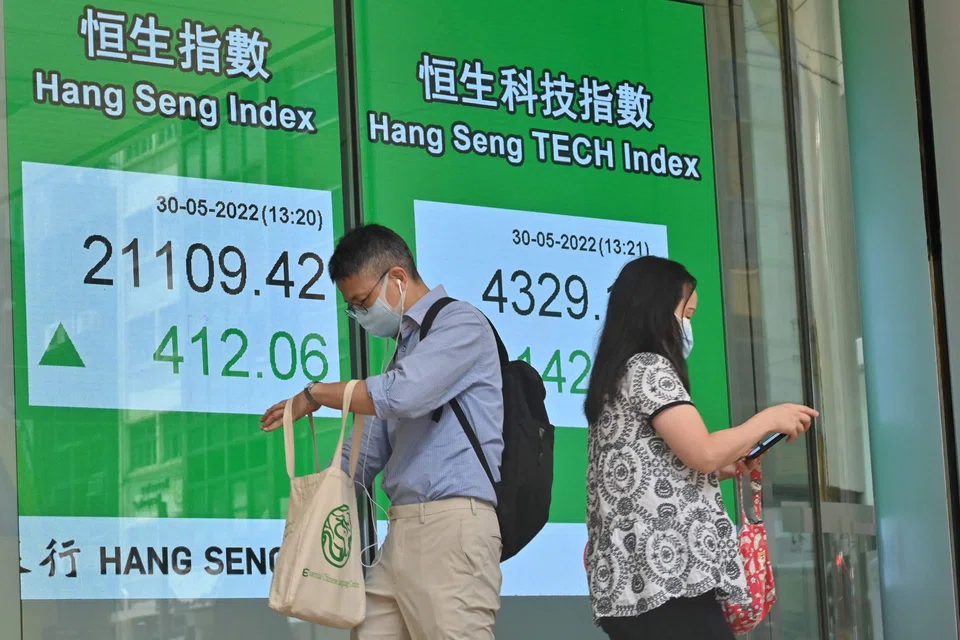
STOCK markets across South-east Asia tumbled on Monday (Jun 13), after news that the US inflation rate in May hit a 4-decade high on Friday, in a development that has now put pressure on the US Federal Reserve to raise interest rates further.
Inflation in the US rose 8.6 per cent in May from the corresponding month last year. The Consumer Price Index for all products also rose 1 per cent in May from April, due largely to higher prices of food, gas and shelter.
“Asian equity markets are taking some serious selling pressure,” said Oanda’s senior market analyst Jeffrey Halley.
“Obviously, the slump by Wall Street has provoked a negative reaction in Asian markets today, and mass testing in China over the weekend has lockdown nerves elevated once again.”
Markets were on the receiving end of a double whammy on Monday, as the yen tumbled to a fresh 2-decade low against the dollar as the US inflation data drove up Treasury yields.
Asian markets were not left unscathed in the global rout. Locally, the benchmark Straits Times Index opened in the red on Monday, shedding 0.7 per cent or 22.4 points to 3,159.33 as at 9.03 am. As at the midday break, the index had recovered only marginally, and was still down 0.6 per cent or 19.6 points at 33,162.13.
Over the second half of the trading day, the STI fell further, eventually closing at 3,139.35 — down 1.3 per cent or 42.38 points.
It was a similar story across the region. The Nikkei 225 lost 3 per cent; the Hang Seng Index slipped 3.4 per cent, and the SSE Composite Index lost 0.9 per cent. The KLCI fell 2 per cent, and the Kospi tumbled 3.5 per cent.
Risk aversion has picked up in Asia, while the slip in US consumer confidence levels is also sending shock waves of concern around an economic slowdown, said Saxo Markets’ Asia-Pacific strategy team.
“This has meant another round of coordinated sell-off in bonds and equities, with only commodities continuing to provide a room to hide for traders and investors with a shortage in supply for physical assets.”
All eyes are now on the Federal Reserve, and market watchers have stressed that another rate hike is imminent.
Vishnu Varathan, head of economics and strategy at Mizuho Bank, said that a 50 basis point hike is “as good as a done deal” in June. “The bar is high to derail plans for another follow-through 50 basis point hike for July,” he said.
Saxo’s strategists said the odds of a third 50 basis point rate hike at the September meeting are now “100 per cent”, but warned that there have also been calls for a 75 basis point rate hike this week.
Christian Scherrmann, US economist at DWS, is expecting the Fed to hike rates in instalments of 25 basis points in September and beyond to as high as 3.25 per cent to 3.5 per cent in May 2023.
However, the Fed could be forced to make cuts thereafter, as Scherrmann pointed out there is an “elevated recession risk” of around 40 per cent in the second half of 2023.
There is now “growing evidence of slowing growth and the risk to earnings”, said Morgan Stanley in a note. It advised investors to focus on stocks that can “deliver on earnings in a very difficult environment for many companies to navigate“.
Morgan Stanley’s preferences include classic late-cycle winners such as defensives and energy stocks, as well as companies with high operational efficiency.
Oanda’s Halley said the Fed meeting is not the only one to watch a policy decision this week. The Swiss National Bank and Bank of England have their respective meetings on Thursday, and the Bank of Japan is set to meet on Friday.
TRENDING NOW

If Europe goes to war, the fallout will be felt in East Asia

Government to bring forward raising of retirement age, give employers more financial support to create flexi-load jobs

Indonesia stocks suffer worst plunge in nearly 30 years as MSCI proposes standalone status

Mapletree Industrial Trust posts 6.6% drop in Q2 DPU to S$0.0297

