

Asian stocks joins global rally on US-Iran breakthrough hopes
Overnight, Wall Street rallied with the three major indexes registering their biggest daily gains since Apr 8
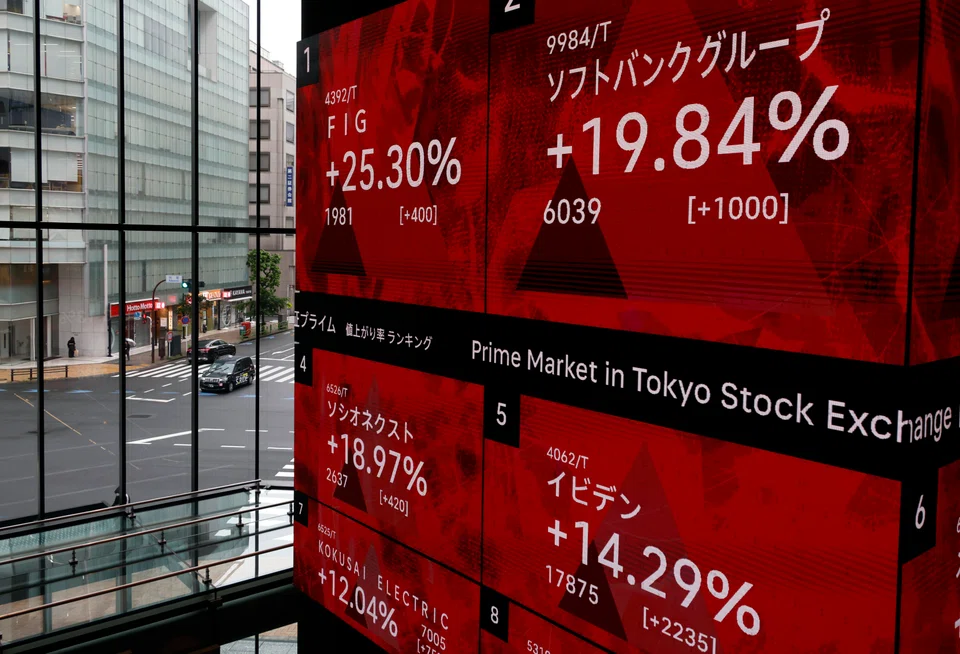
[SYDNEY] Asian stocks joined a global rally on Friday (Jun 12) on hopes a Middle East peace deal may finally materialise, while the US dollar and bond yields dropped and oil prices fell to two-month lows, tempering inflation fears.
All eyes are on the hotly-awaited market debut of Elon Musk’s SpaceX, which has made history with the biggest-ever initial public offering. The IPO raised a record $75 billion, valuing the rocket and spacecraft manufacturer at US$1.77 trillion and making Musk the world’s first trillionaire.
US President Donald Trump said on Thursday that a peace deal could be signed as soon as this weekend, hours after threatening more strikes on Iran. He said negotiations with Teheran had advanced to the highest levels of Iran’s leadership and had been approved by a broad coalition of regional powers.
Trump’s remarks follow repeated bouts of optimism from the president that have failed to yield a deal, keeping markets on edge.
Nonetheless, “this does look perhaps a bit more tangible than we have had,” said Ray Attrill, head of FX strategy at National Australia Bank.
“If we hear something from Iran that sounds positive, the odds (of a peace deal) are clearly going to flip quite dramatically.”
The deal, if confirmed, would be the most significant diplomatic breakthrough yet to end the three-month-old war, which has sent global energy prices sharply higher. The European Central Bank had to raise interest rates for the first time in nearly three years on Thursday to nip war-driven inflation in the bud.
Oil prices slumped to two-month lows on the news of an agreement before trimming some of the losses. US West Texas Intermediate (WTI) crude futures were last down 1.2 per cent to US$86.69 a barrel, on top of a 2.6 per cent drop overnight. Brent dropped 1.1 per cent at US$89.40 per barrel, having fallen nearly 3 per cent overnight.
MSCI’s broadest index of Asia-Pacific shares outside Japan jumped 3.2 per cent, led by a 7.4 per cent surge in South Korea’s Kospi. Japan’s Nikkei rose 2.7 per cent.
SEE ALSO


China’s blue-chip CSI300 rose 1 per cent, while Hong Kong’s Hang Seng gained 1.3 per cent.
Overnight, Wall Street rallied with the three major indexes registering their biggest daily gains since Apr 8, when the US and Iran agreed to a temporary ceasefire. The Nasdaq jumped 2.5 per cent, helped by expectations of a strong market debut for Musk’s SpaceX.
IG estimates the expected market cap of SpaceX at the close of business on Day 1 would be just over US$2.4 trillion.
“It suggests that SpaceX’s market cap ... will be about 35 per cent higher than the US$1.78 trillion valuation set for the IPO,” Tony Sycamore, analyst at IG, said in a note. “This, in turn, suggests the SpaceX share price will likely finish today somewhere in the ~US$175/US$180 range.”
Treasuries held onto gains as hopes of a peace deal in the Gulf led markets to trim bets of a rate hike from the US Federal Reserve in 2026. Pricing for a hike in October has come down to 36 per cent from 51 per cent.
Two-year Treasury yields were steady at 4.074 per cent on Friday, having slumped 6 basis points (bps) overnight. Benchmark 10-year Treasury yields held at 4.4710 per cent, after falling almost 8 bps overnight.
The US dollar stabilised after overnight losses. It rose 0.2 per cent to 160.20 yen, after retreating 0.4 per cent in the prior session. Traders are still on high alert for intervention from Japanese authorities as the yen stays close to the 160 level that many see as a line in the sand.
The Australian and New Zealand dollars were down about 0.3 per cent each against the greenback, following overnight jumps.
Precious metals resumed declines on Friday. Spot gold slipped 0.6 per cent to US$4,189 an ounce, following a 3.5 per cent jump overnight, while spot silver also fell 0.6 per cent to US$66.93 an ounce, after a 5.8 per cent gain.
Decoding Asia newsletter: your guide to navigating Asia in a new global order. Sign up here to get Decoding Asia newsletter. Delivered to your inbox. Free.
Share with us your feedback on BT's products and services
TRENDING NOW
Companies still in search of AI use cases with worthwhile ROI, says Broadcom’s CEO
Malaysian king buys stake in Singapore-listed mining firm expanding into rare earths

Once staunchly pro-China, Malaysian Chinese businesses are now distancing themselves from Beijing

Singapore’s wealth management success should extend to everyday families

