

Asia’s wealthy investors turning to private markets as AI stocks look ‘frothy’: Brookfield
Alternatives space offers cheaper entry point to AI infrastructure than public equities, says the global asset manager

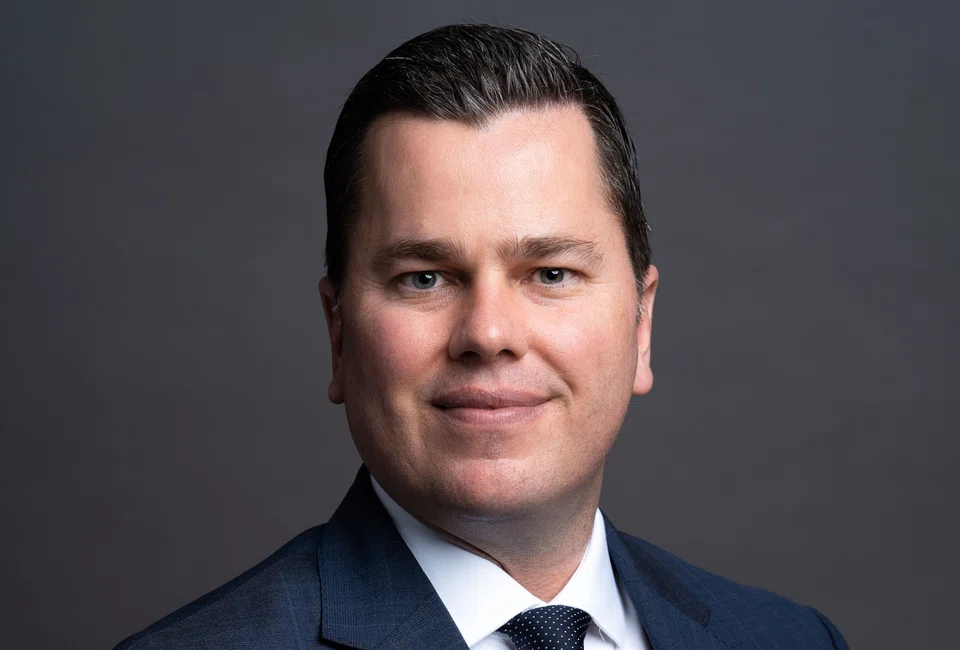
[SINGAPORE] With public equity valuations in artificial intelligence looking increasingly “frothy”, wealthy investors in Asia seeking exposure to the megatrend should look towards private markets such as infrastructure, where valuations remain far more reasonable, according to global asset manager Brookfield.
Jeremy Hall, managing director and head of international for Brookfield’s private wealth group, told The Business Times that investors in Asia are becoming more selective as stock market valuations climb.
“We think investors are underallocated to private markets,” he noted.
He cited a JP Morgan Asset Management study, which showed that when the S&P 500 reaches peak valuations – trading at 21 to 23 times earnings – investors faced average returns of around negative to positive 2 per cent.
“Today, the S&P 500 is trading around 24.5 times, and therefore we believe that investors are starting to see that equity valuations are fairly full,” said Hall.
By contrast, private equity managers are acquiring companies at around eight to nine times earnings before interest, taxes, depreciation and amortisation.
This valuation gap is driving a pronounced shift towards alternative investments among private wealth clients, Hall added, noting a “significant uptick in alternative allocations by individual investors”, particularly in Asia.
Growth in Apac
The momentum has driven Brookfield’s private wealth business to grow 60 per cent year on year in Asia-Pacific. Its wealth vehicle strategy, launched in 2023, has raised US$9 billion of capital, with a “huge component” coming from Singapore, said Hall.
The group’s international team now stands at more than 250 professionals globally, including 24 people across Apac and 11 based in Singapore, in roles such as client relationship management, marketing, investor servicing and business management.
The growing appetite for alternatives is also reinforcing the city-state’s role as a regional private wealth centre. In 2025, the Monetary Authority of Singapore proposed a regulatory framework for retail private market investment funds, with the growing interest seen for such investments.
Brookfield is actively recruiting for roles in the Republic to continue strengthening its local investment and capital-raising teams, but declined to reveal figures.
Singapore continues to attract both domestic and international wealth, Hall noted, especially from India and Indonesia.
This expansion is further boosted with the institutionalisation of family offices, adoption of alternatives and progressive regulatory frameworks, such as the variable capital company (VCC) structure provided in Singapore.
“Many of our intermediary partners have adopted the VCC structure as a way to support the uptick in growth in alternatives locally,” said Hall. “Singapore is seen as a hub for local investors and cross-border investors that are taking advantage of the growth of alternatives.”
Infrastructure the biggest opportunity
Among private market assets, Hall sees infrastructure as a “US$152 trillion opportunity”, supported by three structural tailwinds: decarbonisation, digitalisation and deglobalisation.
“Infrastructure touches each and every one of these broader themes,” he noted.
The energy transition is driving investment into renewables and electrification, while AI and digitalisation are fuelling demand for data centres, power networks and semiconductor infrastructure. At the same time, supply chain reshoring is adding another leg of growth.
Against this backdrop, he observed that private wealth clients are rapidly ramping up their infrastructure exposure even as it is historically dominated by institutional funds.
Beyond infrastructure, Brookfield is also seeing growing interest in private credit, where its subsidiary Oaktree Capital Management sees its performing credit investments yielding around 6.5 to 7.5 per cent.
Meanwhile, private equity is looking increasingly attractive as it continues to offer access to a much broader investment universe than listed markets.
Today, Hall noted, over 86 per cent of companies generating more than US$100 million in annual revenue remain private – a massive investable universe to which most private wealth investors have minimal exposure.
Manager selection and liquidity risks
While infrastructure, credit and private equity present an attractive opportunity for investors, Hall cautioned that they are not without risks.
Particularly, he said that private market allocations require a clear understanding of the trade-offs that investors should be aware of – most notably, lower liquidity in their investments.
“Alternatives offer all these benefits, but you need to take a long-term time horizon,” he added.
Addressing the volatility seen in private credit earlier in the year, Hall noted that while private credit provides attractive income return exposures, risk management and manager selection are critical.
With the growth in the number of private credit managers ballooning from roughly 15 following the 2008 global financial crisis to more than 500 today, many of these managers have not been cycle-tested through a major downturn, he warned.
TRENDING NOW

Government to bring forward raising of retirement age, give employers more financial support to create flexi-load jobs

Former minister Maliki Osman, Revolut chairman join Asia Gulf Holdings advisory board

Is Manila Asia’s new dining hot spot?

Simba at risk of losing operating licence over spectrum misuse

