

To avoid a ‘graveyard of pilots’, Seatrium gives AI projects 3 months to deliver
Short timeline prevents them from remaining in experimental stage indefinitely


[SINGAPORE] Seatrium gives selected artificial intelligence proof-of-concepts just three months to demonstrate measurable business value before they are either advanced towards deployment or discontinued.
At the end of that period, pilots must be stopped or moved into a collaboration stage, where they are refined with safeguards and risk controls before being rolled out.
This approach is designed to prevent the company from becoming a “graveyard of pilots”, said Lee Wey Lii, senior vice-president of digital at Seatrium.
The aim is not to prevent pilots from failing. Instead, the short timeline seeks to prevent projects from remaining in the experimental stage indefinitely.
“We have limited space, we have limited projects and limited time for projects to run in here,” he told The Business Times in an exclusive interview.
The type of measurable result Seatrium is seeking can already be seen in one of its engineering workflows, where the group implemented AI to match thousands of equipment tags against complex engineering diagrams.
The process – which used to take up to 50 man-days – can now be completed within two man-days, using a combination of optical character recognition (OCR) and AI.
Unlike standard diagrams and drawings, engineering drawings do not have text in fixed positions.
“The accuracy was not what we wanted,” Lee said of the group’s earlier OCR-only approach, adding that the results were unsatisfactory.
Deployment as KPI
For Seatrium CEO Chris Ong, the success of the group’s AI programme is measured not by the number of pilots launched, but by how many projects reach live operations.
Projects that remain in the pilot stage do not count towards the digital team’s key performance indicator (KPI).
“What counts is what ends up in the operations,” said Lee.
The emphasis on deployment is reflected in how Seatrium organises its AI programme.
The group established its AI council, which is chaired by Ong, in late 2024.
Consisting of 15 members from senior leadership and management across different departments, the council oversees the implementation of AI projects in the offshore and marine group.
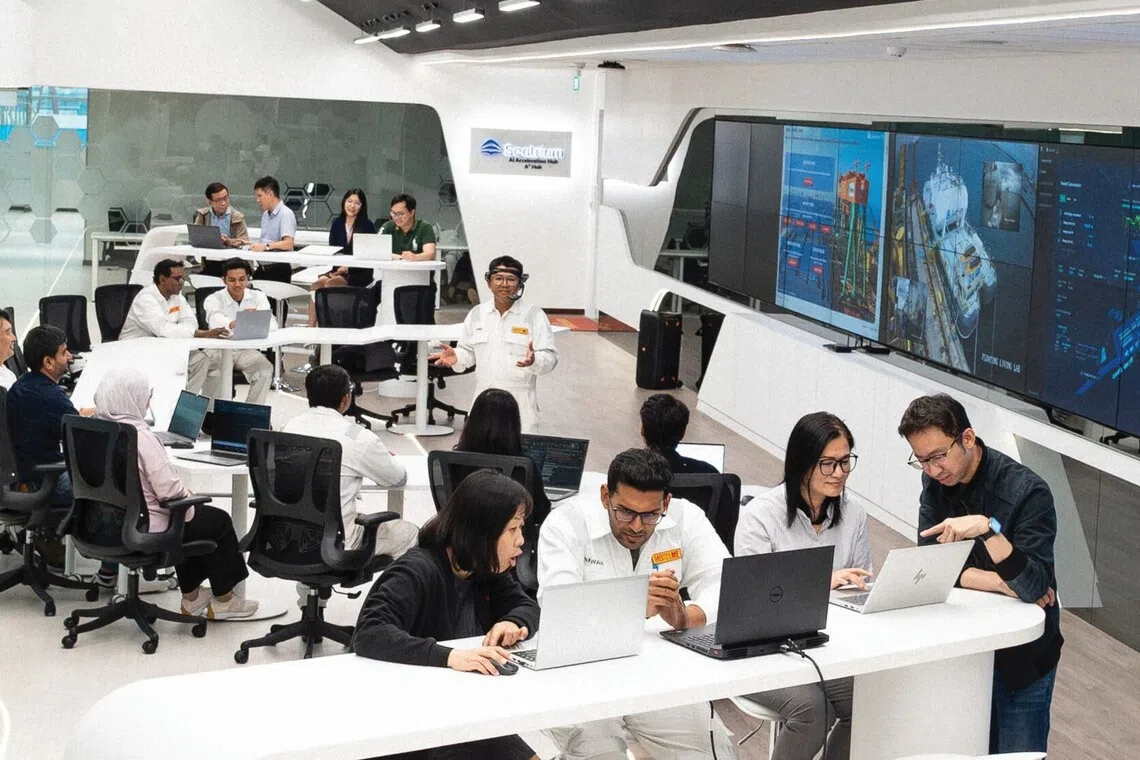
The council meets at Seatrium’s AI Acceleration Hub, where they collaborate to take on project ideas from the ground and transform it into live projects.
But the push for more AI was not an overnight decision for the Seatrium management team.
“We didn’t wake up one day and say that today we have to start AI,” said Lee, noting that the AI push is rooted in the group’s digitalisation push back in 2018, where the company first formed its digitalisation team.
Led by Lee himself, the original three employee-strong team established the digital infrastructure and data needed to digitalise Seatrium’s operations.
The digital twin
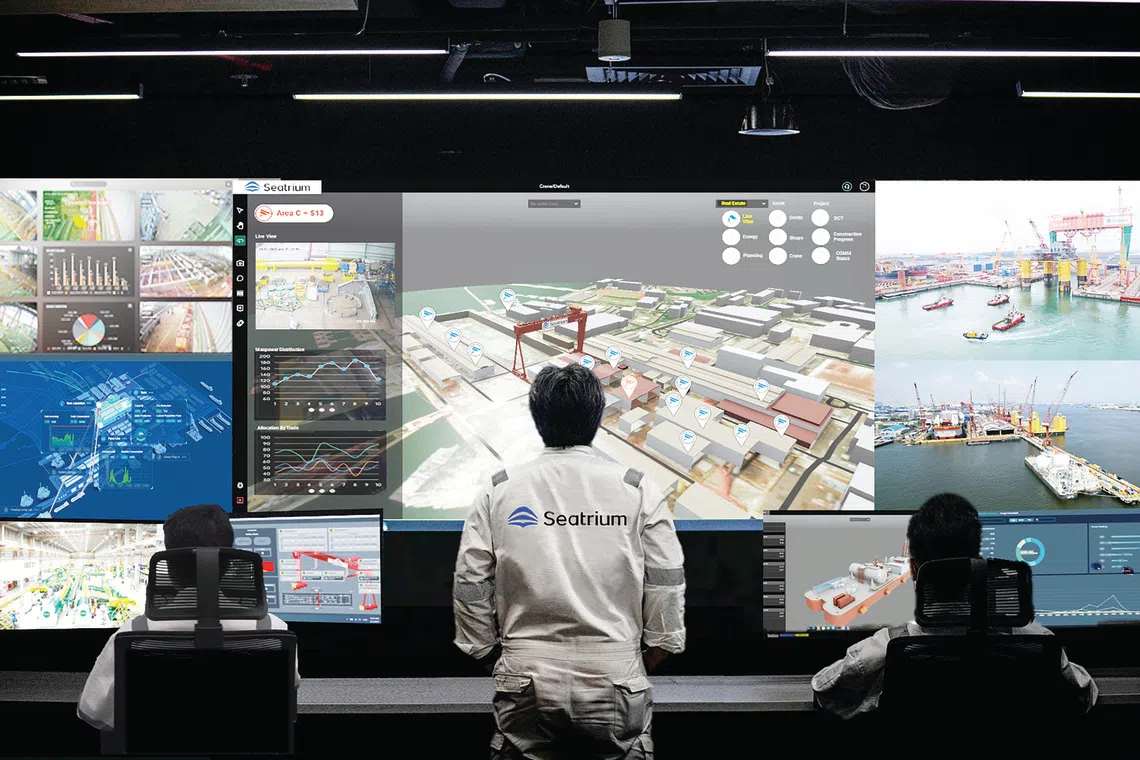
Beyond equipment-tagging, another major project the group worked on is a “digital twin” of its shipyard.
A digital twin recreates a physical location in the digital realm. It allows the group to create simulations and models which then use AI to process calculations to generate insight and predictions.
Using this, the group is able to map out the space, resources and project progress.
Separately, when an enquiry for an engineering or construction project arrives, the group uses an AI planner, which subsequently uses the data from the digital twin to propose an initial allocation of the space.
“(After the calculations), the human-in-the-loop will come in (to) make a deeper judgement, and take the options as given,” he said.
Running these intense calculations are graphics processing units located within the Seatrium yard, rather than the cloud.
Lee said that the on-premise setup ensures that the security and performance of its AI functions are not compromised.
Niche skill sets needed
As Seatrium expands its AI capabilities, it also needs to find the right talent to do so.
Now, Seatrium works with about 100 people, including partners and collaborators, on digital initiatives. Lee noted that the ecosystem of talent is continuing to grow. However, he stopped short of providing a target headcount.
Rather than relying solely on external AI hires, the company is building teams that combine deep shipyard expertise with data science and AI capabilities.
Ideally, the talent that work for Seatrium will need to blend both tech and domain-specific knowledge, he said.
The group is working alongside institutions of higher learning such as the Singapore Institute of Technology and the Institute of Technical Education to cultivate a “healthy pipeline” of talent, Lee said.
“We have jointly curated the curriculum with the professors to bring in our industry lens... of what the landscape is today and what we want the students to learn.”
Looking ahead, Lee expects the entire maritime sector to become an AI-driven industry as offshore operators around the world contend with a shrinking workforce.
But as the industry begins to reap the benefits of AI, Lee noted that cybersecurity remains his biggest concern.
To ensure that Seatrium is prepared for potential cybersecurity risks, Lee noted that all technology must pass the group’s cybersecurity playbook and safeguards before being deployed in live operations.
The offshore and marine group’s net profit surged 158.3 per cent to S$372.9 million for the first half ended Jun 30.






