Bank of America’s Asia-Pacific president sees a silver lining in US dollar volatility
Investments in South-east Asia to flow to digital infrastructure, data centres, healthcare, says BOA’s Jin Su

[SINGAPORE] The US dollar has lost significant value in 2025 amid tariff uncertainty, rising debt and inflation concerns in the US. The US dollar index is down 8 per cent year to date, with market observers expecting it will stay weak going forward.
But for Bank of America (BOA), which carries the name of the US in its brand, this is not necessarily a bad thing.
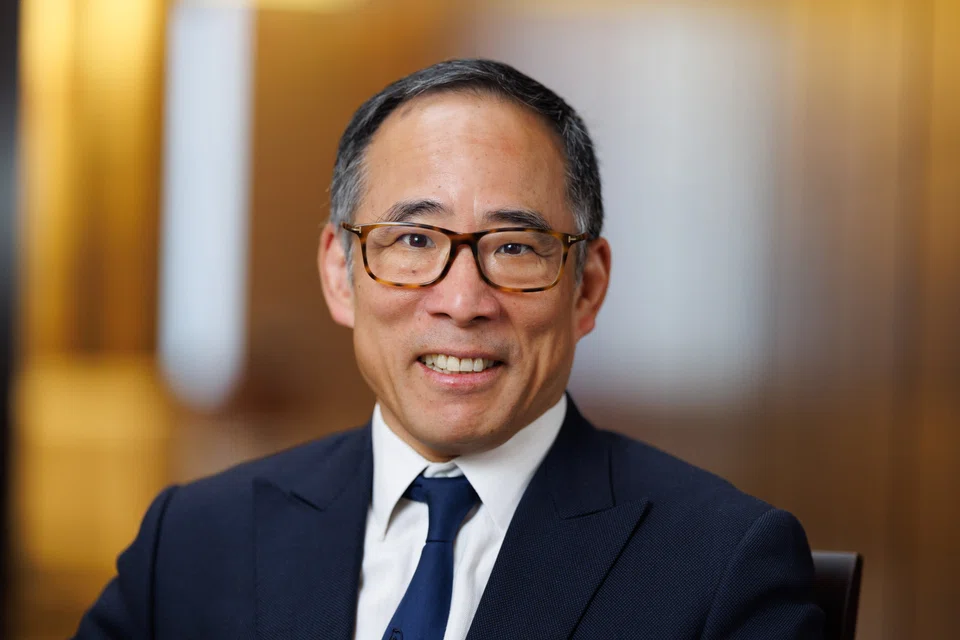
“When our clients move around (the world), what they’re primarily moving is US dollars, and we have one of the best systems for doing this,” said Jin Su, BOA’s president of Asia-Pacific and head of Asia-Pacific global markets.
The bank – whose international business is primarily cross border – has seen a lot of hedging activity in 2025, and attracted investors looking for advice across its operations in 35 countries.
“This is one of the reasons why we’ve done extremely well this year, because we’ve benefited from the fact that people come to us for hedging or advice,” Su said in an interview with The Business Times.
At BOA, the international business makes up just over 10 per cent of the bank’s overall results. For the full year 2024, total revenue stood at US$100 billion, while revenue of the international business segment was US$13.4 billion.
But Su noted that the international business is a “substantial engine for growth” for its institutional business, with the Asia-Pacific region core to that strategy.
In 2024, the international segment made up 40 per cent of its global corporate and investment banking and global markets revenues.
“The last five years we’ve seen a lot of growth here (in Asia), and we have a very constructive outlook for the next five years,” he said.
Intra-Asian trade
This comes as global trade is shifting towards intra-Asian and intra-regional trade.
“This term ‘deglobalisation’, I don’t really see that, because if you look at a global trade, it is at an all-time high,” Su said.
He expects the trade corridor between North Asia and South-east Asia will likely continue to grow, while he also noted increased activity between Asia and the Middle East and Europe.
At the centre of this growth is South-east Asia – the region boasts several economies that are still growing “at a very robust clip”, while the region has also gained from the China plus one strategy, he said.
Asian markets also benefit from investors who are looking to diversify their holdings from US assets, he added.
Most investors are likely overweight on the US dollar as the US stock market would likely make up a significant part of their investment portfolios given compounded returns in the last five years.
“From that overweight level, if people want to diversify, that’s very normal, but in terms of people moving away from the US dollar, I haven’t really seen that from any corporate or official institution,” he said.
In South-east Asia, Su expects investments will continue flowing into the sectors of digital infrastructure, data centres and healthcare services.
Deal activity for data centres is centred on capital raisings, as platforms secure private funding to build newer and larger assets.
Initial public offerings (IPOs) have also helped companies recycle capital by listing real estate investment trusts (Reits) that hold stabilised data centre assets.
Meanwhile, investors are looking at tower infrastructure to support the rapid expansion of 5G networks across the region.
In 2025, BOA was the lead arranger for the IPO of data centre Reit NTT DC Reit in Singapore.
It also helped ST Telemedia Global Data Centres with its US$2.2 billion capital raising from a KKR and Singtel consortium in 2024.
As for the regional healthcare sector, the bank expects near-term activity to be driven by private equity monetisation and growth merger and acquisition initiatives by strategics.
For example, in August 2025, BOA was the exclusive financial adviser to Ayala Health for a minority stake investment from Temasek-based ABC Impact, and to Fullerton Health for a strategic investment from Mitsubishi Corporation.
Increasingly, issuers are also looking to explore the capital markets for fundraising.
Looking ahead, Su remains positive on the growth outlook of the Asia-Pacific region.
“The region is growing at a very decent clip compared to other parts of the world, we seem to be climbing despite all the noise,” he said.