

Al Gore calls out ‘greenwashing’ risks as funds quit green club
 Add BT as a preferred source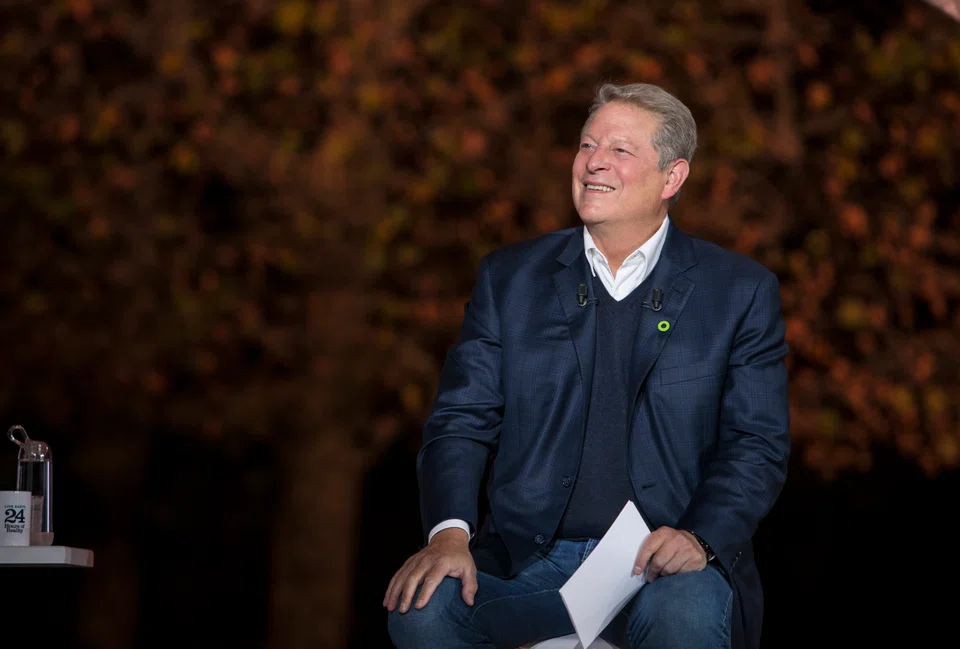
AL Gore, the former US vice-president-turned-climate-activist, said investors are growing increasingly impatient with evidence of potential “greenwashing”, amid signs that net-zero pledges made by some members of the financial industry weren’t credible.
Speaking in an interview just before Climate Week in New York got under way last week, he said commitments made by members of the No. 1 green club for bankers and investors – the Glasgow Financial Alliance for Net Zero or GFANZ – are “very welcome” and “not meaningless”.
“But obviously they have to be followed up,” he said.
GFANZ, which counts roughly 500 members representing more than US$135 trillion in assets, was hailed as a milestone at the COP26 climate summit last year. But now, “it’s become apparent that some who made impressive pledges did not immediately begin to put in place a practical plan to fulfill those pledges”, Gore said.
“Investors and others are sniffing out greenwashing more readily these days,” said Gore, who chairs Generation Investment Management. “And the pressure is going to grow.”
Against that backdrop of growing scrutiny, GFANZ has now seen its first official defections. Bundespensionskasse, an Austrian pensions firm, quietly exited last month, said the GFANZ unit to which it reports.
And the departure of the A$70 billion (S$65.9 billion) Australia-based Construction & Building Unions Superannuation Fund, known as Cbus, was made public earlier this month by the sub-alliance to which it belonged. “We made the difficult decision to focus our resources on our internal climate change activities,” a spokesperson for Cbus said. “We support the important work that the alliance is doing and wish all members the best in their endeavours.”
GFANZ has sought to build credibility, while remaining a voluntary alliance without binding rules that might frighten off members. But as it tries to introduce stricter standards, cracks are becoming visible. For some members, there’s a growing realisation that they may fail to meet the goals set out by the alliance; others have expressed fear the organisation’s requirements for decarbonization could make them legally vulnerable.
Last week, it emerged that Wall Street heavyweights JPMorgan Chase & Co, Bank of America Corp and Morgan Stanley were considering a possible exit from GFANZ. That was followed by a clarification of the GFANZ criteria, giving financial firms scope to set weaker fossil-finance targets, and ostensibly easing tensions behind the scenes.



For some, the development was a red flag. It “calls into question how genuine their commitment was to net zero in the first place”, said Jeanne Martin, head of the banking programme at ShareAction, a non-profit that promotes responsible investment. “Ultimately, this is indicative of the limits of leaving urgent climate action up to banks and other voluntary initiatives.”
Rebecca Self, a former senior banker at HSBC Holdings who now runs Seawolf Sustainability Consulting, said GFANZ members appear to be realising that “it requires more than an initial commitment and nice words”.
“For net-zero initiatives like GFANZ to work well, they require credibility beyond the initial commitment and fanfare,” she said. “This includes transparency such as routine progress reporting and verification, including disclosing the financing of fossil fuels.”
Mark Carney, former Bank of England governor, co-chairs GFANZ together with Michael R. Bloomberg, the founder of Bloomberg News parent Bloomberg.
In an interview with Bloomberg Television’s Francine Lacqua, Carney played down the risk of defections and said Race to Zero, the UN-backed net-zero project that underpins GFANZ, had gone “too far” with recent requirements for more stringent decarbonisation targets. Race to Zero has since updated its language and emphasised that members must “independently find their own route” to the 1.5 deg C-aligned climate goal.
Cbus didn’t cite concerns around legal risks for its departure from GFANZ. Instead, it listed the administrative burden involved in staying. That’s as developing regulations and standards require signatories to meet parallel frameworks.
For some, these hurdles have led them to snub GFANZ from the get-go. Blackstone Inc, Apollo Global Management Inc and KKR & Co Inc are among private equity giants that judged GFANZ membership an unnecessary burden. Insiders, on condition of anonymity, have referred to the near-impossibility of coming up with credible plans to eliminate their carbon footprints by 2050 as reason enough to avoid GFANZ and its sub-alliances.
Self says it’s now “evident the voluntary approach to climate action will not work”.
Failure to meaningfully cut emissions comes at a huge cost, Gore said.
“The cost of these climate-related extreme events to the global economy was US$2.5 trillion, an increase of US$1 trillion over the previous 10 years,” he said. “And because we’re continuing to add another 162 million tonnes of man-made global warming pollution every single day to the troposphere, of course it’s getting worse.”
The accumulated greenhouse gas pollution “in the thin shell of atmosphere surrounding our planet, which we’re using as if it’s an open sewer, now traps as much extra heat every day as would be released by 600,000 Hiroshima-class atomic bombs exploding every 24 hours,” Gore said. “It’s quite literally insane. We have to change!” BLOOMBERG
Decoding Asia newsletter: your guide to navigating Asia in a new global order. Sign up here to get Decoding Asia newsletter. Delivered to your inbox. Free.
Share with us your feedback on BT's products and services
TRENDING NOW
NDR 2026: Singapore to create new Western island to support 'new generation of industries'

MSCI drops S-E Asian heavyweights Sembcorp, GoTo and Ayala Land from global benchmarks

E-commerce is killing ‘real’ commerce, says China’s beverage king Zhong Shanshan

Asia-Pacific aviation: is up really the only way?

