Are Singaporeans ready for retirement?
RETIREMENT planning has been a longstanding challenge in Singaporeans, compounded further by Covid-induced uncertainties, inflation and longer life expectancies.
The Business Times takes a look at the pressing retirement concerns and risks that Singaporeans face today.
Barely meeting basic expenses
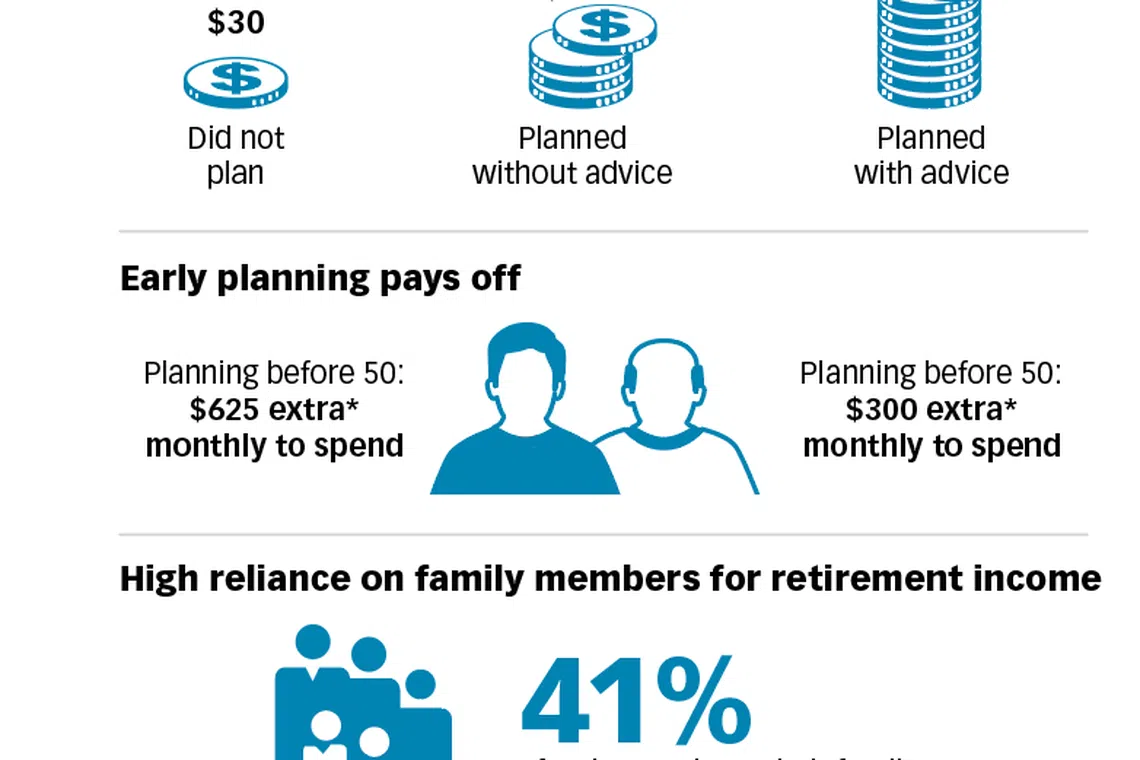
Retirees who did not plan for retirement and depended on a monthly income of S$1,200 (mainly from savings, CPF payouts and family members' allowances) were barely meeting their basic monthly expenses, a survey by Great Eastern showed.
They were left with S$30 extra each month - which is not enough to cover unexpected or additional expenses such as medical costs.
In comparison, retirees who started planning before age 50 have an average of S$625 extra each month, while those who planned after 50 had S$300 extra to spend.
Yet, nearly 1 in 2 Singaporeans have not started planning
About 39 per cent of Singaporeans are worried about retirement inadequacy, yet almost half have not started planning. This is more apparent among those below 35, according to a survey by Endowus.
Overall, Singaporeans are 13 per cent below the target for their retirement planning, separate research from AIA Singapore showed.
In Prudential's Saving for 100 survey, 56 per cent of those polled have some degree of confidence that they will save enough to support themselves until death. But 44 per cent are not confident.
Most are underestimating the amount needed
On average, Singaporeans plan to retire at 60, which will require at least 25 years of retirement income.
Close to half of those surveyed by AIA want to maintain their current lifestyle after retirement, but more than two-thirds underestimate the actual retirement amount needed by S$967 per month. Among families with children, the underestimated amount is slightly higher at S$1,020 per month.
Covid-19 uncertainties have further widened the shortfall between expectations and reality of retirement among Singaporeans.
The expected monthly expenditure during retirement now stands at S$2,000, an increase from S$1,500 in pre-pandemic times.
Yet, it is worrying that the median value set aside for retirement each month remains the same at S$251 to S$500, said AIA, not forgetting the inflation rate which would also affect how much one's retirement dollars will really be worth in future.
Prioritising children's needs over their own
Young parents in Singapore are spending at least 2.5 times more of their monthly expenses on their children's needs rather than taking charge of their own retirement planning, said AIA.
Parents surveyed spend almost 20 per cent of their income on their children but less than 7 per cent on their own retirement planning.
Savings priorities tend to be more short term, focusing on family needs and emergency spending instead of longer term goals like retirement. Emergency spending is the top priority, followed by ensuring financial security for the family.
Today, retirement planning has taken a further backseat as the pandemic further necessitates the shifting of savings allocation towards children and shorter-term needs.
Among young families with kids, 76 per cent intend to leave an inheritance for their children, but only half have started planning for it.
Over-reliance on bank savings
Bank deposits are the most popular savings instruments for about 9 in 10 Singaporeans; only 21 per cent supplement this with investment tools.
Nearly 1 in 3 Singaporeans' savings was negatively impacted in 2020, according to AIA.
Separate data from Great Eastern showed that the top three retirement income sources were past savings (56 per cent), CPF payouts (43 per cent) and allowances from family members (41 per cent).
Lacking confidence in CPF investing
In its retirement report, Endowus noted that 1 in 2 Singaporeans are planning to use or are currently using CPF to fund their retirement.
About 72 per cent of those surveyed seek higher returns, but despite that, only 25 per cent are currently investing their CPF, even though it is the only way to achieve higher returns on their CPF.
This is largely represented in the Gen X (born 1965 to 1980) segment and employed persons with more than S$8,000 in household income.
Most Singaporeans are unsure of whether they should invest their CPF; 68 per cent are not confident in investing their own CPF monies well by themselves.
The broad uncertainty is understandable, given that only 1 in 2 CPF members who invested made returns that were more than the CPF-OA interest rate of 2.5 per cent for the financial year from October 2019 to September 2020.
Overall, Singaporeans ranked higher returns than the CPF interest rates, guaranteed returns, and low costs as the most important criteria for CPF investing, said Endowus.
Women at higher risk
Women are found to be half as likely as men to "strongly agree" that they are confident in having sufficient money for retirement.
This is especially concerning, given that women live longer than men with a life expectancy of more than 86 at birth and beyond 88 if they live to 65, said Endowus.
Great Eastern's survey found that women were much more dependent later in life on their children and family members for monthly allowances (45 per cent) than men (39 per cent); and had less investment income (18 per cent) than men (31 per cent).
With singlehood and childlessness on the rise here, women are likely to be their sole financial contributors in life. It's important for them to prioritise retirement planning as life expectancy is expected to reach 85.4 for women in Singapore by 2040.
50/30/20 rule
As a simple guide, AIA recommends monthly income to be spilt using 50/30/20 rule.
Allocate the first 50 per cent of one's take-home income pay on necessities such as housing, food, and transport. The remaining should be split up between 20 per cent for long-term savings and investments and with 30 per cent for "wants" like hobbies and travel.