

Australia’s central bank holds rates steady, rules out further cuts
Bond yields spike to a 13-month high after governor Bullock says that price risks have ‘tilted to the upside’
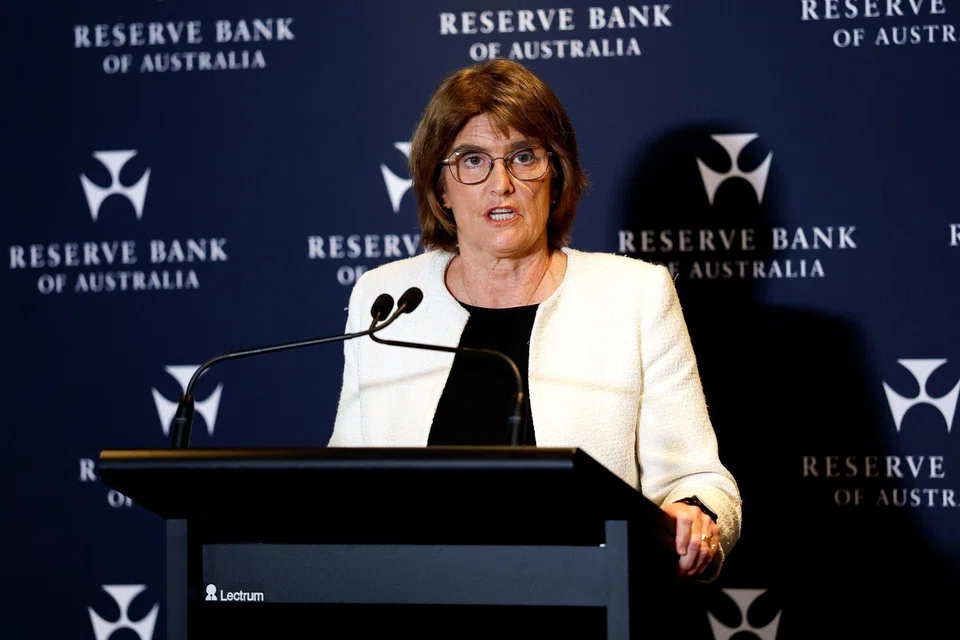
[SYDNEY] Australia’s central bank governor Michele Bullock called an end to a truncated easing cycle as policymakers gauge whether a pickup in inflation requires an extended interest-rate pause or a switch to tightening.
Bond yields spiked to a 13-month high after the governor on Tuesday (Dec 9) said that price risks have “tilted to the upside” following the central bank board’s widely-expected decision to hold the cash rate at 3.6 per cent.
“I don’t think there are interest rate cuts on the horizon for the foreseeable future,” Bullock told reporters. “The question is, is it just an extended hold from here or is it the possibility of a rate rise? I couldn’t put a probability on those but I think they’re the two things that the board will be looking closely at coming into the new year.”
The Australian dollar advanced 0.3 per cent and policy-sensitive government bond yields jumped as much as 12 basis points to the highest since November 2024, after the Reserve Bank of Australia (RBA) chief’s hawkish guidance. Money markets are almost fully pricing a rate increase in May.
“It felt like the governor was laying the markers for a full pivot towards a tightening bias,” said Pat Bustamante, a senior economist at Westpac Banking. “It’s a conditional tightening bias right now, conditional on the fourth-quarter inflation report.”
Australia’s economy is operating close to capacity with unemployment at historically low levels and inflation back above the top of the 2-to-3 per cent target. That has forced the RBA to the sidelines after three cuts this year, putting it on track for one of the developed world’s shortest easing cycles.
Consumers meantime remain cautious with real per-capita spending broadly flat and the savings ratio edging higher as households rebuild financial buffers. That makes for a challenging backdrop to setting monetary policy in 2026.
“The onus is on the data to stop the RBA from hiking with all the data since the board last met surprising to the upside,” said Su-Lin Ong, chief economist for Australia at Royal Bank of Canada. “The RBA is willing to wait for more data but further upside surprises will make it challenging.”
The RBA’s board on Tuesday unanimously agreed to keep rates unchanged for a third-straight meeting after delivering 75 basis points of cuts between February and August, having started its easing campaign later than counterparts.




Over in the US, traders are ramping up bets the Federal Reserve will deliver its third consecutive cut later this week following pressure from President Donald Trump for easier policy and the release of private data suggesting a softening jobs market.
The divergence has already driven a heavy sell-off in Australian bonds with the yield premium they hold over Treasuries widening in the current quarter at the fastest pace since early 2020.
Australia’s 10-year bonds are the highest yielding in the developed world, increasing borrowing costs for the government as it prepares to release a mid-year budget outlook next week that’s set to see deficits stretching for years ahead.
The RBA operates under a dual mandate that aims for inflation at the midpoint of its 2-to-3 per cent target while trying to keep the economy at maximum sustainable employment. New monthly inflation data released in late November showed headline CPI at 3.8 per cent, and the bank’s latest forecasts only have it returning inside the target in mid-2027.
A report last week showed while the economy grew at a surprisingly softer pace last quarter, labour costs remained elevated. Private data on Tuesday showed capacity utilisation in the economy edged up to 83.6 per cent, the highest level in 18 months, suggesting if growth accelerates it may further fuel price pressures.
The government this week announced it is scrapping power-bill rebates that have helped shield households from surging electricity prices. The policy has held down headline inflation in recent times and its termination is set to trigger a spike in upcoming CPI reports, though the central bank had already incorporated the change into its latest forecasts.
The RBA still isn’t “sold” on the trajectory or cause of higher inflation, said Belinda Allen at Commonwealth Bank of Australia, given some of the recent strength may be noise.
“The press conference took a giant leap into hawkish territory,” said Allen, head of Australia Economics at CBA, adding “the February meeting is live.” BLOOMBERG
Decoding Asia newsletter: your guide to navigating Asia in a new global order. Sign up here to get Decoding Asia newsletter. Delivered to your inbox. Free.
Share with us your feedback on BT's products and services
TRENDING NOW

Once staunchly pro-China, Malaysian Chinese businesses are now distancing themselves from Beijing

Cliff Tan has 7 million followers and a 4-month waitlist. Why won’t he expand his business?

Grab CEO’s wife Chloe Tong on life with Anthony Tan and finding her purpose

Singapore F1 to proceed despite haze; no changes planned to outdoor entertainment

