Bank of England holds rates as officials consider hikes ahead
The Monetary Policy Committee (MPC) voted 8-1 in favour of leaving the benchmark rate at 3.75%
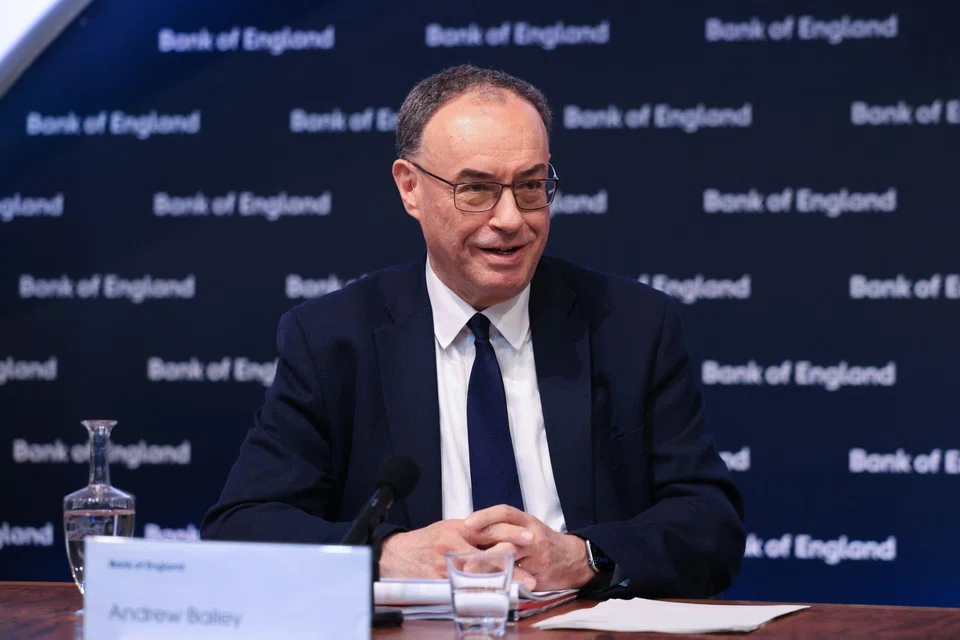
[LONDON] The Bank of England (BOE) kept interest rates on hold with several policymakers saying they might consider future hikes, just as oil prices soared within reach of the central bank’s most pessimistic scenario for the economy.
The Monetary Policy Committee (MPC) voted 8-1 in favour of leaving the benchmark rate at 3.75 per cent, minutes from its latest meeting said on Thursday (Apr 30). Chief economist Huw Pill was the sole dissenting voice on the panel but others signalled they could join him at upcoming meetings.
Governor Andrew Bailey said holding rates was a “reasonable place” to be given softness in the UK economy but signalled they may need to rise in the event of continued substantial disruption to energy supplies. The BOE now sees inflation in the third quarter of the year 1.4 percentage points higher than it forecast in February’s report, prior to the Iran war.
Gilts extended gains after the decision. The two-year yield fell as much as 10 basis points to 4.45 per cent, with the pound little changed at 0.8662 per euro. Money markets trimmed wagers on the extent of BOE hikes this year, pricing around 66 basis points – equivalent to two hikes and just over a 60 per cent chance of a third. It was around 73 basis points prior to the decision.
Because of the high degree of unpredictability stemming from the conflict in Iran, the bank scrapped its central inflation projection, instead laying out three scenarios based on different paths for energy prices and second-round inflation effects.
All three suggested that rates will need to rise, with the worst envisaging oil prices staying near US$130 per barrel – a level oil markets came in sight of on Thursday morning ahead of the decision, before later easing back. Under that outcome, modelling used to show the possible effect on monetary policy pointed to rates needing to rise more sharply, by between 66 to 151 basis points.
Several policymakers suggested that rates could soon rise if energy prices do not quickly come down. Deputy governors Dave Ramsden and Clare Lombardelli, and external members Megan Greene and Catherine Mann all signalled financial conditions may need to be tightened.
Still, the MPC noted that the tightening in financial conditions since the Iran war broke out, a subdued economy and weakening labour market will help constrain inflation. The panel stuck with language signalling it “stands ready to act” if more concerning evidence on inflation emerges.
The decision showed the UK central bank waiting for further clarity on the endgame of the Iran war, with the conflict dragging into a third month and the US and the Islamic Republic still at an impasse.
SEE ALSO


“Only one hawkish dissent is probably a bit of a dovish surprise, I think many folk expected at least one of Mann or Greene to also dissent,” said James Athey, fund manager at Marlborough Investment Management.
The BOE underlined that the prospects for global energy prices are “highly uncertain,” pointing to a risk of “material” second-round effects in pricing. The volatility in energy markets was laid bare by oil prices soaring to a wartime high ahead of the MPC decision, after Axios reported that US President Donald Trump was set to receive a briefing on new military options for action in Iran.
“Attempting to bring inflation back target too quickly after a shock like this may cause undesirable volatility in output,” Bailey said, in a media conference after the event. There’s not much “monetary policy can do to prevent these cost increases from affecting UK businesses and households.” He said on Thursday’s wild swings in the oil price were an example of how the BOE cannot simply “stop the music” and make decisions based on a certain level of expected cost pressures.
Several rate-setters pointed to their middle scenario as the most likely, including Bailey. This shows inflation peaking at 3.7 per cent by the end of the year with some modest second-round effects. The third and most downbeat outcome shows inflation hitting a high of 6.2 per cent in early 2027 and remaining above the BOE’s 2 per cent target throughout the forecast period. The governor said he places “some weight” on this outcome.
On Wednesday, Federal Reserve policymakers meeting for the last time under chair Jerome Powell were almost unanimous in agreeing to hold interest rates steady. But a deep split emerged over where rates might go from here, with three officials dissenting over language that still pointed to future cuts. The European Central Bank also kept the interest rates unchanged, with president Christine Lagarde and other officials signaling a hike will be on the table at the next meeting in June.
Britain is expected to be one of the hardest hit advanced economies by the conflict given its dependency on energy imports and gas supplies. The National Institute of Economic and Social Research warned this week the UK economy could slip into recession later this year and face a series of rate rises if the Middle East crisis worsens.
There are already signs of the Iran war pushing up price pressures with motor fuel costs driving UK inflation up to 3.3 per cent in March. A predicted rise in household energy bills in July when the UK’s gas and electricity price cap is next updated is expected to keep inflation elevated in the second half of 2026. BLOOMBERG
Decoding Asia newsletter: your guide to navigating Asia in a new global order. Sign up here to get Decoding Asia newsletter. Delivered to your inbox. Free.
Share with us your feedback on BT's products and services