

Bank of Korea says cost of living not a priority in their price stability mission
 Add BT as a preferred source
DeeperDive is a beta AI feature. Refer to full articles for the facts.
SOUTH Korea should try to address the country’s high cost of living through structural reforms instead of relying on the central bank to fight it, a Bank of Korea (BOK) official said, as the bank mainly targets inflation rather than price levels.
“Targeting price level rather than the inflation rate could end up increasing volatilities to inflation and the economy as monetary policies would be responding backwardly to price trends,” senior deputy governor Ryoo Sangdai said in a written response to Reuters’ queries.
Ryoo, a voting board member, was responding to whether the central bank should do more to address inflation eating into people’s pay cheques.
Soaring food prices around South Korea’s staples including apples and green onions have been at the centre of public debate since the country’s parliamentary election in April, where President Yoon Suk-yeol’s party suffered a stinging defeat amid voter anger over rising food prices.
Ryoo’s comments come as the mood turns increasingly dovish in Asia’s fourth-largest economy ahead of a monetary policy meeting on Jul 11. It will be the first time its policy board meets after president Yoon said this week a cut may be necessary, in the strongest remarks yet from the government.
Ryoo declined to comment on interest rates ahead of next week’s policy decision, but said the won’s recent movements amid rate cut expectations seem to be also affected by South Korea’s economic conditions and capital flows, among others.
Navigate Asia in
a new global order
Get the insights delivered to your inbox.
The BOK, whose chief mandate is “to promote macroeconomic stability including price”, executes its policies independently and targets to keep headline inflation at 2 per cent over the medium term.
But the central bank made it clear in a Jun 18 report that monetary policy alone cannot solve the high cost of living, as the source of inflationary pressure is agriculture and the way products are distributed.
Consumer price inflation eased to 2.4 per cent in June from a year earlier, the slowest pace since July last year, but an index for the cost of food, shelter and clothes was at 155 in 2023. That was above the average of 100 for countries in the Organisation for Economic Co-operation and Development, data compiled by BOK showed.

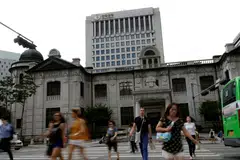

Analysts expect the BOK to cut the benchmark interest rate, currently at a 15-year high of 3.5 per cent, by 50 basis points in the fourth quarter.
Asked if the central bank was ready to manage extended US dollar/won trading hours which kicked off on Jul 1, Ryoo said he was aware that volatility may increase and that trading might be thin during night hours early on.
“Foreign exchange authorities will maintain the principle of appropriately deploying market stabilising measures to alleviate volatility in times of excessive FX moves possible with herd-like trading behaviours.”
Decoding Asia newsletter: your guide to navigating Asia in a new global order. Sign up here to get Decoding Asia newsletter. Delivered to your inbox. Free.
Share with us your feedback on BT's products and services
TRENDING NOW
‘Boring’ is the new black: The stars are aligning for a Singapore stock market revival

Near sell-out launches in March boost developer sales to 1,300 units after four slow months

China pips the US if Asean is forced to choose, but analysts warn against reading it like a sports result

Genting Singapore’s Lim Kok Thay receives S$7.5 million pay package for FY2025

