

Bank of Korea stands pat as board wary of weak won, property market rally
Inflation has remained broadly in line with the central bank’s projections
 Add BT as a preferred source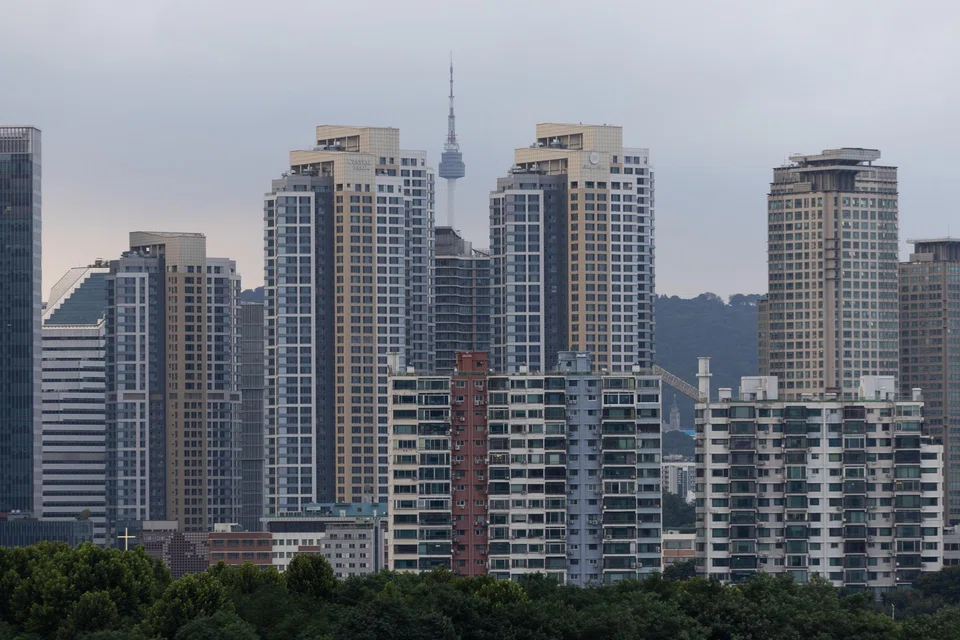
DeeperDive is a beta AI feature. Refer to full articles for the facts.
[SEOUL] South Korea’s central bank left its benchmark interest rate unchanged in a widely expected move, as authorities monitor the weakening won along with risks of financial imbalances stemming from a persistent property market rally.
The Bank of Korea (BOK) held its seven-day repurchase rate at 2.5 per cent for a fifth straight meeting on Thursday (Jan 15). The decision matched expectations from all 21 economists surveyed by Bloomberg. The move extends a pause that began in July after four rate cuts since October 2024.
The decision to hold comes after the economy showed signs of resilience, even with the outlook for global trade somewhat cloudy due to protectionist trade policies. In November, the BOK raised its 2026 growth forecast to 1.8 per cent, citing strong exports and a gradual recovery in private consumption, while also nudging up its inflation outlook to 2.1 per cent.
Thursday’s meeting follows the board’s move towards a more neutral posture in November, when it removed a reference in its statement on maintaining a rate-cut stance. Governor Rhee Chang Yong said at the time that officials were evenly split on whether a rate cut could come within three months or whether the bank would need to stand pat over that period. He said that the policy rate is already near a level deemed neither restrictive nor stimulative.
While policymakers have kept one eye on supporting the economy, they have focused more attention of late on guarding against renewed financial market instability tied to the housing market and the foundering currency.
“While the BOK kept rates on hold, it appears keen to keep some room for rate-cut expectations,” said Jeong-Woo Park, an economist at Nomura Holdings. “The bank sees the output gap turning from negative to positive towards the end of this year, largely because while headline growth looks strong due to exports, the recovery in domestic demand is likely to remain sluggish.”
Navigate Asia in
a new global order
Get the insights delivered to your inbox.
The won has been Asia’s weakest-performing currency this year, raising risks of faster inflation via more costly imports. Treasury Secretary Scott Bessent highlighted the moves in a meeting with South Korea’s Finance Minister Koo Yun Cheol in Washington.
“Their discussion addressed the recent depreciation of the Korean won, which the secretary noted was not in line with Korea’s strong economic fundamentals,” the Treasury said in a statement released overnight. Bessent “emphasised that excess volatility in the foreign exchange market is undesirable”.
Meantime the housing market rally has persisted despite a series of government measures meant to cool demand, and mortgage debt levels continue to increase. Apartment prices in Seoul have advanced for 49 consecutive weeks, according to the latest figures.
SEE ALSO




Growth in total household credit in the July to September quarter slowed to 0.8 per cent, while the outstanding balance reached a record high. The pace of gains in the previous quarter was the fastest since 2021.
Inflation has remained broadly in line with the central bank’s projections, theoretically giving the BOK room to manoeuvre, but policymakers have warned that the weakening currency could pose upside risks to prices.
In the government’s strategy growth policy for this year, it struck a slightly more optimistic tone than the central bank, forecasting 2 per cent growth, although it cautioned that without structural reforms the country’s potential growth rate could slip towards 1 per cent in the 2030s and near zero thereafter.
While semiconductors are set to lead growth, Rhee has cautioned that momentum outside the tech sector remains weak, with non-IT growth running well below the headline pace, a divergence that has complicated the policy outlook.
Rhee is scheduled to brief reporters later Thursday, when he is expected to elaborate on the board’s policy outlook and disclose whether there were any dissenting votes.
Markets will watch whether officials preserve language signalling scope for further easing or continue the shift towards neutral by emphasising financial stability risks. BLOOMBERG
Decoding Asia newsletter: your guide to navigating Asia in a new global order. Sign up here to get Decoding Asia newsletter. Delivered to your inbox. Free.
Share with us your feedback on BT's products and services
TRENDING NOW
‘Boring’ is the new black: The stars are aligning for a Singapore stock market revival

Near sell-out launches in March boost developer sales to 1,300 units after four slow months

China pips the US if Asean is forced to choose, but analysts warn against reading it like a sports result
Genting Singapore’s Lim Kok Thay receives S$7.5 million pay package for FY2025

