BOJ chief signals chance of September rate hike, debate on price risks
The BOJ raised interest rates to a 31-year high of 1 per cent in June
 Add BT as a preferred source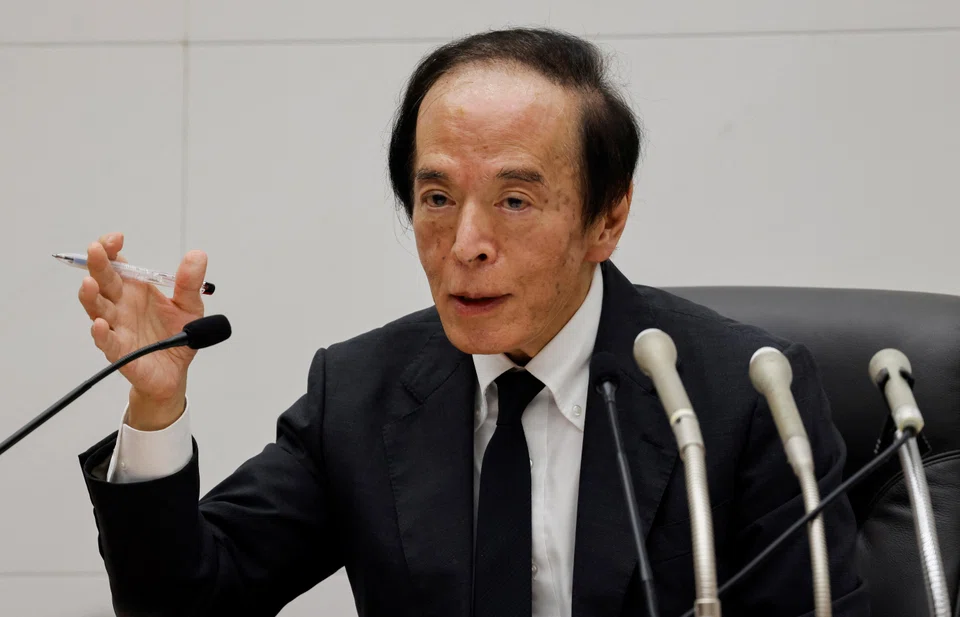
[ASHEVILLE, North Carolina] The Bank of Japan will debate raising interest rates including in September with a focus on whether inflationary risks were heightening, its governor Kazuo Ueda said on Tuesday (Sep 1), signalling a strong chance of a hike this month.
The remarks came in the wake of a statement by the US Treasury Department saying Treasury Secretary Scott Bessent met Ueda and called for “decisive” monetary steps to combat the weak yen - cementing the case for a Japanese rate hike this month.
While he refrained from pre-committing to a September hike, Ueda said he hoped to discuss with the board this month whether the likelihood of the BOJ‘s economic scenario materialising was heightening and whether upside price risks were increasing - both prerequisites for further rate increases.
“We hope to continue raising interest rates as financial conditions remain accommodative. On the other hand, we’ve raised rates five times so far, so we need to carefully assess the cumulative impact on the economy,” Ueda said.
“Having said that, we will set policy mindful of upside risks to inflation,” he told a news conference after attending the G20 finance leaders’ gathering in Asheville, North Carolina.
In a separate speech in northern Japan, hawkish BOJ board member Hajime Takata said the BOJ should raise rates nimbly in response to inflationary pressures, rather than at a fixed semiannual pace, to forestall risks of an inflation overshoot.
The hawkish comments helped lift the yield on the two-year Japanese government bonds (JGB), which is most sensitive to monetary policy, to 1.83 per cent on Wednesday, the highest since 1995.
In the news briefing, Ueda confirmed the meeting with Bessent on Sunday but did not comment on what was discussed.
Focus on inflation risks
SEE ALSO






The comments are Ueda’s last opportunity to speak publicly on policy and economic conditions before a blackout period ahead of the upcoming policy meeting on Sep 17-18.
Global inflation and a subsequent selloff in bond markets were among key topics of debate at the G20 finance leaders’ gathering with Japan’s 10-year bond yield hitting 3 per cent for the first time since 1996.
Ueda said recent data suggests that economic and price conditions were moving roughly in line with its projections in a quarterly outlook report in July, adding that the BOJ‘s basic approach on monetary policy remained unchanged.
With underlying inflation quite close to the BOJ‘s 2 per cent target, however, the BOJ must pay particular attention to inflationary risks in guiding policy, Ueda said.
Among key factors to scrutinise were upside price risks from the Middle East conflict, robust AI-related demand and the boost to inflation from a weak yen, he said.
“We will scrutinise whether the economy and prices are moving in line with our baseline scenario, as well as risks,” Ueda said. “We will debate these factors thoroughly, including at our next policy meeting.”
Ueda declined to comment when asked about markets near fully pricing in the chance of a rate hike at the September policy meeting.
On the rise in JGB yields, Ueda said it was largely driven by global upward pressures on yields but stressed that the BOJ will stay vigilant to market developments.
The BOJ raised interest rates to a 31-year high of 1 per cent in June on the view Japan was on the cusp of durably hitting its 2 per cent inflation target.
It kept rates steady in July but signalled a strong chance of a near-term hike on mounting price pressures from the Middle East war and a weak yen.
Bessent’s repeated calls for higher BOJ rates and a slew of hawkish communications from the central bank have led markets to near fully price in the chance of a rate hike this month. REUTERS
Decoding Asia newsletter: your guide to navigating Asia in a new global order. Sign up here to get Decoding Asia newsletter. Delivered to your inbox. Free.
Share with us your feedback on BT's products and services