Cashless fees not a major hurdle for hawkers: study
Singapore
HAWKERS in Singapore - the bastion of the city-state's national treasure, food - have no problems handling cash despite the supposed hassle of physical notes and coins, a study by Visa Singapore has shown.
But what may change the dynamics is if cashless solutions help to ease the labour crunch, and if done right, hawkers are willing to fork out a fee of under one per cent per transaction to go cashless.
With that, Visa Singapore's country manager Ooi Huey Tyng told The Business Times that it is exploring a low-cost and "incremental" model for smaller merchants keen to provide contactless payments, with Ms Ooi dismissing the idea that fees alone are crimping demand for cashless payments.
"Paying some cost is not an issue. If a S$5 bowl of noodles means taking a few cents, they are okay with it as long as you give them value."
Visa recently conducted one-on-one interviews with 24 hawkers and coffeeshop merchants here to understand the demands for cashless. The study results, shown to BT, indicated that cash handling is not a salient challenge for hawkers.
Instead, there is an emotional need to have cash in hand, with hawkers sharing worries that older consumer segments will be alienated by cashless payments and avoid frequenting the hawker stalls.
But hawkers also pointed to the current pain point of getting more help, given the quotas on foreign help and with few Singaporeans keen on jobs at hawker centres. From the in-depth interviews, Visa Singapore found that hawkers also fret that they lose customers because service is slowed by a lack of staff.
In weighing the benefits of raising productivity at stalls by introducing electronic payments acceptance, the hawkers also said they are willing to accept charges similar to the Nets pricing of 0.8 per cent.
Getting hawkers on board the cashless movement is pertinent as a 2016 KPMG study showed the use of cash in Singapore is most prevalent when shopping at a wet market or hawker centre. Nine in 10 consumer transactions there are paid in cash.
Ms Ooi points to Singapore's reputation for being very efficient and very safe, which does not turn people away from cash transactions.
She further noted that Singapore has about 2,700 ATMs scattered across the island. Sweden, which has nearly double the number of people, has just 3,200 ATMs.
Statistics show that on average, 30 per cent of transactions in Singapore are still done in cash, with the use of cash pervasive at hawker centres and among small merchants.
"We have to educate consumers that cash is not free," said Ms Ooi.
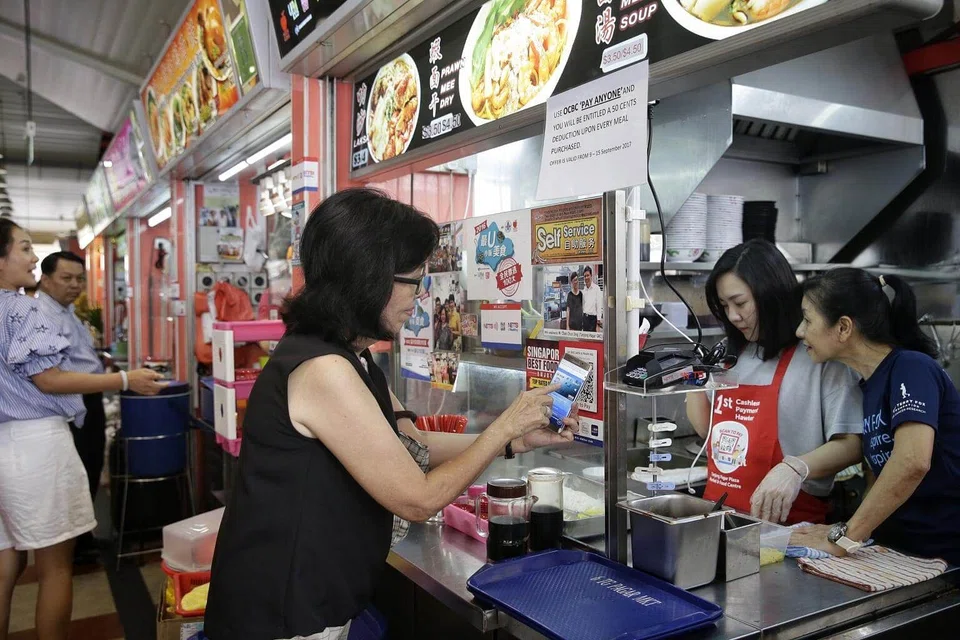
Hawkers added that they are familiar with contactless payments, ranking Visa payWave and Kopitiam card as among the top two forms of e-payment services that they are familiar with. They also prefer contactless payments compared to QR-based (Quick Response) payments, noting that QR-based payments require an extra step of having to check if the amount sent is correct.
The upside is that QR payments are widely used in China, and the trend "carries the potential to exert social pressure that QR payments cannot be that difficult for them".
Visa separately did an online poll of 500 Singaporeans, which showed that eight in 10 Singaporeans would be interested to use Visa payWave at hawker centres and coffeeshops. By comparison, just five in 10 would be interested in QR-based payments.
If Visa payWave is available at hawker stalls, about 50 per cent of consumers will choose it as a mode of payment over cash. If QR payments are available at hawker stalls, the number of consumers that will pick that option over cash falls to about 40 per cent.
By the end of this year, Singapore is looking to develop a common QR code that can accept both domestic and international payment schemes. The standardised QR code function should also be applied to merchants that only use Nets.