

China's central bank signals easing as economic risks mount
Latest monetary policy report indicates more credit support in coming months
 Add BT as a preferred source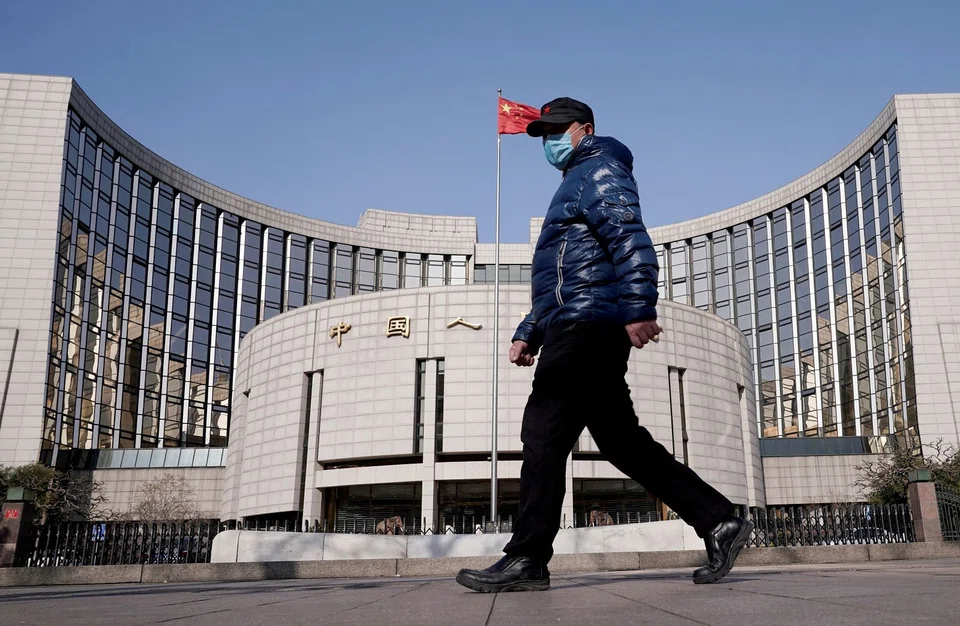
DeeperDive is a beta AI feature. Refer to full articles for the facts.
Beijing
CHINA'S central bank has signalled possible easing measures to aid the economy's recovery after a sharp downturn in recent months fuelled by a property slump.
In its latest quarterly monetary policy report published last Friday (Nov 19), the People's Bank of China removed from its policy outlook a few key phrases cited in previous reports, including sticking with "normal monetary policy". That suggests a shift in stance towards more supportive measures, several major banks like Citigroup, Nomura and Goldman Sachs said.
The report dropped previous phrases to "control the valve on money supply" and vowing not to "flood the economy with stimulus", signalling more credit support in coming months. "We expect Beijing to soon significantly step up its monetary easing and fiscal stimulus to counteract the increasing downward pressure," Nomura's Lu Ting wrote in a Nov 21 note.
China's CSI 300 Index gained as much as 0.5 per cent on Monday morning on expectations of potential loosening, while the 10-year government bond futures contracts gained as much as 0.3 per cent.
The PBOC's more dovish outlook follows growing concerns about the economy's outlook flagged by several officials recently. Premier Li Keqiang told a seminar on Friday that China still faces "many challenges" in keeping the economy stable, although this year's goals will likely be achieved. Liu Shijin, who sits on the central bank's monetary policy committee, said in an online forum on Nov 21 that the economy could enter a period of "quasi-stagflation", which needs close attention if it happens.
Navigate Asia in
a new global order
Get the insights delivered to your inbox.
"The concern for growth slowdown is clearly rising among technocrats at different government agencies," said Macquarie's Larry Hu. "But the key is whether the top leaders share such a view."
The Politburo meeting in December and Communist Party's Central Economic Work Conference due in the same month will provide more clues, he said.
Growth could weaken to below 5 per cent next year, according to some forecasts, testing authorities' resolve to cut the economy's reliance on the highly leveraged property sector. In the quarterly report, the PBOC said the economic recovery faces restrictions from "temporary, structural and cyclical factors" and it has become more difficult to maintain a stable economy.
Any easing steps would likely be targeted towards small businesses and green finance, according to economists, similar to measures the PBOC has already taken in recent weeks, including 200 billion yuan (S$42.7 billion) of financing for coal projects announced last week. It is also likely to allow credit growth to accelerate next year, according to Guotai Junan analysts led by Qin Han.
Goldman Sachs' Hui Shan and colleagues said policy interest rates were likely to remain unchanged, while Nomura's Lu said the chance of a reduction in the reserve requirement ratio will rise in coming months.
The PBOC's report also addressed a number of other factors:
- Property: The central bank reiterated that it won't use the property market to stimulate growth, adding it will work with local governments to maintain the "stable and healthy development" of the market and protect consumers' rights. That suggests marginal structural easing in coming months, according to Tommy Xie, head of Greater China research at Oversea-Chinese Banking Corp.
- Currency: There are signs that Beijing is becoming more uncomfortable with the rally in the yuan, the best performer in emerging markets this year, with warnings to banks to cap speculation in the foreign exchange market. In its quarterly report, the PBOC said it will better manage market expectations, help small businesses improve risk management and develop the offshore yuan market. The PBOC may gradually allow a more flexible currency, Xie said in a report on Monday.
- Fed Policy: The PBOC said the normalisation of monetary policy in overseas countries, including the US, will have limited impact on China, partly because of its cross-cyclical policies and increasing flexibility in the exchange rate. The central bank will continue to base its policy on domestic conditions and strengthen its autonomy, it said.
- Inflation: The PBOC reiterated that inflation pressures are controllable overall. China is a major producer in the world with relatively high self-sufficiency, and this will help it cope with the global commodities surge and rising inflation overseas, according to the report. BLOOMBERG
Decoding Asia newsletter: your guide to navigating Asia in a new global order. Sign up here to get Decoding Asia newsletter. Delivered to your inbox. Free.
Share with us your feedback on BT's products and services
TRENDING NOW

Shelving S$5 billion office redevelopment plan proved ‘wise’ as geopolitical risks mount: OCBC chairman

Eurokars Group introduces rental car franchises Enterprise Rent-A-Car, National Car Rental, and Alamo to Singapore

20 photos that show how dramatically Singapore has changed in two decades
Singapore’s key exports up 15.3% in March from electronics surge, exceeding forecasts

