

China's yuan ends at 1-year low, with more downside seen
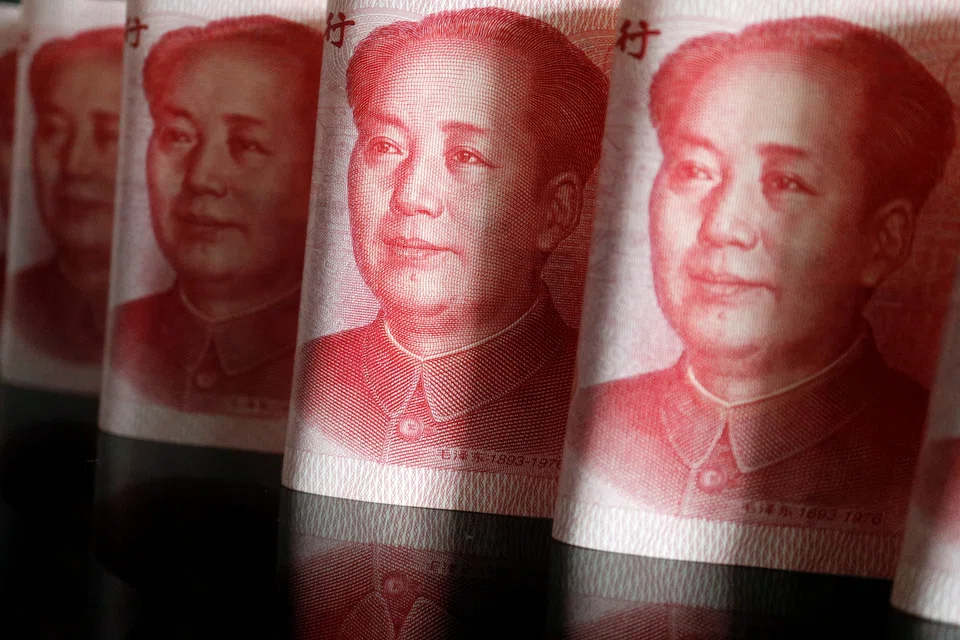
CHINA'S yuan finished domestic trading on Monday (Apr 25) at a 1-year low against the US dollar, extending losses after posting its worst week since 2015, as a worsening economic growth outlook drove investor concern that the currency had more room to fall.
Sentiment also took a knock on fears that strict lockdown measures will spread to Beijing, after the capital city required everyone living or working in Chaoyang district to take 3 Covid-19 tests this week and put more than a dozen buildings under lockdown.
Lockdowns in various cities across the country, including the financial hub of Shanghai, have heightened worries over wider disruption to economic activity and raised doubts about China reaching this year's growth target of about 5.5 per cent.
Some analysts wondered if the People's Bank of China (PBOC) was presaging further falls in the yuan by its apparent lack of discomfiture at the 2.6 per cent decline in the currency over the past week.
"The lack of any intervention by the PBOC despite the elevated downside volatility in CNY may signal that China could be shifting to a more growth-orientated currency management at a time when tight containment measures are posing significant risks to the country's economic outlook," ING said in a note.
"Should markets receive more indications that this is the case, selling pressure on the yuan may well continue."
Some economists said they would pay close attention to the meeting of the politburo, China's highest decision-making body, later this week for clues on any measures to prop up the economy.
The PBOC set the midpoint rate on Monday at 6.4909 per US dollar prior to market open, the weakest level since August 2021 and not far from Reuters' estimate of 6.4873.
In the spot market, both onshore and offshore yuan, breached the key 6.55 per US dollar, touching their weakest levels since April 2021. The onshore yuan finished at 6.5544 per US dollar, the weakest close since Apr 9, 2021.
Guan Tao, global chief economist at BOC International and a former senior official at China's foreign exchange regulator, said the current round of yuan depreciation was driven by the offshore market rather than by guidance from the official midpoint setting.
"The recent yuan decline was not the cause but the result of foreign investors' reduction in yuan assets ... Once the market confidence is restored, foreign capital may return at any time, and the yuan will regain support," he said.
Meanwhile, some traders said they are seeing growing demand for US dollars from their corporate clients, who are betting on further declines in the Chinese currency.
The US dollar's strength - against the backdrop of aggressive US Federal Reserve tightening, the vanishing Chinese yield advantage and growing economic pressures - also has weighed on the yuan.
"Looking ahead, the next target (for USD/CNY) would be the March 2021 high near 6.5795," Win Thin, global head of currency strategy at Brown Brothers Harriman, said in a note.
"With monetary policy divergence with the Fed set to widen, we think this yuan move still has legs," he added, noting the yield spread between the world's 2 largest economies would continue to move in the US dollar's favour.
Share with us your feedback on BT's products and services
TRENDING NOW

Two Singapore-listed palm oil firms named in Greenpeace report on Indonesian plantation fires

Singapore Airlines flight returns to San Francisco after ‘unruly’ passenger incident

Singapore looking into which companies responsible for haze-causing fires: PM Wong

Deluge IPO 3.86 times subscribed ahead of SGX debut

