

Citibank Malaysia chief executive sanguine about macrolandscape challenges

Anita Gabriel
Singapore
GOING by the track record of Citibank Malaysia's past chief executive officers, one of two things could await Singapore-born Lee Lung Nien, the flamboyant chief executive of the American bank's Malaysian unit.
Mr Lee, or Lung as he is known in banking and social circles - now eight months into his post - could stay long in the job and match Sanjeev Nanavati, whom he succeeded, as the longest serving boss of Citibank Malaysia; he could also have a relatively short stint in Kuala Lumpur and return to Singapore, where bigger things could unfold, as they did for Mr Nanavati's predecessor, Piyush Gupta, who now helms South-east Asia's largest bank, DBS Group.
It is a question no CEO wants to be asked, lest things turn out differently - not even the cool, highly energetic Mr Lee, who took the helm of Citibank Berhad last October, just as he was wrapping up an 18-month stint to beef up the bank's regional anti-money laundering hub in Kuala Lumpur.
But, when asked what if a job offer beckoned from home, the veteran banker and son of Lee Ek Tieng, one of Singapore's most prominent top civil servants, replied: "I wouldn't go looking, but if I'm tapped . . . say, it's a calling to do 'national service', then it depends.
"(But) if it's banking, I'll have to think really hard."
That Mr Lee is averse to joining another bank may be in part due to a ferocious loyalty - not undeserving - to a bank which has shepherded his career since 1990 across a smorgasboard of duties ranging from credit analysis and FX trading to e-commerce, marketing and sales and compliance across its offices in London, New York, Singapore and Malaysia, all of which have led to his long-desired career goal - to be a country chief.
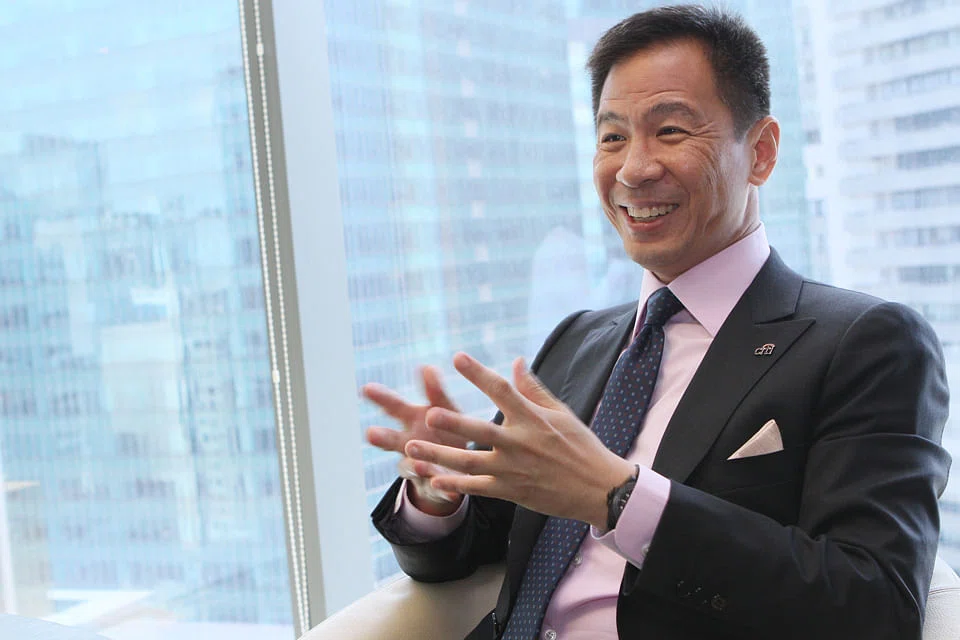
The 51-year old, dapper in a dark Camps de Luca suit from Paris, told The Business Times in an interview: "The beauty about Citi is that it's like that old Tangs tagline, 'All the best under one roof'. Everything can be done here. I didn't need to join another bank."
For now, he is one of the many Singaporeans scattered across the globe in high-level jobs, some of whom may want to return home eventually to serve their own.
"Hopefully, my next posting is Singapore. It's home," said the man whose list of extra-curricular activities would put any multi-tasking fiend to shame; his hobbies range from playing the drums at weddings, golf and football to go-kart racing, scuba diving and photography. (He is a retired diving instructor and has had his works on show at Leica's store opening in Orchard Road.)
These hobbies have given him ways to be engaged with Citi staff. He appears to have won their hearts by going beyond the practice of walking about the shop floor and eating with the troops in the office canteen - both of which he does as well.
"I can have a conversation with my staff on anything under the sun and can relate better to them," he said.
Citibank Singapore, where he clocked 18 years in total, is familiar ground to him. As chief operating officer of the Singapore business between 2010 and 2012, he was tasked with relocating the bank to nine floors in Asia Square Tower in 2011.
Before that, the self-confessed geek set up the e-commerce platform for FX trading and other market products for Citi's Asia-Pacific operations within a year and on the strength of a four-man team.
Now, as head of Citi's business in Malaysia, which delivers retail and corporate banking services with a 6,400-strong staff across 11 branches, he is hiring - even as his industry peers are axing jobs.
He said: "Citi is ahead of the curve, as we did the cutbacks earlier on, right after the crisis. By the end of this year, we'll have 6,800 staff. The compliance and controls world and sales in the consumer and corporate banking sides are all growing.
"Under our (Execution 2.0) strategy, Malaysia has been identified as a key site. So, yes, we are hiring."
In Malaysia, Citi has a market share of 18 per cent in the credit card segment in terms of sales, and is ranked second among foreign banks for its wealth-management business.
"It's not bad for a foreign bank," he said.
But there are challenges in Malaysia's macro landscape - a ringgit that has weakened much, precipitated by capital outflows; a slowing economy and high household debt, which could be a risk when interest rates rise. These, among other factors, have dented business and consumer sentiments.
Is he worried?
Not quite, he replied, because Citi's clients are the "mass affluent" and "top-tier corporates".
"We can't be bankers to everybody, so that way, we are cushioned when the market is stressed. There is still a lot of money in the system."
TRENDING NOW

South-east Asia has lost Nvidia’s best salesman

Demand, tech capabilities position Apac and AI as Skyscanner’s next growth frontiers: CEO Bryan Batista

Peter Kwee’s Ridley Park bungalow on the market with S$100 million asking price

Beyond the greenback, Vietnam’s big borrowers turn to Asian-currency bonds

