

Credit Suisse wealth management growth to remain robust

Genevieve Cua
Singapore
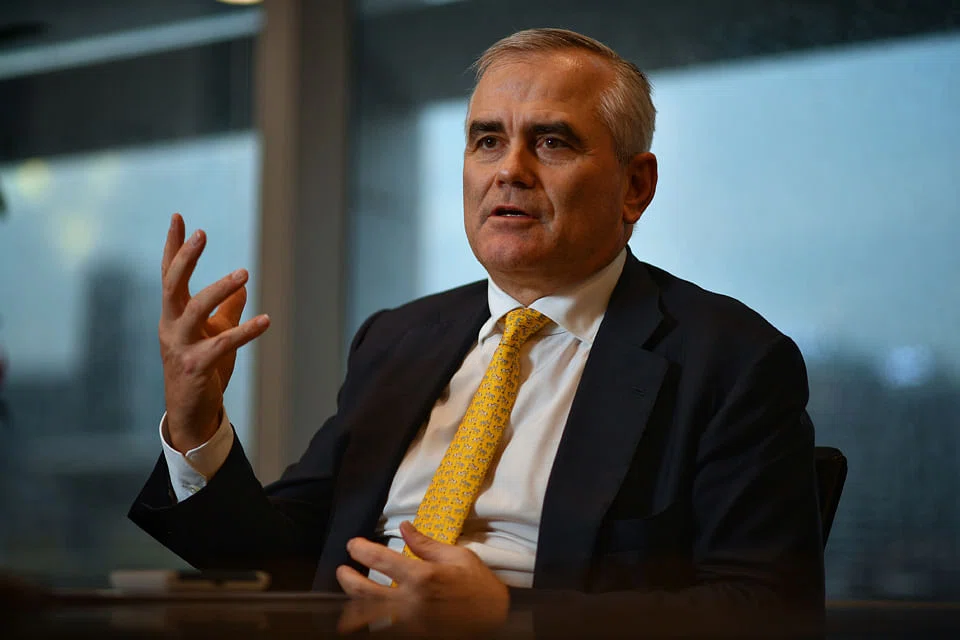
CREDIT Suisse's business model has proved to be resilient through the Covid-19 crisis, and growth in its global wealth management business remains "very robust", the bank's group chief executive Thomas Gottstein told The Business Times.
Mr Gottstein, who was recently in Singapore, succeeded Tidjane Thiam as chief executive earlier this year. His career with Credit Suisse has spanned over 20 years.
"Covid-19 has demonstrated that our business model of being a leader in wealth management with strong investment banking capabilities, is quite crisis-resistant. (Our) global wealth management growth has come down a bit in 2020, but it's still very robust," he said in his first interview in Asia.
"And investment banking has been quite strong. Trading volumes have been high; capital markets have been very active and corporates need financing. We have been much less hit by the crisis unlike other banks that have, for example, strong exposure to the credit card business or consumer lending."
Mr Gottstein said the bank aims to expand client business volume, which includes assets under management, lending volume and assets under custody.
"In particular, our lending initiative is an important one... because we can add a lot of value to clients."
In an environment of ultra-low interest rates, demand for financing has risen for Credit Suisse, which helps to offset lower net interest income. This demand is understood to be particularly strong among Asia-Pacific clients.
Lower rates and a search for yield have also spurred interest in private investments including private equity and alternative investments, which Mr Gottstein said make up another area of potential growth.
The bank is also seeking to expand client adoption of mandates, such as discretionary portfolio services, and sustainability products, including ESG-compatible (environment, social and governance) mandates.
"At the same time we want to be very active on the ESG front in terms of the financing of renewable companies, the issuance of green bonds and transition bonds and helping our corporate clients to finance their transition to a carbon-neutral world."
He said the core of the bank's strategy is to be the leading bank for entrepreneurs. "We feel that entrepreneurship and being a bank for entrepreneurs is in our DNA and Asia is absolutely core to our strategy because of the huge opportunities for growth in the region."
Credit Suisse's third quarter results showed "continued momentum" in wealth management.
Assets under management (AUM) at the end of Q3 2020 hit around 1.5 trillion Swiss francs (S$2.25 trillion).
Total net new assets for the nine months of 2020 came to 33.6 billion Swiss francs, of which Asia-Pacific generated 9.7 billion Swiss francs. Asia-Pacific accounts for about 30 per cent of the overall wealth management client assets.
The Asia-Pacific region has made a strong showing even in the third quarter alone, despite the pandemic. In Q3 2020, Asia-Pacific generated net new assets of 2.2 billion Swiss francs, and achieved record client assets of 294 billion Swiss francs, comprising AUM of 219 billion Swiss francs and custody assets of 75 billion Swiss francs.
While the overall wealth management business was affected by client deleveraging during the March market trough, transaction-based revenues were strong. In the Q3 2020 statement, the bank said it expects the current environment of macroeconomic uncertainty to continue to result in elevated levels of transactional and trading activity in both wealth management and investment banking businesses.
Lower interest rates are also supportive of higher levels of financing demand, and higher loan growth is expected to help Credit Suisse offset the pressure from lower rates.
In Asia-Pacific, digitalisation has facilitated client advisory and engagement. Said Helman Sitohang, Credit Suisse Asia Pacific chief executive: "As a digital-ready bank, we are prepared for all kinds of situations and given recent events, it is clear that this is the right strategy."
In the region, the bank's platform called SPARK saw a 3.5 times increase in the number of views on product pages, and over five times increase in product searches. SPARK delivers targeted investment ideas and data-driven recommendations.
Credit Suisse's digital private banking platform boasts an adoption rate of 65 per cent. Business traffic on the digital platform and the encrypted CS Chat surged, and an "exceptionally high" volume of trades was executed digitally. More than half of equity trades for private banking in Asia-Pacific is placed digitally.
READ MORE: Citibank Singapore to double AUM by 2025 in big wealth push
TRENDING NOW

Grab CEO’s wife Chloe Tong on life with Anthony Tan and finding her purpose

Jacqueline Loh to step down as MAS deputy MD in senior leadership reshuffle

Why 1 in 2 young Singaporeans who said ‘no kids’ now say ‘yes please’: new study

Private home prices accelerate with 1.4% rise while HDB resale values dip further in Q3: flash data

