

Singapore’s 6-month Treasury bill yield drops amid lower Fed rate hike expectations

Tay Peck Gek

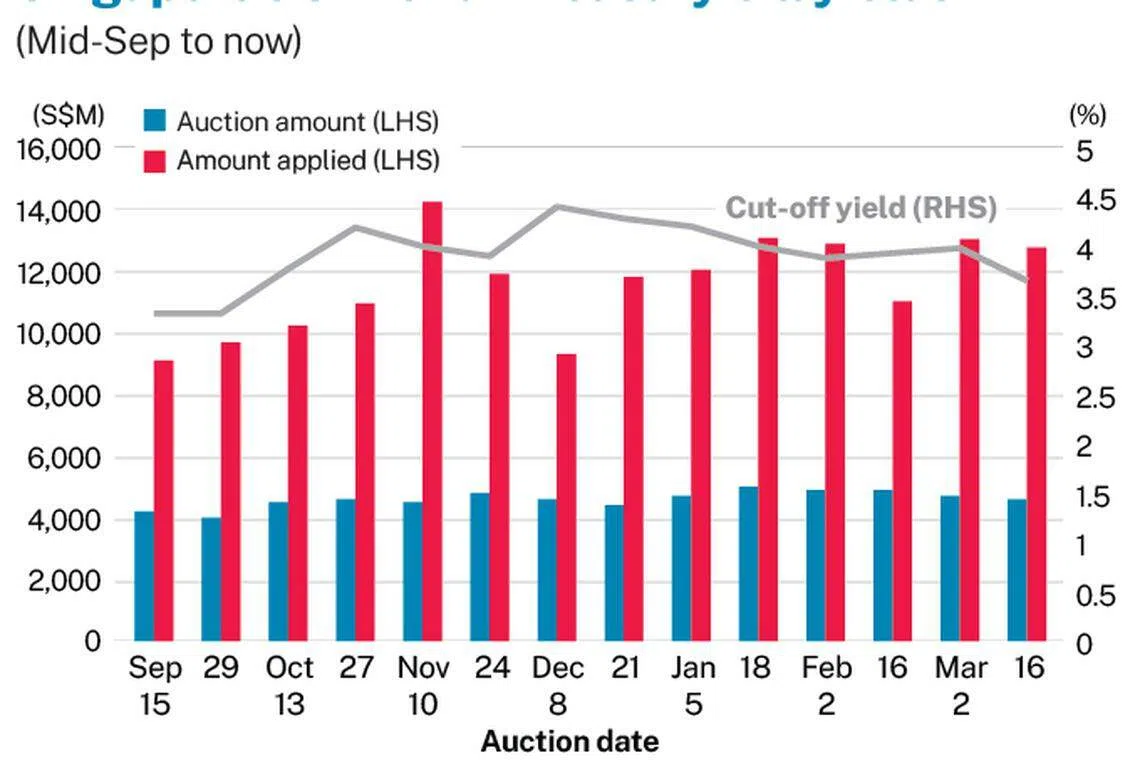
AGAINST a backdrop of heightened volatility in the global financial markets, Singapore’s latest six-month Treasury bill (T-bill) had a cut-off yield of 3.65 per cent when the auction closed on Thursday (Mar 16). This was the lowest since last September’s 3.32 per cent.
The allotment size was S$4.6 billion, with an oversubscription rate of about 2.8 times. The non-competitive applications – without specifying a yield – were fully allotted as these amounted to only S$837 million, well below the 40 per cent of allotment amount. Of the competitive applications at cut-off yield, 66 per cent were allotted.
The median yield was 3.58 per cent and the average yield was 3.41 per cent.
The risk-free, fixed-income instrument achieved a yield of 3.98 per cent in the last auction on Mar 2, or 33 basis points higher. However, the global markets have since become volatile in the aftermath of Silicon Valley Bank’s (SVB) money woes, putting the United States’ two-year Treasury yields through a roller-coaster ride last week, reaching above 5 per cent before dropping to below 4 per cent currently.
DBS senior rates strategist Eugene Leow noted that Thursday’s auction result was the first meaningful drop in Singapore T-bill yields in the current hike cycle. “This drop probably reflects risk aversion that took hold as the banking sector worries hit the US and Europe. The Fed‘s hike expectations have also been pared, leading to lower T-bill rates.”
Victor Yong, rates strategist at UOB, flagged that Singapore interest rates have been caught up in the same storm; and the Swap Offer Rate (SOR) as well as the interest rate swaps market rates have already adjusted lower before Thursday’s T-bill auction.
Although he is not surprised at the decline, Wong Di Ming, Bondsupermart’s research analyst for global fixed income, nonetheless finds the fall “more drastic than initially expected”.
“The downward trend technically started with the fall-out of SVB, though if the market assumes that the fall in cut-off yield has been overly compensated for, it would be likely for future T-bill yields to recover slightly above 3.65 per cent,” Wong said. “We will only have a better idea on how the yields might move in the Fed meeting next week when the Federal Open Market Committee (FOMC) addresses the SVB issue in a detailed manner.”
The FOMC is meeting on Mar 22, and its decisions will be keenly watched as market conditions have changed drastically after the liquidity problems of three banks in the US surfaced last week. A smaller or no hike is expected, down from a 50 basis point raise before the banking turmoil broke out.
Leow of DBS noted that financial stability concerns now dominate macro considerations. “Much will depend on how fast confidence returns to the banking system in the US and Europe. It will be difficult for the Fed to hike rates if contagion worsens... (Singapore) T-bill (yields) will probably plateau out until the Fed cuts rates.”
Tan Chin Yu, advisory team lead at wealth management firm Providend, pointed out that the principles of making sure that money needed in the short term should only be in safe, guaranteed assets such as T-bills, fixed deposits (FDs) and Singapore Savings Bonds remain.
“As such, the alternatives to T-bills – if (T-bill) rates are low – is to look at FDs that might give a higher interest, especially those that are still on promotional offers,” he added.
Singapore T-bills attracted strong investor interest in 2022 as their yields rose steadily. They hit a 30-year high of 4.4 per cent for the six-month tenor in December on the back of higher global interest rates. But the yields have been falling in recent months and seemed to have peaked, after the Federal Reserve signalled a slowdown in its rate-hike trajectory.
T-bills can be purchased with cash, Supplementary Retirement Scheme funds or Central Provident Fund (CPF) money.
OCBC and UOB ’s CPF Investment Account customers using their ordinary account (OA) savings will soon be able to buy T-bills online. The start date is Mar 31 for OCBC customers and Apr 22 for UOB customers.
Currently, customers using DBS or POSB as their CPF Investment Scheme OA agent can apply online using OA savings, saving them a trip to the bank branch. DBS opened its online application avenue for OA through its Internet banking portal in February.
TRENDING NOW

Singapore identifies 7 firms responsible for haze fires, notices issued urging action: Grace Fu

‘How many will survive?’: Bubble fears arise as China’s humanoid robotics face reality check

GIC-backed Bank Jago sees wealth management as next growth engine as Indonesian investor base grows

Ageing in Asia: Huge potential for the consumer economy

