Dividends preferred over share buybacks for shareholder returns: OCBC CEO Helen Wong
The bank aims to keep its excess capital as dry powder to support franchise flows and potential inorganic growth opportunities that may pop up

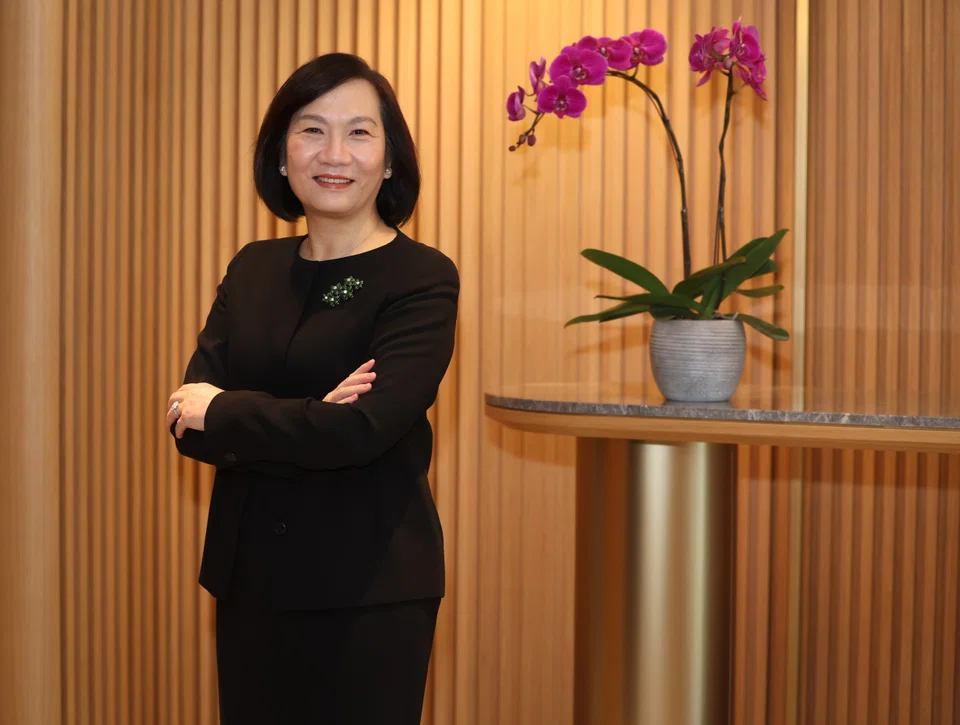
OCBC prefers to give dividends over share buybacks to return excess capital to shareholders, said chief executive Helen Wong.
“It is the same results (as) doing shareholder returns, but I keep the capital base,” she said at the third-quarter 2024 earnings briefing on Friday (Nov 8).
This bucks the trend from other local banks, with DBS embarking on a share buyback programme which will see it cancel shares bought on the open market, while UOB said a share buyback programme is not off the books.
While OCBC has done share buybacks, it will meet the needs of the employee share plan, said chief financial officer Goh Chin Yee.
The bank has the right to issue new shares to fulfil the needs of the employee share plans, but chooses not to do so to not dilute its existing capital base.
OCBC aims to keep its excess capital as dry powder to support franchise flows and potential inorganic growth opportunities that may pop up. Such moves have happened previously, such as the merger of OCBC Indonesia with PT Bank Commonwealth, as well as the Great Eastern offer. “We are excited about the future and provide enough capacity for Helen to go shopping. We particularly like portfolios (that can) bolt-on sort of acquisition,” said Goh.
OCBC will maintain Common Equity Tier-1 (CET1) at 14 per cent to maintain the “AA” ratings with rating agencies.
The bank’s CET1 ratio as at Sep 30 stood at 17.2 per cent based on the transitional uplift from changes to international standards for bank capital requirements under Basel IV. Fully phased-in, the CET ratio would be 15.6 per cent.
Post-Trump victory
Even with a Trump victory there are still uncertainties in the market, and Wong is looking to focus on flows in Asia – a trend that has not changed or deteriorated despite trade conflicts. OCBC has been tapping intra-Asia trade from corporate clients or small and medium enterprises in the supply chain, as the China plus one strategy materialises.
“We continue to see flow, and nowadays we talk more about China plus N rather than China plus one, because Chinese companies are no longer just going to one country like Vietnam for low-cost manufacturing,” she said.
Singapore still holds the key as the centre to manage investments into South-east Asian countries such as Indonesia, Malaysia and Vietnam. OCBC has been a benefactor of such flows as part of its corporate strategy.
If geopolitical tensions increase, Wong believes that it would be good for the bank. While the benefit might not be linear, OCBC will have to see the impact and how to capture these opportunities.
“With the shift of China manufacturing or investments coming out, it does benefit a bank like us,” said Wong. OCBC has prepped by having Greater China business offices in Singapore, Malaysia, Thailand, Indonesia and Vietnam, in order to engage such opportunities.
Besides China, this shifting of manufacturing is also impacting Korean and Taiwanese companies and multinational corporations (MNCs), which OCBC is looking to bank as well.
“To cover some of the bigger MNCs as they continue to use Asean more for the supply chain, we could be taking more risks as we finance the receivables of the supply chain companies,” said Wong.
Should the Chinese government’s stimulus measures improve economic activities and sentiment in China, this could provide “more wind in the sails” for OCBC, said Wong.
Shares of OCBC were up 1.1 per cent or S$0.18 at S$16.06 at the market close on Friday.