

European leaders dig in on budget disputes as talks stall
The tensions risk derailing a year-end deadline the EU has set to finalise its near-2 trillion-euro (US$2.2 trillion) budget
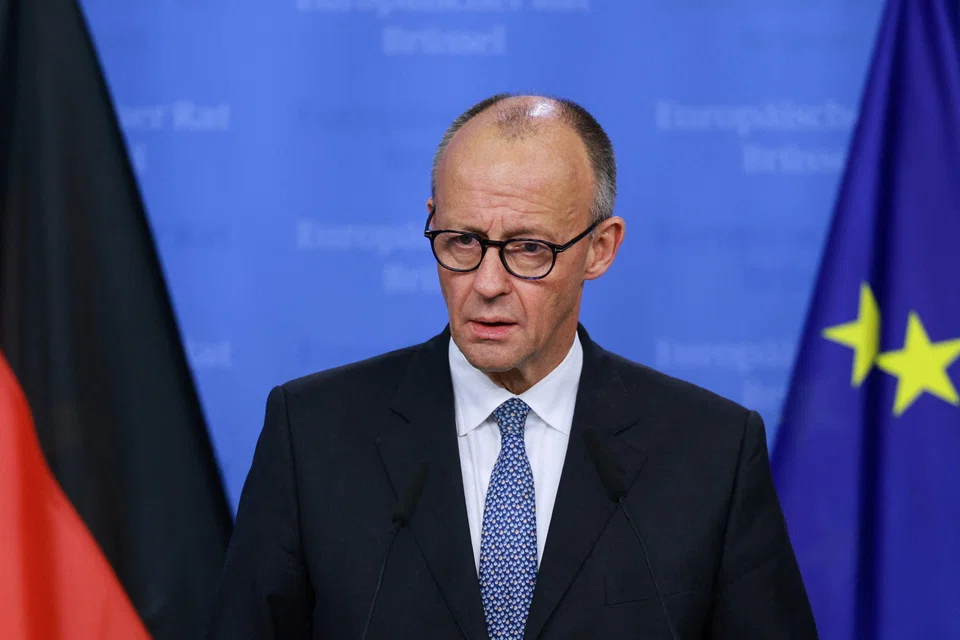
German Chancellor Friedrich Merz said European Union leaders called off a second day of budget talks in Brussels on Friday (Nov 27), as countries refused to budge in negotiations over the bloc’s long-term funding plan.
THE leaders had gathered on Thursday morning for a summit meant to create momentum for a December deal over the bloc’s next seven-year budget, which runs from 2028 to 2034.
Within hours, however, officials were privately grumbling about how the negotiations were evolving as countries stuck to their long-entrenched positions, according to people familiar with the matter. They requested anonymity in order to speak freely about the meeting.
Several participants focused their ire on European Council President Antonio Costa, who oversees EU summits, with some questioning the strategy behind the meeting. In the end, leaders conceded they were simply too far apart.
“There are far too many efforts that need to be taken,” Merz told reporters late on Thursday. “Far too much work that needs to be done.”
The tensions risk imperiling a year-end deadline the EU has set to finalise its near-2 trillion-euro (US$2.2 trillion) budget, a vital source of funding for Europe’s farmers, infrastructure projects and defence.

The timing is meant to prevent the talks from being swept into France’s election, where far-right leader Marine Le Pen is leading in the polls and has been calling for cuts to EU budget contributions.
“We’re light years away” from a budget solution, Italian Prime Minister Giorgia Meloni told reporters on the summit’s sidelines.
In truth, the plan on Thursday was never to reach a deal — at least not yet — but to suss out where there might be room to manoeuvre. Costa first asked all 27 EU leaders to meet together, before sending them into a series of smaller groups for 30-minute chats to test for potential compromises.
Leaders were set to then reconvene around midnight to determine whether it was worth staying until Friday to keep talking.
But before that meeting even happened, some of them decided against it.
It was evident, the people said, that countries remained far apart on critical issues, ranging from the budget’s overall size to new EU taxes to how much money should be spent on narrowing economic gaps between regions.
Some officials left angry, arguing there had been little reason to hold the discussion while leaders remained so divided. Ambassadors, they noted, can discuss procedural matters.
A person close to Costa pushed back on the notion, insisting the discussions concerned fundamental political issues that needed leaders’ input.
The person stressed that even if everyone was repeating well-known stances, the breakout sessions offered a chance to advance the discussions and identify areas of convergence.
The EU’s budget divides tend to be a mixture of regional, economic or ideological disagreements.
Broadly speaking, wealthier EU countries across the west and north — which contribute more than they receive from the bloc’s budget — want a smaller budget.
“We cannot be an ATM for the European Union,” said Swedish Prime Minister Ulf Kristersson.
Countries across the south and further east, however, have been defending a larger EU budget that retains significant funds to lift up less-affluent regions.
“Cohesion is really the goal of the European Union and the Czech Republic,” said Czech Prime Minister Andrej Babis. “We will fight for this money.”
At the core of the fights are shifting beliefs about what values should infuse the EU budget.
Historically, a large chunk of the bloc’s money has gone toward agriculture, for instance, supporting farmers’ income and food production.
While countries still consider that essential, there have been calls to also spend more on helping companies grow and compete with the US and China — a change linked to anxiety that Europe must spur economic activity and cut reliance on foreign partners.
Additionally, numerous leaders say the EU budget must prioritise defence spending — something it historically eschewed. With Moscow menacing and the US pulling back from the continent, many countries, especially those closer to the Russian border, say it’s now a vital part of the EU’s mission.
“A cheap Europe could turn out to be a very expensive mistake,” Polish Prime Minister Donald Tusk said in a social media post during the meeting. “Security comes at a price. As simple as that.”
By this logic, funding for Ukraine has been pulled into the EU budget talks.
EU leaders are trying to finalize a new 45 billion-euro (US$49.2 billion) loan for Kyiv as the country’s financial needs escalate nearly five years into Russia’s full-scale war.
While that money would be separate from the EU budget, economic heavyweights like Germany and the Netherlands are saying that if countries don’t participate in the loan, they shouldn’t enjoy certain EU budget benefits.
Those seeking an opt-out from the loan, including Hungary, Slovakia and the Czech Republic, did not back down on Thursday, insisting the two issues shouldn’t be linked.
But the topic didn’t feature much into the conversation once leaders got in the room, the people said, and the loan itself isn’t at risk.
For now, talks will continue at lower levels, with the hopes that compromises can be found between now and a summit planned for Dec 17 and 18, a Thursday and Friday. Already, officials are signaling that the gathering may go straight through the weekend.
“We all want to be home by Christmas,” Merz said. BLOOMBERG
Decoding Asia newsletter: your guide to navigating Asia in a new global order. Sign up here to get Decoding Asia newsletter. Delivered to your inbox. Free.
Share with us your feedback on BT's products and services
TRENDING NOW
LNG, stronger regional power links key to Asean’s energy resilience: Shell
Keppel CEO on telco merger: S$34 million StarHub dividend beats M1’s S$3 million contribution

OCBC opens 100-tonne gold vaulting facility to meet growing institutional demand

As Indonesia picks new vice-president to succeed Gibran, investors see risks and opportunities

