Fed signals inflation concerns, possible earlier end to supports
Inflation at a 30-year high, virus variant Omicron threatens to derail economic recovery, millions still not working
 Add BT as a preferred source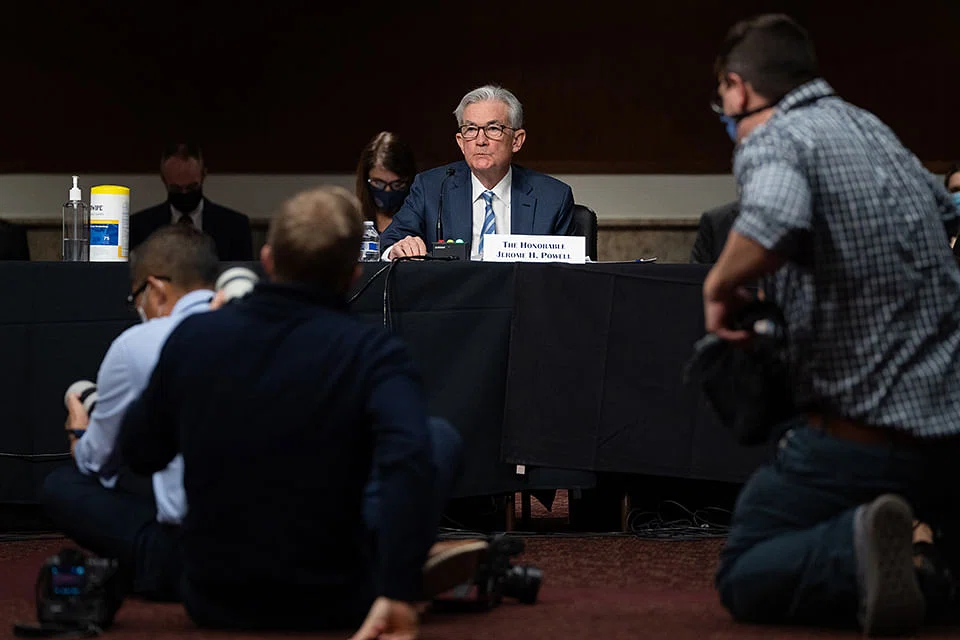
DeeperDive is a beta AI feature. Refer to full articles for the facts.
New York
JEROME Powell, the Federal Reserve chair, signalled on Tuesday (Nov 30) that the central bank was growing more concerned about high - and stubborn - inflation, and could speed up its plan to withdraw financial support from the economy as it tries to ensure that rapid price gains do not become long-lasting.
Powell, whom President Joe Biden has renominated for a second term, testified before the Senate Banking Committee at a fraught economic moment.
Inflation has jumped to its highest level in 3 decades and a new coronavirus variant, Omicron, threatens to keep the economy from returning to normal, potentially dragging out supply and demand mismatches.
Yet millions of workers are still missing from the job market - and the health threat could keep them on the sidelines.
As arguably the nation's most important economic policymaker, Powell must navigate that divide. His comments on Tuesday suggested that he was preparing to do it with an eye more firmly focused on the threat of inflation. That could mean ending the Fed's bond-buying programme sooner than expected.
Navigate Asia in
a new global order
Get the insights delivered to your inbox.
The central bank had been buying US$120 billion in government-backed securities each month throughout much of the pandemic to bolster the economy by keeping money flowing in financial markets.
In November, officials announced plans to slow those purchases by US$15 billion a month, which would have the programme ending midway through 2022.
But Powell said the central bank could wrap up more quickly, reducing the amount of economic juice the Fed is adding.
"At this point, the economy is very strong, and inflationary pressures are high," he said. "It is therefore appropriate, in my view, to consider wrapping up the taper of our asset purchases, which we announced at our November meeting, perhaps a few months sooner."
His comments further rattled investors, who had already been fretting about Omicron's potential impact. Stocks, down roughly 0.5 per cent for much of the morning, tumbled after his comments; the S&P closed down 1.9 per cent.
Short-term bond yields, heavily influenced by expectations for Fed rate increases, spiked as investors began to expect what is sometimes referred to as a "hawkish", or aggressive approach to interest rate policy.
"The tone of his remarks was notably hawkish, suggesting that the Fed's primary focus is on the risk of more persistent excess inflation," Krishna Guha, an economist at Evercore ISI, wrote in a research note reacting to the testimony.
Powell said he expected Fed officials to discuss slowing bond purchases faster "at our upcoming meeting," which is scheduled for Dec 14-15. He stressed that between now and then, policymakers will get a better sense of the new Omicron virus variant, a fresh labour market report and updated inflation numbers.
While he emphasised that much is unknown about Omicron, he said experts could get a better sense of it "in about a month", and will know at least something about the risks "within a week or 10 days".
For now, he focused on the risk the central bank has already come to know: rapid price gains. Inflation is running at its fastest pace since the early 90s in the United States, and prices have picked up in Europe and across many other advanced economies as booming consumer demand runs into sharply constrained supply.
In the eurozone, annual inflation jumped to 4.9 per cent, data released on Tuesday indicated. This is the highest since records began in 1997.
Global factory shutdowns, clogged ports and unusual shipping patterns have driven shortages in couches, cars and computer chips. Fed officials had for months predicted that the snarls would clear and price gains would fade. Instead, they have broadened - which has worried central bankers like Powell increasingly.
He said on Tuesday: "Generally, the higher prices we're seeing are related to the supply-and-demand imbalances that can be traced directly back to the pandemic and the reopening of the economy, but it's also the case that price increases have spread much more broadly in the recent few months. I think the risk of higher inflation has increased."
Monetary policymakers had spent recent months focused on helping the economy to heal, hoping to pull the millions of workers still missing from the job market back into work. To that end, the Fed's policy interest rate, its more traditional and more powerful tool, has remained set to near zero.
Officials had been stressing that they would be patient in pulling back that support and cooling down the economy, giving missing employees more time to return. But their tone appears to be shifting as prices for food, rent and goods are jumping.
Slowing bond purchases quickly would put officials in a position to raise borrowing costs sooner than previously forecast.
Lifting interest rates earlier or faster would pump the economic brakes, slowing down home-building, business expansions and consumer spending. Weakening demand would in turn tamp down prices over time.
Powell's willingness to pull back support faster despite the new variant - and his full-throated recognition that price gains are not poised to be as short-lived as officials had once hoped - caught investors' attention.
"The Fed is the ultimate owner of the 'transitory' characterisation, and the chair's decision to move beyond that is a decidedly hawkish step," wrote Ian Lyngen, head of US rates strategy at BMO Capital Markets in New York, in a note to clients shortly after Powell's comments.
At one point, Powell even said that at "coming meetings" he expected the Fed's policy-setting committee would say that when it comes to inflation, its standard for lifting interest rates had been met. That would mean that central bankers would simply be looking to the job market as they weighed when, whether and how much to raise borrowing costs.
For Powell, the timing is complex. The Biden administration has already renominated him as chair of the Fed, and said it would elevate Lael Brainard - now a governor - as the central bank's vice-chair. Both await Senate confirmation.
Inflation is factoring into the political moment as well, as Republicans try to blame the high inflation on the Biden White House. Republican senators asked tough questions of Powell and Treasury Secretary Janet Yellen during their joint testimony on Tuesday. Senator Thom Tillis of North Carolina, for instance, asked Powell: "At what point do we get back to a more normal execution of Fed policy?"
"We have to be humble about our ability to predict this, or really understand," Powell replied, after saying that the central bank did not expect the Omicron variant to have fallout that is "remotely comparable" to the initial pandemic-spurred state and local lockdowns. NYTIMES
Decoding Asia newsletter: your guide to navigating Asia in a new global order. Sign up here to get Decoding Asia newsletter. Delivered to your inbox. Free.
Share with us your feedback on BT's products and services