

Inside local bank’s AI engine: From smarter security to personalised banking, at scale
OCBC has built one of the region’s most extensive artificial intelligence operations – hundreds of use cases, billions in protected assets, and services designed around its customers
MILLIONS of decisions made by artificial intelligence (AI) every day.
At OCBC, that is not a futuristic ambition but a daily reality. Across the bank, AI powers processes ranging from personalising credit card offers to detecting fraud at speed.
Behind this scale of AI usage lies decades of groundwork in data.
The bank’s Data Lake – established in the 2000s – brings together rich information from transactions, processes and behavioural insights over two decades, giving the bank a deeper understanding of its customers, operations and markets.
That foundation allows data to be analysed at speed and at scale. For customers, this translates into more relevant product recommendations, faster services and stronger safeguards against fraud.
Today, hundreds of AI use cases support activities ranging from marketing and customer service to risk monitoring and operational processes.
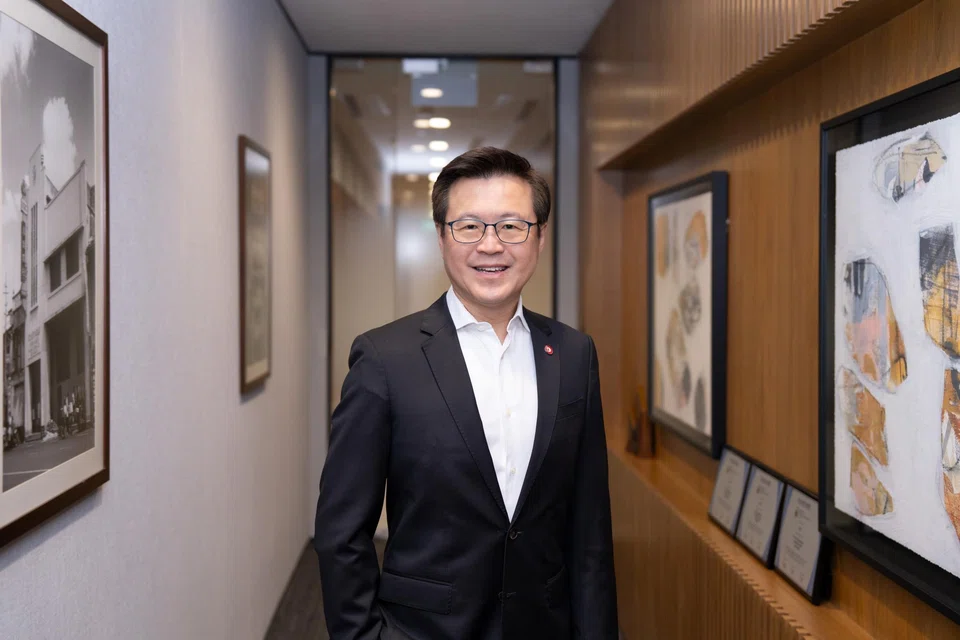
As Melvyn Low, group chief strategy and transformation officer at OCBC, puts it: “AI is not a standalone initiative but an institutional capability, embedded in all our processes.”
With a strong data foundation, OCBC was able to move early. In 2018, it became the first bank in Singapore to set up a dedicated AI unit to build in-house capabilities.
Today, OCBC uses AI as a strategic lever in three key areas: increasing revenue, reducing risk and enhancing productivity.
From productivity to personalisation
OCBC’s early AI initiatives focused on improving how employees work, long before ChatGPT launched in 2022.
The bank’s engineering and data teams had developed AI tools to help employees summarise documents, transcribe calls, write code and query internal knowledge bases, boosting productivity.
“Our initial efforts improved employee productivity, but now we’re seeing AI drive revenue by enabling deeper personalisation,” says Low.
That shift is increasingly visible in customer-facing applications. One example is A.I. Oscar, which Low describes as Singapore’s first AI-powered stock-picking tool. It predicts stock price movements and generates hyper-personalised stock ideas for customers.
Within three months of launch, A.I. Oscar helped to drive a 95 per cent increase in trading accounts opened.
At Bank of Singapore, OCBC’s private banking subsidiary, HOLMES AI supports relationship managers (RMs) by curating talking points, personalised investment insights and multi-asset strategies for client engagement. The tool has delivered productivity gains of up to 20 per cent.
AI is also used to improve customers’ experience with OCBC’s banking services. The bank’s mobile banking app provides suggestions that make financial planning easier and more convenient by using data drawn from customer behaviour.
In cybersecurity, AI is reinforcing the bank’s anti-scam efforts by improving its ability to detect and block suspicious transactions. This has contributed to a 30 per cent increase in suspicious transactions detected.
More time for higher-value work
Alongside these customer-facing scenarios, OCBC continues to invest in internal AI tools that free employees to focus on more complex and meaningful work, such as problem-solving.
An AI copilot for corporate RMs generates environmental, social and governance, financial and industry analysis for those reviewing lengthy, unstructured documents during credit assessment, reducing preparation time by up to 30 per cent.
Its next-generation agentic code assistance tool helps engineering teams build digital solutions faster and more reliably by generating code and automating routine tasks. The result is up to 30 per cent productivity gains, lower operational risk and more time for higher-value work.
Yet the bank is clear that innovation must operate within governed boundaries, especially with emerging technologies like agentic AI.
“AI should not just be transformational, but also trusted,” says Low. He adds: “Strong guardrails are essential: clear checkpoints, validation steps and escalation paths that keep workflows reliable, auditable and fit for purpose.”
For example, while an AI-powered Source of Wealth Assistant checks the databases of Bank of Singapore and OCBC to assess whether client information is plausible against benchmarks such as salary levels and company revenue, RMs remain in control by reviewing the AI-generated drafts before reports are sent on for further assessment.
Low says OCBC’s AI models also undergo regular reviews to monitor accuracy over time and are tested to prevent bias related to group, gender or nationality, in line with FEAT principles of being fair, ethical, accountable and transparent.
Looking ahead, OCBC sees the confluence of AI, Digital and Data as central to its next stage of growth, underpinning its new corporate strategy ‘The Next Frontier’. The bank plans to deepen these capabilities across the organisation to build scale, personalise service and improve cost efficiency.
“Being deliberate and intentional in how we incorporate AI, Digital and Data with people – such that it is part of our DNA – will be our differentiator,” says Low.
With AI, Digital and Data at its core, the bank aims to significantly strengthen its contextual marketing propositions, guided by the three Rs: reaching the Right customer, offering the Right product, and doing so at the Right time. It also sees AI as an enabler for the whole workforce, not just specialists.
Over the past three years, from 2023 to 2025, around three in five employees participated annually in an AI-, digital- or data-related training programme as part of continuous upskilling.
“We will continue to encourage adoption and upskilling,” says Low.
Speeding up source-of-wealth checks with agentic AI
From 10 days to an hour.
That is the massive time savings an artificial intelligence (AI)-powered tool rolled out in June 2025 has made possible for relationship managers (RMs) at the Bank of Singapore, OCBC’s private banking subsidiary.
Kelvin Chiang, head of platform and analytics at Bank of Singapore, led the development of the Source of Wealth Assistant (SOWA) tool together with OCBC.
The tool streamlines one of the most time-consuming processes in private banking: preparing Source of Wealth (SOW) reports to build an accurate profile for every client.
Previously, RMs had to sift through hundreds of pages of client documents to piece together a clear picture of how wealth was accumulated. The work involved extracting key facts, applying assumptions such as tax and inflation rates, and compiling everything into a detailed report that met strict compliance standards. Preparing a single SOW report could take up to 10 days.
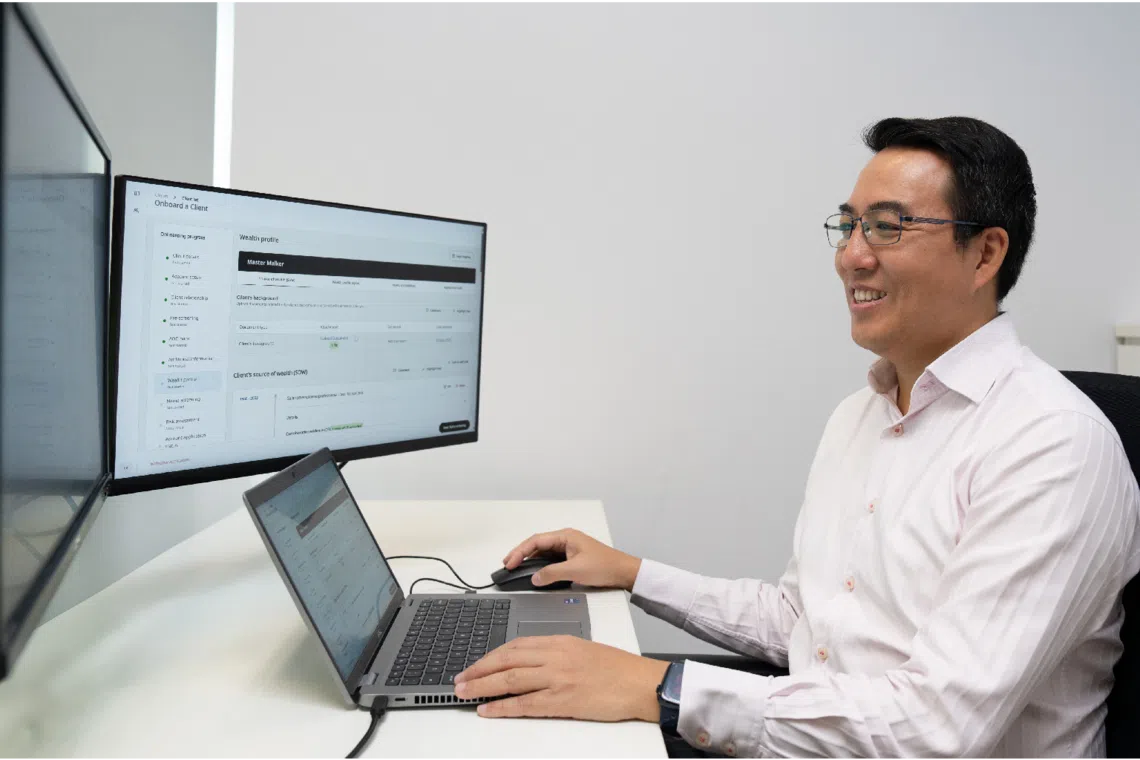
Chiang had experience using robotic process automation and generative AI, but these technologies fell short. He noticed how his daughter’s essay was graded – assessed according to structure, keywords and the quality of reasoning – an insight that gave him a new way to think about the problem.
It led him to design an agentic AI workflow in which specialised models handle different steps, from extracting information to drafting the report and applying compliance guardrails.
Today, SOWA can produce a draft report in about an hour – one that is more consistent and easier to review.
With the heavy lifting done by AI, RMs can focus on assessing risks and advising clients – a shift that is increasingly important as private wealth in Asia continues to grow.
Chiang notes that as client portfolios become larger and more complex, bankers need to spend more time on higher-level judgment rather than administrative work.
“With the rapid influx of wealth into the region and increasingly complex client structures, relationship managers can no longer afford to be weighed down by administrative tasks. Time saved from producing SOW reports allows RMs to spend more meaningful time with their clients – deepening relationships, strengthening their understanding of client needs and ultimately enhancing the overall client experience. Their true value lies in delivering strategic advice, not paperwork,” he says.

Share with us your feedback on BT's products and services
TRENDING NOW

ComfortDelGro appoints two new independent directors

Once staunchly pro-China, Malaysian Chinese businesses are now distancing themselves from Beijing

NoonTalk needs continued financial support from CEO Dasmond Koh, auditors warn
DP Architects sets the benchmark for sustainability disclosure and design

