

G-7 holds off criticising Japan over yen's drop
This increases possibility BOJ will be emboldened to loosen monetary policy further, pushing currency even lower
Tokyo
JAPAN was let off lightly by its Group of 7 (G-7) partners meeting in Germany last Friday over the sharp and continuing drop in the value of the yen against other key currencies, increasing the possibility that the Bank of Japan (BOJ) will be emboldened to loosen monetary policy further, pushing the yen even lower.
A key development could be the release this Wednesday by the Organisation for Economic Cooperation and Development (OECD) of its latest Economic Outlook on Japan, and whether the Paris-based organisation endorses the need for stronger monetary action by the BOJ.
In a report earlier last month, the International Monetary Fund (IMF) urged the Japanese central bank to be more proactive in ridding the nation of its long-standing deflationary mindset by taking stronger action in support of the BOJ's 2 per cent annual inflation target.
With the G-7 holding off criticising Japan and the IMF giving Tokyo the effective green light to pursue more vigorous monetary actions, any hint in the Wednesday report that the OECD is taking a similarly liberal line could clear the way for further monetary easing, some economists believe.
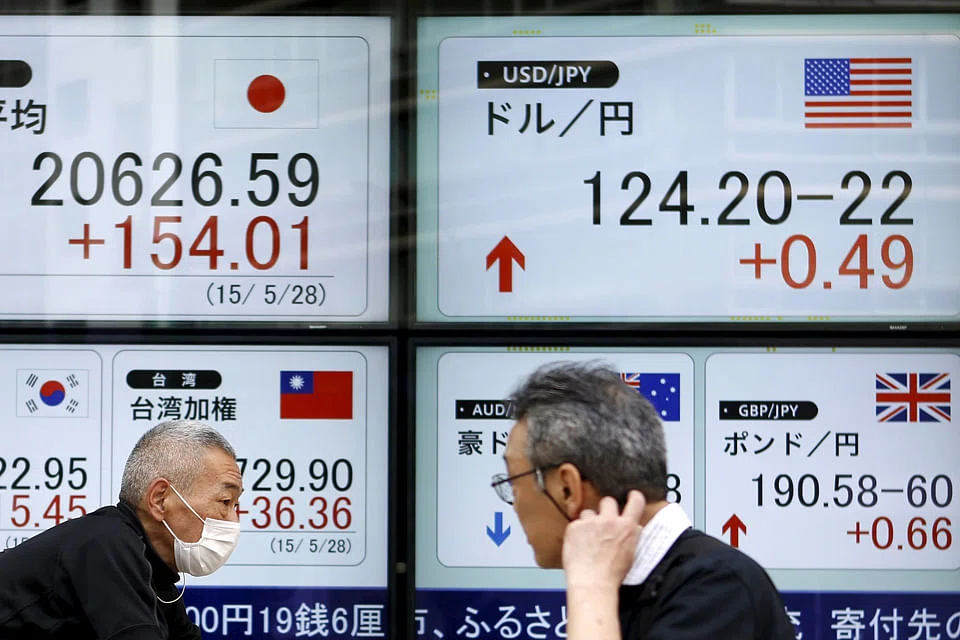
That, in turn, would virtually guarantee further falls in the yen, which dropped to a 12-year low of around 124 to the US dollar at one point last week and would also bolster the yen value of Japanese exporters' overseas earnings, helping push Tokyo share prices above their current 15-year high.
Chairman of Starfort Holdings and former vice-president of Goldman Sachs in Asia, Kenneth Courtis, told The Business Times that the US dollar-yen rate had broken its 25-year trend line and was on course to meet Starfort's longer-term target of 150 to the US dollar.
Others do not see it falling quite that far, but most forecasts have pegged it to fall some more, perhaps significantly, below its current level in the short to medium term, trading perhaps between 120 and 130 to the US dollar.
Following the yen's recent plunge, Japanese Finance Minister Taro Aso and US Treasury Secretary Jack Lew agreed during bilateral talks in Dresden last Thursday that volatile movements in foreign exchange markets are undesirable, Kyodo news service reported.
Mr Aso, unusually, described the yen's recent fall as being "rough" but there is little that Japan can do to stem the currency's further drop, even if it wished to, one official (who did not wish to be identified) told BT.
Both Japan and the US are effectively "locked into" certain courses of monetary action that virtually ensure that their currencies continue moving in opposite directions against each other, sources say.
BOJ governor Harihiko Kuroda is determined to push up inflation expectations in order to boost personal consumption and private capital investment, they point out. The most obvious way to do this is to maintain or boost BOJ purchases of financial assets, thus expanding the money supply in the process.
Many have been critical of this tactic, because of its impact on the yen and on import and living costs in Japan. But the IMF recently signalled its approval, noting that "persistent differences between market expectations and the BOJ's inflation target and time frame pose a dilemma".
While inflation expectations "have risen markedly since the introduction of quantitative and qualitative monetary easing (QQE), the rate has been broadly flat at around one per cent in recent months, suggesting that the desired regime shift has not yet materialised".
Maintaining the BOJ's commitment to push inflation up to 2 per cent would preserve the desired "anticipation effects" of additional easing on the part of the market, the IMF report added.
The US, on the other hand, is more or less committed now to begin tightening monetary policy in coming months (as distinct from simply "tapering" Federal Reserve purchases of government bonds and other financial instruments), analysts say, citing recent hawkish comments by Fed chair Janet Yellen.
That, in turn, implies the US dollar is destined to move higher against the yen and other currencies in the near term, unless the US economy and unemployment levels in the world's largest economy take a sudden and unexpected turn for the worse.
Last week's G-7 finance ministers' meeting was seen as a key test of whether the still-powerful group of advanced economies would tolerate recent sharp currency adjustments without at least issuing oral warnings against such movements. Instead, they limited themselves to only modest hints of concern.
TRENDING NOW

Nvidia reinstates Jensen Huang as CEO; Trump says move poses no national security risk

Indonesia’s coal tycoon Low Tuck Kwong replaced as Bayan Resources president-director

Nvidia surges 33% after reinstating Jensen Huang, reviving AI trade; stocks soar in US and Europe

Consider lowering homeownership barriers for some non-resident foreigners

