

Goldman cuts Aussie dollar forecast to 72 US cents
It expects Reserve Bank of Australia to lower interest rates again in May
Sydney
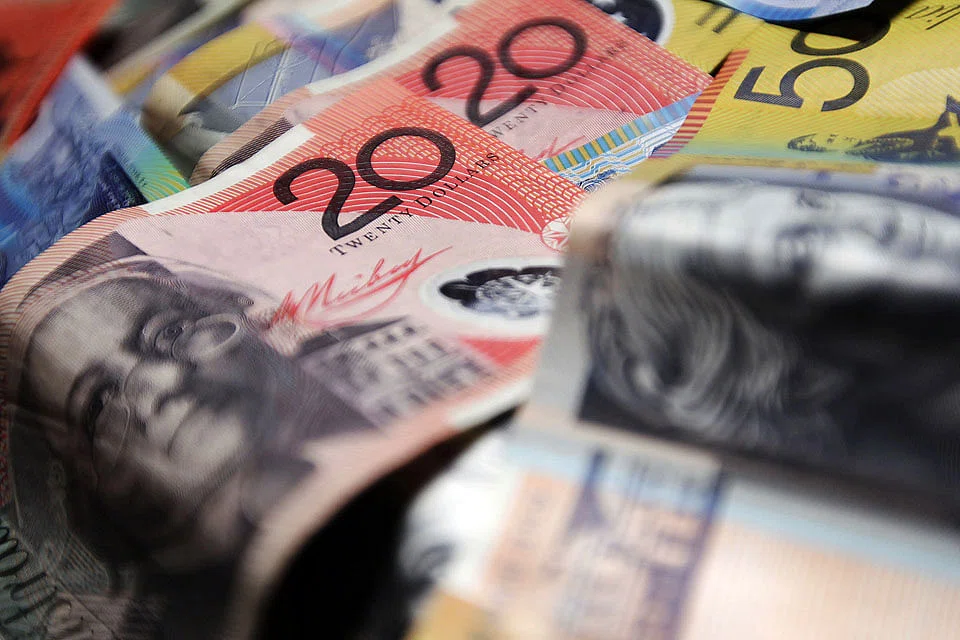
AUSTRALIA'S dollar will fall 7 per cent this year to 72 US cents as a faster-than-anticipated plunge in commodity prices leaves the nation A$500 billion (S$526 billion) poorer in the coming decade, Goldman Sachs Group Inc said.
The US investment bank, which had previously forecast an exchange rate of 75 US cents, also brought forward to May its prediction for another interest-rate cut after the Reserve Bank of Australia (RBA) on Tuesday reduced the cash target by a quarter point to a record 2.25 per cent. The RBA will stay at 2 per cent and start lifting rates in the final quarter of 2016, Goldman economists led by Tim Toohey said in a report on Wednesday.
"The commodity prices that matter for Australia have fallen faster than even our own bearish expectations," the Goldman analysts wrote. "This dramatic change to the commodity complex has material and wide-ranging implications for the Australian economy and policy makers."
The Aussie dropped as much as 2.3 per cent on Tuesday after the RBA said it is overvalued when announcing its policy decision, one that wasn't predicted by a majority of economists. National Australia Bank Ltd, the country's biggest lender by assets, said it's reviewing forecasts, while United Overseas Bank Ltd cut its call to 70 US cents by year-end. The Aussie was at 77.66 US cents as at 11.21 am in Sydney after touching 76.26 yesterday.
Slower medium-term growth, low interest rates for longer and a deterioration of the nation's fiscal and trade balances provide scope for the Australian currency to move lower than previously forecast, according to Goldman.
While the economic growth outlook for this year is unchanged at 2 per cent, Goldman is more pessimistic than it was for the coming years. Goldman sees gross domestic product climbing 3.25 per cent in 2016 versus an earlier view of 3.6 per cent, while the outlook for 2017 has been trimmed by half a percentage point to 3.5 per cent.
Prior to this week's RBA decision Goldman had predicted rate cuts in March and in August. Traders are currently pricing in the next cut for May, with a 44 per cent probability it will come as soon as March, according to overnight index swaps data compiled by Bloomberg.
The Australian dollar has fallen more than 17 per cent from its September high as mineral and energy prices have plummeted. Iron ore has dropped 49 per cent over the past year, while the price of oil in New York is down 45 per cent over the same period.
The worsening outlook for bulk commodities and liquefied national gas will hurt Australia's revenues and put additional pressure on both the trade and budget positions, according to Goldman. Weaker commodity prices are likely to create a A$40 billion tax revenue shortfall over four years and a return to surplus doesn't look feasible any longer, the bank said.
"The ongoing adjustment in both spot commodity prices and changes in our strategists' longer term price forecasts require a reassessment of the impacts upon key economic indicators for Australia over the medium term," according to Goldman. "The slower forecast path for real economic growth also suggests slower progress in closing the output gap, a contained inflation environment and low interest rates for a longer period than previously forecast." BLOOMBERG
TRENDING NOW

Nvidia reinstates Jensen Huang as CEO; Trump says move poses no national security risk

Indonesia’s coal tycoon Low Tuck Kwong replaced as Bayan Resources president-director

Nvidia surges 33% after reinstating Jensen Huang, reviving AI trade; stocks soar in US and Europe

Consider lowering homeownership barriers for some non-resident foreigners

