Hong Kong intervenes to defend its dollar for first time since 2019
 Add BT as a preferred source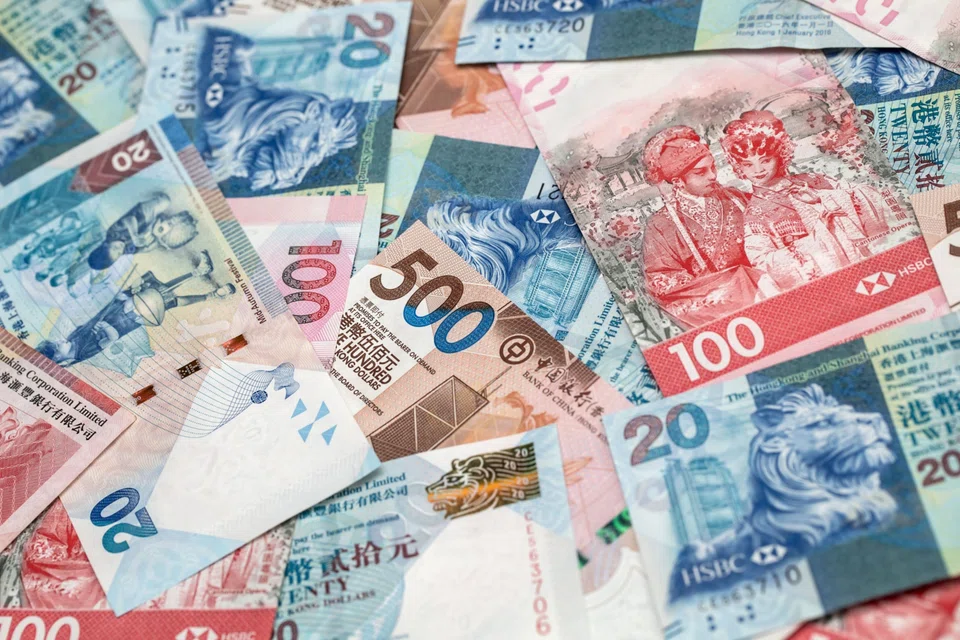
DeeperDive is a beta AI feature. Refer to full articles for the facts.
HONG KONG intervened to defend its currency for the first time since 2019, putting further upward pressure on interest rates in an economy already reeling from strict pandemic border controls and a shaky property market.
Capital outflows fuelled by rising interest rates in the US sent the Hong Kong dollar to the weak end of its permitted 7.75-to-7.85 per greenback trading range late Wednesday (May 11). The Hong Kong Monetary Authority (HKMA) bought about HK$1.6 billion (S$283.9 million) to prop up the currency, which was still trading at the weak end as of 10.45 am local time on Thursday.
Further intervention will drain liquidity from the financial system, driving up borrowing costs when the local economy is contracting under the weight of some of the world’s strictest Covid-containment measures. Rising interest rates also pose a threat to Hong Kong’s property market, with Goldman Sachs Group saying earlier this year that home prices may slump 20 per cent by 2025.
“The Hong Kong dollar will hover around 7.85 throughout the second and third quarters, and the HKMA will need to sell more US dollars to defend its currency on the weak end,” said Qi Gao, a strategist at Scotiabank.
The move comes as central banks from India to Taiwan act to defend currencies buffeted by expectations of aggressive Federal Reserve rate hikes. While some commentators have called on Hong Kong to abandon its dollar peg, there’s little sign that authorities plan to change a system that has survived multiple speculative attacks since 1983 and helped turn the city into one of the world’s most important financial centres.
In a statement released Thursday, the HKMA vowed to continue to closely monitor market situations and reiterated its oft-stated view that the city’s linked exchange rate system is functioning well. The Hong Kong dollar continued to operate in an orderly manner and interbank rates will rise, it said.
Navigate Asia in
a new global order
Get the insights delivered to your inbox.
Selling of the local dollar has intensified in recent months as a hawkish Fed boosts the US currency, while pandemic restrictions in the former British colony have damped its growth outlook. The testing of the band’s limit on Wednesday came around the same time as faster-than-expected US inflation data sent the greenback briefly up and Treasury yields surging. While gauges of the US dollar and longer-maturity Treasury yields subsequently retreated, Hong Kong’s currency continues to hover right near the band’s edge.
The Hong Kong dollar has weakened by about 0.7 per cent this year, with some of the declines coming as Fed-rate hikes widen the funding rate gap between the US and the special administrative region. That widening gap has led traders to borrow from the interbank market the Hong Kong currency, which they then have been selling for the higher-yielding greenback. The premium of the 3-month US interbank rate, known as Libor, over Hong Kong’s equivalent, Hibor, expanded to the widest since 2019 in April.
The HKMA last intervened in the foreign-exchange market in 2020, when the currency hit the strong end of trading band. That came roughly a year after the authorities intervened on the weak end in early 2019, when shorting the Hong Kong dollar became a hot trade among hedge funds.

The Hong Kong dollar will remain under pressure as US yields climb on rate-hike bets, said Samuel Tse, an economist at DBS in Hong Kong.
The Hong Kong dollar’s 3-month Hibor climbed 3 basis points to 0.79 per cent on Thursday, its highest level since June 2020, while the 1-month rate was little changed at 0.18 per cent. The 3-month tenor jumped to as high as 2.66 per cent in 2019, after the last round of intervention on the weak end of the trading band. BLOOMBERG
Decoding Asia newsletter: your guide to navigating Asia in a new global order. Sign up here to get Decoding Asia newsletter. Delivered to your inbox. Free.
Share with us your feedback on BT's products and services