

Japan defies wave of inflation-fighting hikes by keeping rates at rock bottom
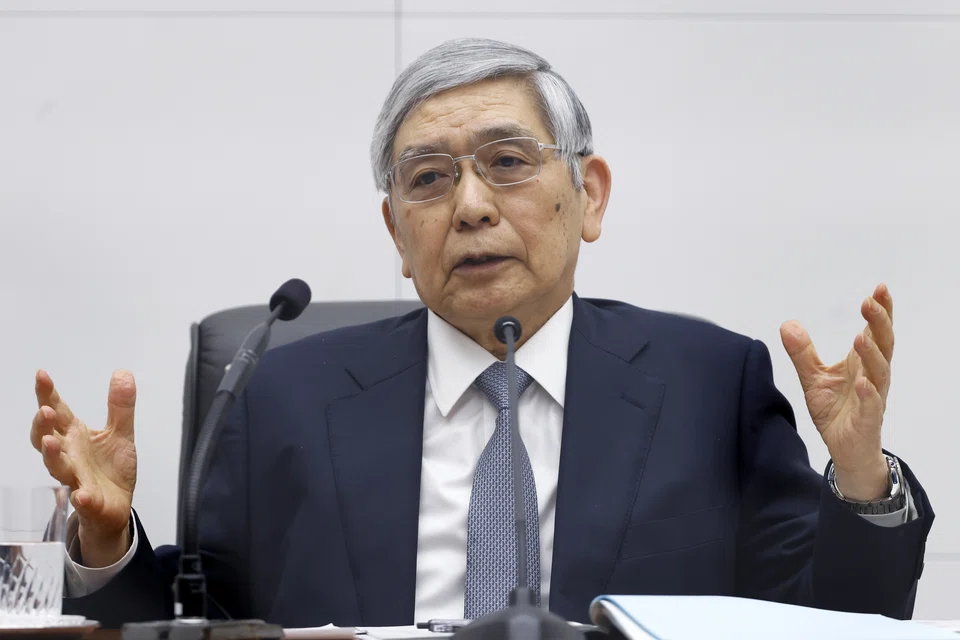
Bank of Japan (BOJ) governor Haruhiko Kuroda emphasised his determination to stick with rock-bottom interest rates even if it means a weaker yen after the bank's latest price forecasts left the door open to continued speculation over policy change.
Following the central bank's decision to stand pat earlier in the day, the BOJ looks set to become the last holdout on rates among major developed economies later on Thursday (Jul 21), assuming the European Central Bank goes ahead with its first hike in more than a decade, as is widely expected.
Recent concern that the global economy risks a hard landing as central banks rush to tackle inflation has helped ease market pressure on the BOJ, with fewer speculative bets against the yen and Japanese bonds.
That has left Kuroda with scope to continue with a short-term interest rate of -0.1 per cent and a 0.25 per cent cap on 10-year yields even though this combination is contributing to yen weakness.
"We have no intention at all of raising rates under the yield curve control framework," Kuroda said in a press conference following the bank's latest decision. "We also have zero intention of expanding the 0.25 per cent range on either side of the yield target. Right now, we need to continue to tenaciously pursue monetary easing."
He also flagged the futility of trying to use a marginal rate hike to influence the exchange rate, citing the example of Korea's weakening won, despite several rate hikes.
"If you were serious about stopping the weaker yen just with rate increases, you would need significant hikes and they would be very damaging to the economy," he added.
His comments helped weaken the yen a touch against the US dollar. But economists were divided on whether he really could keep a lid on change.
The tension between the BOJ's policy stance and market bets is likely to resume in earnest if global recession fears soften.
"While the BOJ gave no sign of moving toward tightening anytime soon, its new inflation forecasts are stronger than the market view," said Nobuyasu Atago, chief economist at Ichiyoshi Securities and former head of price statistics division at the BOJ.
"That's somewhat confusing because the BOJ must know that by issuing those higher forecasts, speculation over policy change won't go away," he added.
The BOJ now sees inflation averaging 2.3 per cent for the year ending in March. That's still a far cry from some of the rampant price growth overseas, but it's the first time the BOJ has expected price gains above its target level of 2 per cent in the current year barring the impact of sales tax hikes.
It then sees the momentum slowing, providing justification for continued easing to achieve sustainable inflation. Its view that the recovery will be slower-than-expected this year also supports that thesis and points partly to the impact of China's lockdowns and the likely hit to consumption from higher energy and food prices.
"It's notable that Kuroda said it would take massive rate hikes to stop yen weakness and that's a sign he has no intention whatsoever to address it," said Keisuke Tsuruta, a bond strategist at Mitsubishi UFJ Morgan Stanley Securities. "The bottom line is no policy change for a while."
For some observers, though, the combination of a favourable price forecast and an unfavourable growth view looks like a typical central bank hedge to keep its options open. Should the global economy avoid a major slowdown, prices might then continue to grow at a solid pace.
The bank should learn from the Reserve Bank of Australia's (RBA) experience of waiting too long to reach an inflation target, according to Tim Baker, head of macro research at Deutsche Bank in Sydney.
"Both the RBA and BOJ went many years undershooting the target, and risk staying dovish too long just because they want to be sure that inflation really does perk up sustainably."
A prolonged attack by speculators on the bond market Down Under and a surge in inflation led to the RBA abruptly abandoning its yield-curve control experiment late last year, an outcome the BOJ is well aware of.
The Japanese central bank said it would continue to offer to buy bonds at a fixed rate on a daily basis, underlining its determination to protect its own YCC framework if not the yen. Just last month it was forced to buy a record amount of bonds to defend its yield ceiling.
This was the first policy meeting since the shocking murder of former Prime Minister Shinzo Abe who handpicked Kuroda to lead the bank and enabled him to become the longest serving BOJ governor.
Some economists including Hiroaki Muto at Sumitomo Life Insurance say the death may have firmed up Kuroda's determination to stick with easing as he looks to continue the legacy of Abenomics in which he has been a key player.
Prime Minister Fumio Kishida's strong victory in a key national election earlier this month has also removed for the time being a potential source of pressure for change.
Aside from rearguard action to fend off speculators, a clearer sign of policy change to come would emerge with more obvious signs of sustainable price growth.
"For that to happen, wages will have to keep up with price gains," said Harumi Taguchi, principal economist at S&P Global Market Intelligence. BLOOMBERG
Decoding Asia newsletter: your guide to navigating Asia in a new global order. Sign up here to get Decoding Asia newsletter. Delivered to your inbox. Free.
Share with us your feedback on BT's products and services
TRENDING NOW

He built the Vingroup empire. Now South-east Asia’s richest man is handing some key roles to his sons
Despite the de-dollarisation debate, demand for dollar liquidity in Asia is growing

Can a first-time homebuyer couple earning S$18,000 a month afford a new EC unit?

Asia needs new energy security architecture

