Lagarde says Europe’s economy has slipped below ECB baseline
Headline inflation in Europe has already jumped past the 2 per cent target
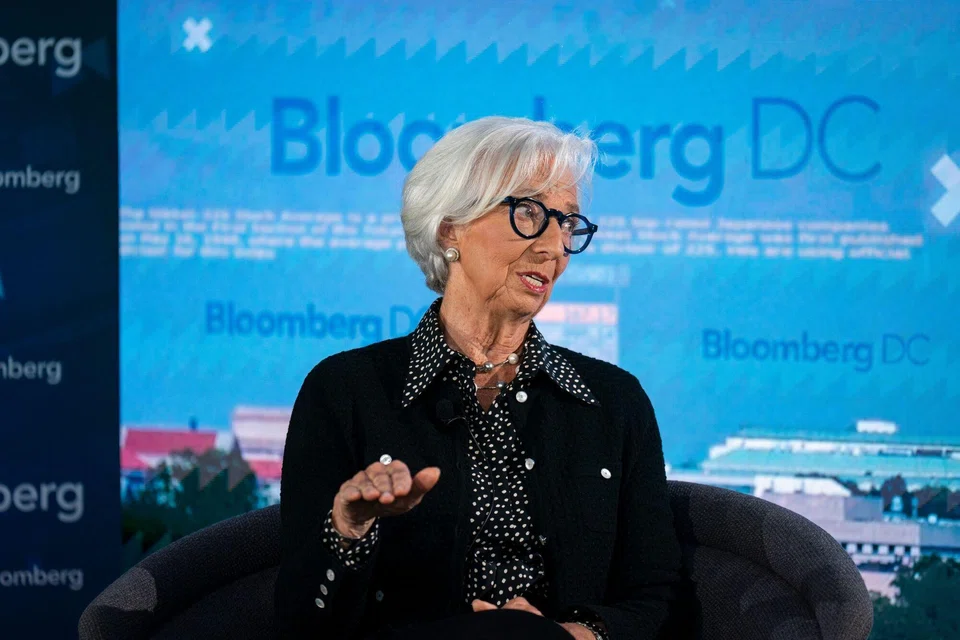
[WASHINGTON] President Christine Lagarde said higher energy costs have pushed the euro zone away from the European Central Bank’s base-case outlook, though not enough yet to warrant leaning toward raising interest rates.
“We are in between the baseline and the adverse” scenarios for the Iran war, Lagarde told Bloomberg Television on Tuesday in Washington, where she’s attending the IMF’s spring meetings.
Asked whether that means the ECB now has a bias toward tightening monetary policy, she said it doesn’t. “We have a compass which indicates price stability predicated on financial stability,” Lagarde said.
The ECB is weighing what action is needed following 6 1/2 weeks of fighting in the Middle East that’s sent oil prices soaring and bruised economic sentiment. Headline inflation in Europe has already jumped well beyond the 2 per cent target. The key question is how persistent the spike will prove.
Markets reckon rate hikes are only a matter of time. But with the fate of peace talks between the US and Iran up in the air, they don’t foresee an increase at the next meeting on April 29-30.
Traders are betting on two full quarter-point hikes this year, with about a 30 per cent chance of a third, compared with wagers on as many as four such increases a week ago. German two-year yields, which are sensitive to policy changes, fell as much as 11 basis points to 2.54 per cent.
“We have to be completely agile and ready to move in the direction that is required,” Lagarde said. “We have to be data dependent, as we have repeatedly said, but it does not predicate as we speak today that we will go in one direction or the other. And it certainly doesn’t determine a rate path that I can confirm today.”
New IMF projections published earlier on Tuesday may add some clarity, suggesting faster global inflation alongside more meager growth. In the 21-nation euro zone, consumer prices are seen rising 2.6 per cent this year — matching the ECB’s own forecast.
Several officials from the Frankfurt-based central bank deem that baseline outcome less likely as the conflict drags on and the closure of the Strait of Hormuz worsens.

That would bring closer the adverse scenario envisaging inflation peaking at 4.2 per cent. Should the situation deteriorate further still, a severe scenario includes a short recession and price gains topping 6 per cent.
For now, officials are watching how strongly higher energy costs feed through to other parts of the economy, keeping a particular eye on things like wage demands, which rose dramatically after inflation exceeded 10 per cent in the wake of Russia’s attack on Ukraine in 2022.
“We’ve said very clearly that we would need data to act, but that we would not hesitate to act,” Lagarde said. “It really captures well the position that we have. We need the data in order to analyse whether it’s a see-through, it’s going to be short-lived, we will get back to the past, if you will. Although I don’t think that’s actually possible.”
Speaking later in the day at the Bretton Woods Committee in Washington, Lagarde struck a similar tone.
“What we need to do on the basis of current circumstances is assess the data, determine the actual nature of the shock, the possible variation of that nature, the magnitude, the potential duration, and then we have to be open, and we cannot, I think it would be a serious mistake today to say this is a case of look through,” she said.
“We simply don’t know, too soon to tell. So where we will move and demonstrate our agility is once we have enough data, enough information, and once that is the case, then we will not be hesitant.”
She again highlighted her institution’s determination to act if needed.
“The key certainty that I have is that number one, we will not let inflation expectations be de-anchored and we will deliver and continue to deliver on our mission to keep prices stable, which means 2 per cent medium term.” BLOOMBERG
Decoding Asia newsletter: your guide to navigating Asia in a new global order. Sign up here to get Decoding Asia newsletter. Delivered to your inbox. Free.
Share with us your feedback on BT's products and services