Market falls threaten to expose cracks in corporate China
Rapid increase in leveraged trading raises fears of forced selling that could trigger broader financial instability
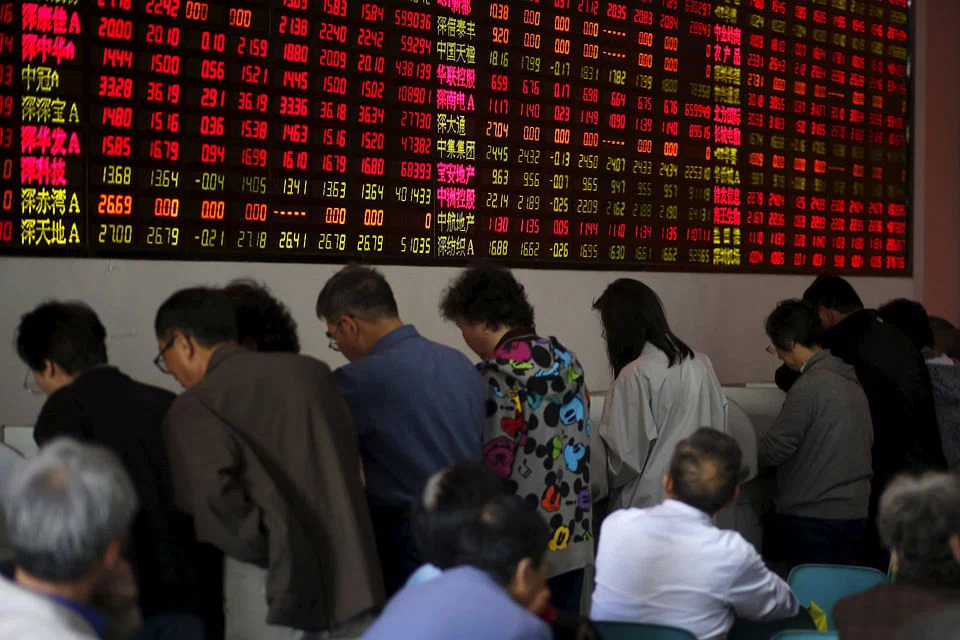
Shanghai
DESPITE reassurances by regulators that margin debt in China's stock markets remains manageable, total leverage could be as much as US$645 billion - magnifying risks not just for retail investors, but also the thinly stretched corporate sector.
The scale of lending in China's stock markets has become a major concern for global investors. For many, it is a greater worry than even the Greek crisis because a Chinese market crash could destabilise the world's second largest economy.
Margin debt, incurred when investors only put down part of the cost of a share purchase, has officially roughly doubled since the beginning of 2015.
That rapid run-up in leveraged trading was brought into sharp focus last week as China's benchmark CSI 300 index tumbled 14 per cent, raising fears of forced selling that could trigger broader financial instability.
But the official numbers only tell part of the story. While margin debt with brokerages stood at 2.2 trillion yuan (S$478.2 billion) in late June, according to Nomura, analysts said that money borrowed to speculate on stocks from largely unsanctioned "shadow lenders" such as trusts could have reached nearly twice that amount, taking total debt to up to 20 per cent of free float.
"No matter how much you want to borrow, we can give it to you," said a so-called grey market lender based in Shenzhen. "If you want to borrow 100 million yuan for example, we need seven days because we need to issue a (wealth management) product for you. If you want to borrow a few million, we can give you the money right away."
China's stock markets enjoyed a credit-fuelled surge in the first half of the year, rising as much as 150 per cent since November, but have fallen back more than 20 per cent from their mid-June peak.
Major indexes rebounded on Tuesday amid signs that Beijing was stepping up support for the market, but some participants worry that the relief may be only short-lived. The Shanghai Composite Index largely gave back these gains on Wednesday, closing down 5.2 per cent.
Xingyu Chen, an analyst at Phillip Securities in Hong Kong, said that the biggest risk came not from debt with regulated brokerages, which typically allow investors trading "on margin" to buy double the value of stock as the cash they put down, but from the poorly understood shadow system, where leverage could be much higher. "Those who have borrowed from outside brokerages, some are leveraged at 1:5, 1:4 - these investors are in a terrible situation," he said.
Unlike in other big economies, retail investors dominate in China, making up 80 per cent of the market, and they have been seen most at risk from "margin calls" -- when a brokerage demands additional money or collateral because the value of an investment has fallen.
But the damage from further equity declines could spread wider, economists said.
Many companies have been channelling money into stocks this year as growth in their traditional businesses dried up, meaning that a sustained equity pullback could reveal a far weaker corporate sector than has been widely appreciated.
"Data from the National Bureau of Statistics show that securities investment income was almost entirely responsible for the return of industrial firms' profits growth to positive territory in April, after six months of declines," wrote Mark Williams of Capital Economics in a research note on June 26. "If financial sector growth were to drop back to the rates seen in the first half of last year, we estimate that a percentage point would be knocked off GDP (gross domestic product) growth."
The problem is that in an environment where returns on business investment are estimated around 3 per cent - far lower than the cost of capital - it makes more sense for firms with access to cheap credit to chase double-digit returns on stocks than to invest in productive assets. But that business model only works for as long as markets keep going up.
"At the moment, we have more than 50 per cent of our assets in the stock market," said a source at one of China's top three trust companies, who asked to remain anonymous because he was not authorised to speak to the press, adding that the financial position of the companies that it lends to was deteriorating. "Before, we had very high leverage - 1:4 or 1:3. Now, just in the last two days, we've had a huge number of companies that are illiquid." REUTERS