

MAS favours going after errant bankers
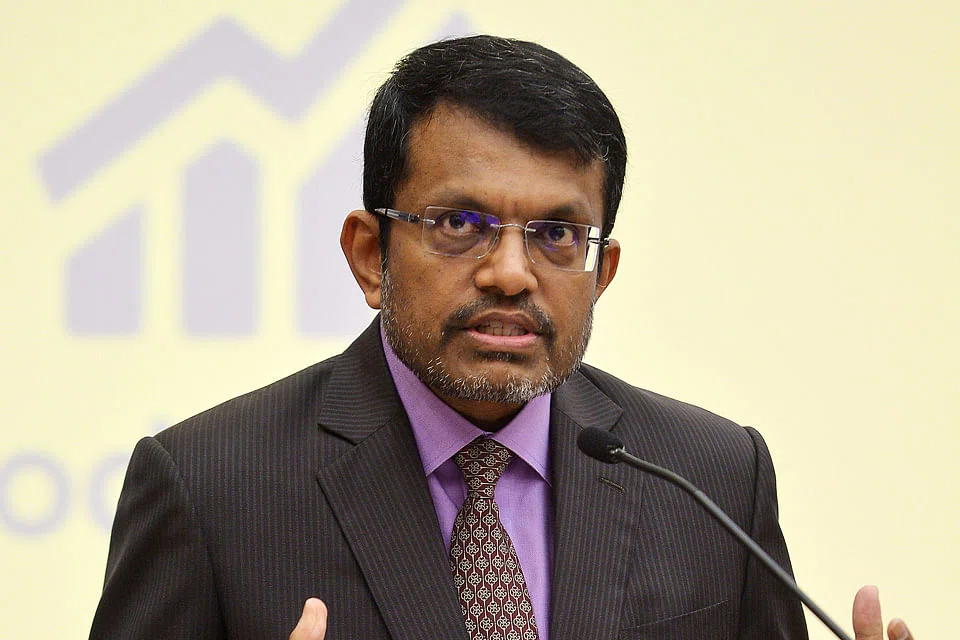
THE hefty fines that hit banks in the United States and Europe for misconduct are punishing shareholders of such institutions rather than addressing the misdeeds of individuals - a serious failing of the current regulatory regime, said Monetary Authority of Singapore (MAS) managing director Ravi Menon.
Regulators have doled out an estimated US$350 billion in penalties on banks, but they have not gone after top banking executives. Recent reports show that out of some 156 criminal and civil actions levelled against large banks by the US Department of Justice (DoJ), less than 20 per cent of these suits involved bank employees. And as estimates put the cost of the crisis at roughly US$15 trillion, Wall Street's top bankers stayed out of jail.
The MAS has fined eight banks nearly S$30 million for 1MDB-related lapses. Asked if the fines levied on banks involved in 1MDB have been heavy enough, Mr Menon pointed out that huge fines do not hit a bank's senior management, board of directors or the errant individuals.
"And that to me is one of the serious failings of the current regime globally. That people continue to do wrong things because they're not being held personally liable and responsible," Mr Menon told reporters on Thursday at a briefing on MAS' annual report.
"What do we want these fines to achieve? Increasingly, the MAS' approach is to place responsibility on the individual responsible for the lapses and their supervisor.
"Punishing the bank serves a purpose and we've done so because it sends a very clear signal to the board and senior management they need to raise the game." In tackling the fallout from the 1MDB scandal, MAS switched from its typically private approach in most supervisory exercises, and publicly named and shamed banks that failed anti-money laundering standards.
MAS has "intensified" its supervision of financial institutions that have higher inherent money laundering risks or control areas found wanting from past inspections, said Mr Menon, without naming the banks.
The largest fine over the 1MDB scandal was the S$13.3 million fine meted out to BSI Bank, which was also ordered to shut its Singapore operations by the MAS. Falcon Bank was also ordered to draw the shutters on its office here due to 1MDB lapses, and fined S$4.3 million.
Standard Chartered Singapore was fined S$5.2 million; Coutts was fined S$2.4 million; UBS was fined S$1.3 million; and DBS was fined S$1 million. Credit Suisse and United Overseas Bank were fined less than S$1 million each.
MAS also issued lifetime bans, for the first time, against two errant individuals, and issued prohibition orders against others.
"The deterrent effect is what we should be judged by," said Mr Menon.
"I believe we have begun the process of restoring that reputation (as a clean and trusted financial centre). We have taken tough and unprecedented enforcement actions and sent an unequivocal message that MAS will not tolerate the criminal abuse of Singapore's financial system."
MAS has also found nothing new in the latest filing by the US DoJ that warrants further action by it. "But if any new relevant information or leads arise from ongoing investigations in Singapore or elsewhere, rest assured MAS will re-open the files and pursue the matter," said Mr Menon.
Separately, MAS said it made a record net profit of S$24.3 billion in fiscal 2017, reflecting positive currency translation effects and higher investment gains. MAS' profit and loss outcomes are subject to sharp swings; it focuses on steady, long-term returns based on conservative investments, Mr Menon said.
READ MORE: Financial sector jobs in focus as middleman role under threat
TRENDING NOW

Knight Frank’s Tan Tee Khoon leaves firm, Nicholas Keong takes over auction business
Keppel Energy, Sembcorp Utilities and Tuas Power to supply biomethane in pilot project

GovTech retrenches another 38 staff in second round of layoffs
Take-up of new private homes dives 45% in Q3 as prices accelerate with 1.4% rise

