

Investment banking still has upside potential despite revenue slide: JPMorgan president Daniel Pinto

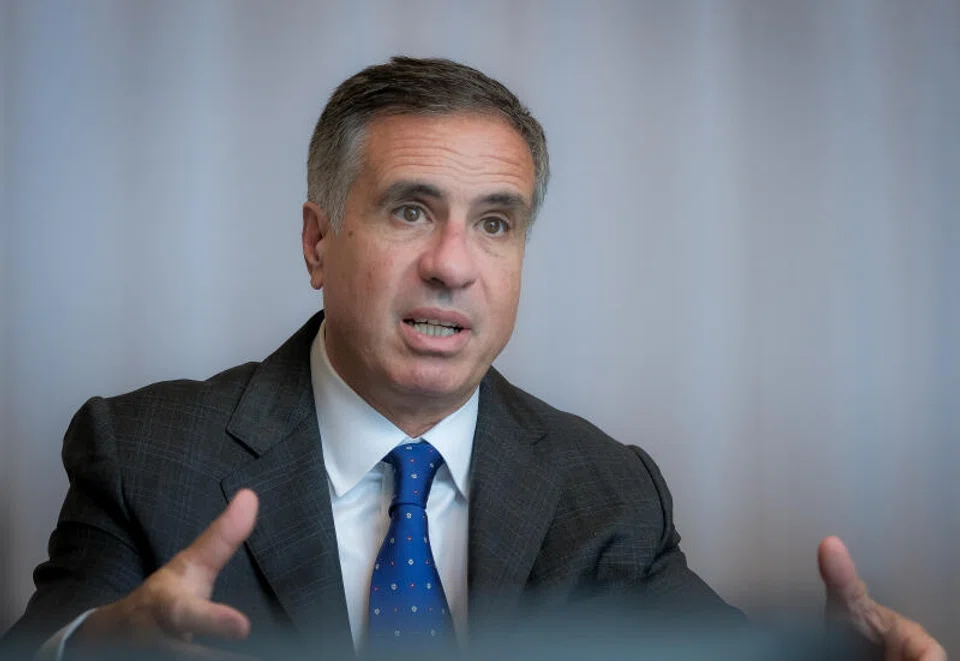
INVESTMENT banking activity has slowed significantly year on year, says JPMorgan Chase’s president and chief operating officer Daniel Pinto, but the base of comparison is a “massively elevated” one.
Pinto, who is also chief executive of JPMorgan’s corporate and investment bank, noted that net revenue for global investment banking came in at a record US$132 billion in 2021.
He estimates this figure will come down 43 per cent, to US$78 billion this year, which would be a “big drop” but is in fact similar to levels seen in the 2010s.
“It’s not misaligned with what we have seen in the past. And I think that there will be upside going forward,” he said.
Pinto, who moved from London to New York City last year, is the second-highest ranking officer at JPMorgan after CEO Jamie Dimon. He is also the bank’s only president.
JPMorgan’s corporate and investment bank ranked first on global investment banking fees last year, with a 9.5 per cent market share, according to Dealogic figures cited in the company’s annual report.
Activity in equity and debt capital markets, as well as mergers and acquisitions, has been weak, Pinto said. But he added that payments and most retail functions, except for mortgages, have done well.
The bank also ranks first on US dollar payments volume and US merchant transaction processing, according to its annual report.
Both corporates and consumers are in a good place, Pinto added.
He pointed to a low unemployment rate in the US, and to the fact that banks are not yet seeing a notable deterioration of credit.
“Considering the challenge we face in the context of the economic measures we were taking during Covid, the geopolitical environment, high energy prices and other headwinds, things are relatively okay,” he said.
Like most other Wall Street banks, JPMorgan recently reported quarterly earnings that were weighed down by the investment banking division but supported by interest income from offering loans.
JPMorgan shares closed at US$130.68 on Friday (Nov 4), down 22.2 per cent from a year ago.
Pinto was measured in his optimism, saying: “I do believe this year and next year will be a challenging environment.”
He nevertheless sees JPMorgan continuing to do well, thanks to its diversified franchise.
The biggest challenge banks face in the medium term is technology transformation, Pinto said. This is a “massively complex” task, involving the integration of legacy technology with the cloud, refactoring digital applications, and training developers with new skills.
“This is just not something that you do in a year or two. It is a multi-year process,” he said.
He does not expect pure digital banks to pose formidable competition to traditional financial institutions, as he believes instant brand recognition, fortified balance sheets, and having well-established companies are factors that will be difficult for pure digital banks to replicate. The presence of physical branches at traditional banks also offers customers the best of both worlds, he added.
JPMorgan has nevertheless hedged its bets with a digital retail bank in the UK under its Chase brand, launched last year, and a 40 per cent stake in Brazilian digital bank C6 bank.
Another tech trend Pinto and his team are watching is the evolution of digital assets such as stablecoins, tokenised deposits, and other forms of digital securities. He noted, in particular, the potential of tokenising investments for smaller customers.
JPMorgan, DBS and SBI Digital Asset Holdings on Nov 3 executed the first-ever live trade between two fiat currencies on a public blockchain, as part of the Monetary Authority of Singapore’s industry pilot that explores potential decentralised finance applications in wholesale funding markets.
Cryptocurrencies, on the other hand, are “relatively irrelevant” for banks, Pinto said, pointing to capital inefficiencies in the crypto market.
“It’s a relatively small (set of) clients. What I see is that the regulation and capital rules that apply to Bitcoin and other forms of cryptocurrency will be very punitive,” he said. “So the possibility of banks getting involved is relatively small.”
TRENDING NOW

Singapore bars Alice Huang, woman tied to affair with Nvidia’s Jensen Huang, for misleading police

Nvidia prepares to oust Jensen Huang after news of second affair, with executive: reports

Higher rates, weaker spending: Is the Philippines entering stagflation?

Special dividend for SIA’s 80th anniversary? CEO says extra payout will need board’s nod

