Yields for 6 and 12-month T-Bills rise as high as 3.77% in October auction

Yong Jun Yuan
Tay Peck Gek
Published Thu, Oct 13, 2022 · 07:57 PM
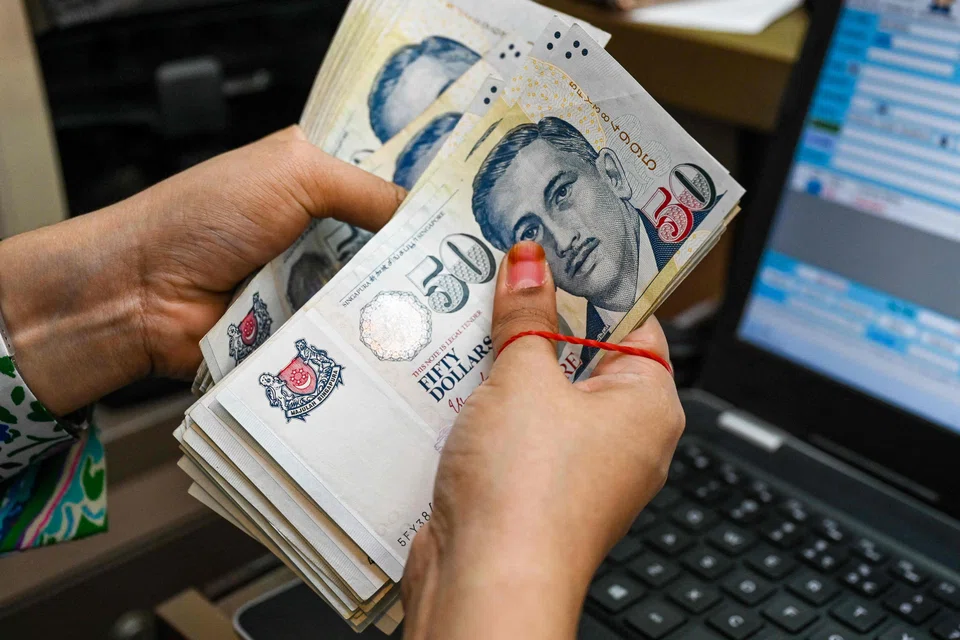
    • Yields on fixed income products have risen in the last few months as a result of rising interest rates.
    • Yields on fixed income products have risen in the last few months as a result of rising interest rates. PHOTO: AFP

    AT the latest Singapore Government Securities Treasury bill (T-bill) auction on Thursday (Oct 13), both the six-month and 12-month T-bills saw increases in yields amid strong demand.

    The six-month T-bill, which will mature on Apr 18, 2023, saw average yield rise to 3.07 per cent per annum, versus 2.85 per cent per annum for the previous six-month T-bill maturing on Apr 4, 2023.

    The cut-off yield rose to 3.77 per cent per annum, compared with 3.32 per cent per annum of the previous six-month T-bill, while the median yield rose to 3.35 per cent per annum, from 3.17 per cent per annum.


    A total of S$4.5 billion in six-month T-bills were allotted, out of a total value of S$10.2 billion in applications. All non-competitive applications were allotted.

    As for the 12-month T-bill, which will mature on Oct 17, 2023, its average yield rose to 3.28 per cent per annum, compared with 2.82 per cent per annum for the previous 12-month T-bill maturing on Jul 25, 2023.

    The cut-off yield and median yield rose to 3.72 per cent per annum and 3.3 per cent per annum, respectively, versus 3.1 per cent per annum and 2.96 per cent per annum for the previous 12-month T-bill.

    A total of S$3.7 billion in 12-month T-bills were allotted, out of a total of S$8.6 billion applied for. All non-competitive applications were allotted.

    The increase in the T-bill yields mirrors rising interest rates on a wide range of fixed income products, forcing banks to actively compete for customers’ cash.

    Still, PhillipCapital head of strategy, investment solutions, Wilfred Lim, said that six-month T-bills would be a better option for investors who are looking for a product that is more sensitive to rate hikes.

    “Compared to fixed deposits, you have to put in (funds for) maybe 12 to 15 months and it’s only giving you maybe a low 3 per cent, so there seems to be some...mispricing in terms of the risk and the different maturities of these products,” he said.

    He also noted that T-bills could be more sensitive to rate hikes than Singapore Savings Bonds (SSBs). The latest November tranche of bonds hit a record high average return of 3.21 per cent over 10 years.

    “When (interest rates) are moving at such a fast pace, the SSBs would take some time to catch up in terms of the yields they offer, and they are also meant to be a longer-term product,” he said.

    Providend senior client adviser Tan Chin Yu noted that another drawback of SSBs is that they have limited allocations. If investors need to deploy large amounts of capital, they may need to consider other instruments, he said.

    Furthermore, he added that for longer-term holdings, equities or high-quality, longer-duration bonds tend to be more appropriate as instruments like T-bills and SSBs do not keep pace with inflation.

    DBS senior rates strategist Eugene Leow noted that the rates of T-bills appear to be quite high and there could be limited upside in future tranches.

    “The market might be speculating that the Fed would cut rates shortly after the hike cycle ends. This is predicated on recession fears and might explain why one-year yields are marginally lower than six-month yields,” he said.

    Notably, investors can also use funds within their CPF ordinary accounts to purchase T-bills. To do so, they will need to open a CPF investment account with either DBS, UOB or OCBC.