New Zealand holds rates at 2.25%, warns of risks to inflation and growth from Iran war
 Add BT as a preferred source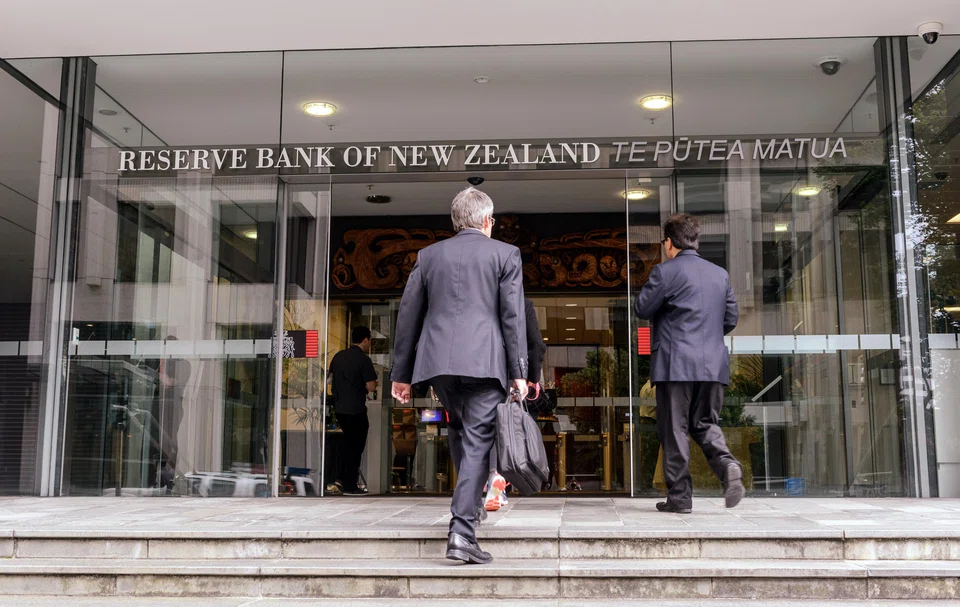
DeeperDive is a beta AI feature. Refer to full articles for the facts.
[WELLINGTON] New Zealand’s central bank kept its policy rate at 2.25 per cent on Wednesday (Apr 8) for a second straight meeting, choosing to sit tight as it gauges the economic fallout from the Middle East war – but signalling it is ready to act if inflation pressures intensify.
In the near term, the conflict will stoke inflation and sap the economic recovery, the Reserve Bank of New Zealand (RBNZ) said, as global policymakers recalibrate their response to the energy shock.
“The committee’s decision to hold the OCR (official cash rate) balances the potential benefits of responding pre-emptively to the risk of higher medium-term inflation against the cost of unnecessarily stifling the economic recovery,” the RBNZ said in its policy statement.
The decision was fully priced in with all 32 economists in the Reuters poll forecasting the central bank would hold the official cash rate.
The pause comes after an aggressive easing campaign, with the RBNZ cutting rates by 325 basis points since August 2024 as inflation cooled and economic growth faltered. That calculus is now shifting.
Inflation is now at 3.1 per cent, outside the central bank’s target range of 1 per cent to 3 per cent and is set to rise further as the Middle East crisis drives up fuel and transport prices.
Navigate Asia in
a new global order
Get the insights delivered to your inbox.
Earlier on Wednesday, the United States, Israel and Iran agreed to a two-week ceasefire, sending oil prices sharply lower, though markets remain nervous over whether the pause in fighting can deliver lasting peace.
Decisive action
The summary of the committee meeting said members discussed how a “pre-emptive response” could head off the risk of inflation expectations becoming unanchored and curb second-round price pressures.
The New Zealand dollar extended its sharp early gains on the hawkish tone and was trading at US$0.5797, while bond yields were down as news of the Gulf ceasefire dominated global markets.



Marcel Thieliant, head of Asia Pacific at Capital Economics, said the central bank sounded “ambivalent about the influence of the energy shock”.
“The upshot is that we expect the Bank to wait until the fourth quarter before tightening policy rather than Q3 as predicted by the OIS (overnight indexed swap) market.”
The central bank does not provide comprehensive economic forecasts in its monetary policy review, but indicated it expected inflation to rise to 4.2 per cent in the June quarter.
In February, the central bank forecast that annual inflation had peaked in December 2025 and would decline towards the 2 per cent midpoint of its target range by mid-2027.
“The extent of the near-term increase in headline inflation will depend on how the conflict in the Middle East evolves and the magnitude and duration of the disruption to global supply chains and energy markets,” the statement said.
It said the Committee remained focused on returning inflation to the 2 per cent midpoint over the medium term, with core inflation and wage growth needing to remain contained and inflation expectations anchored at 2 per cent.
“If these conditions are not met, decisive and timely increases in the OCR would be required,” the statement said.
Fraught backdrop
The backdrop remains fraught. Although New Zealand’s economy has emerged from recession, growth is still anaemic and is being further squeezed by the Middle East turmoil, persistent uncertainty about the war’s broader global impact and a tight fiscal stance.
New Zealand’s cautious monetary policy approach echoes a broader global shift, with central banks forced into an inflation-first posture by the Iran war.
Markets have steadily pared back expectations of rate cuts – and in some cases are even flirting with renewed tightening, particularly in Europe – while the Federal Reserve has stayed on hold, warning that an energy shock could keep price pressures uncomfortably high.
The Reserve Bank of Australia has already hiked rates twice this year to 4.1 per cent and markets imply a better than even chance of a lift to 4.35 per cent in May. REUTERS
Decoding Asia newsletter: your guide to navigating Asia in a new global order. Sign up here to get Decoding Asia newsletter. Delivered to your inbox. Free.
Share with us your feedback on BT's products and services