OCBC eyes rising investment flows from Greater China companies expanding into Asean
Singapore’s position as a financial hub can support companies aiming to break into Asean, says bank’s chief, Helen Wong

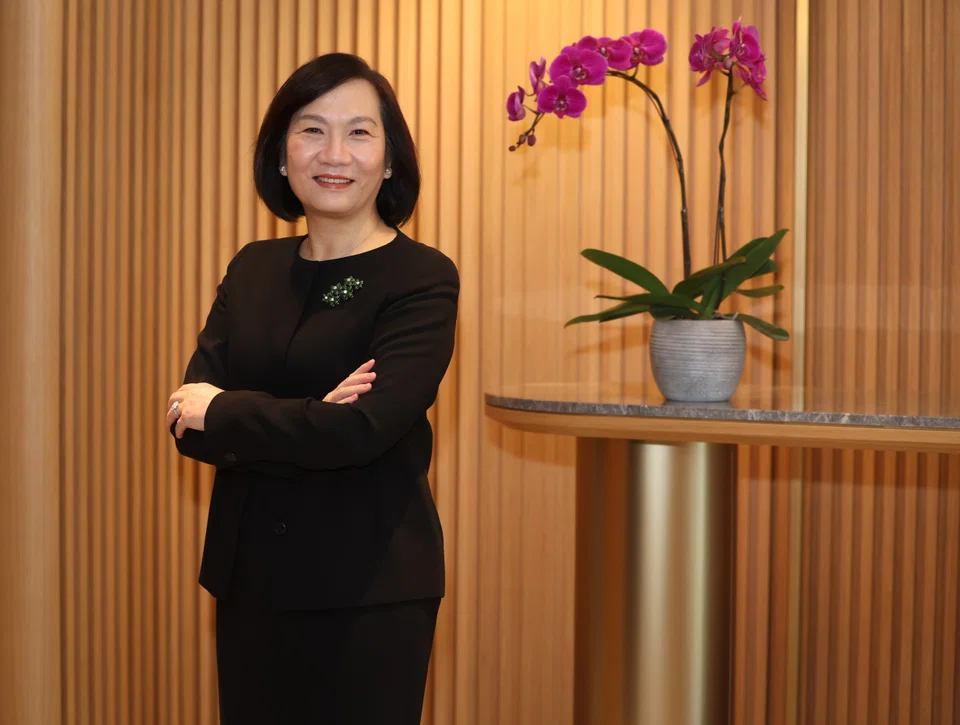
MORE companies in Greater China (China, Hong Kong, Macau and Taiwan) are looking to set up shop in Asean – and OCBC is looking to capture these flows, said OCBC group chief executive Helen Wong.
She noted that 11 per cent of China’s outbound investment flowed into Asean in 2022, and believes that the figure would have been even higher last year.
China’s outward direct investments into Asean rose between 2013 and 2018 at a compound annual growth rate of 13.5 per cent; between 2018 and 2022, it continued to rise at 8 per cent.
“China is taking Asean seriously as a trade partner and continues to look for investment opportunities into this region,” she told The Business Times last week, on the sidelines of OCBC’s media briefing in Hong Kong to unveil its expansion plans in Greater China.
Asean has increasingly become a prime spot for manufacturing, e-commerce and other industries, even as the rise in geopolitical tensions between China and the United States steers Greater China investment flows southward.
Amid this, regional markets such as Indonesia and Malaysia have led the way with rapid growth, driven by a younger population and stable governments with economy-driven policies, said Wong.
Noting also that Singapore and Indonesia were the top two destinations for China money into Asean, she said that as a major financial centre, Singapore provides good banking and financial services in support of companies aiming to set up business in South-east Asia.
OCBC, banking on China’s improving economy and resulting positive spillovers into Asia as key growth drivers, will invest HK$1.5 billion (S$259.1 million) into its technology and facilities in Greater China over the next three years, and hire talents to strengthen its engineering hub.
These improvements will modernise the bank’s technology platforms, channels and products, and so boost its services there. The goal – to add S$3 billion in revenue from its Asean-Greater China strategy by 2025.
Attracting Greater China flows
Wong noted that companies from Greater China want to work with people who understand them as well as the markets in the countries they hope to break into. To meet these needs, the bank has staff that “not only speak Chinese, but understand Chinese company culture and business”, she said.
OCBC also has an established position in South-east Asia, and works closely with the regulators and various business associations in Singapore, Vietnam, Malaysia, Indonesia and Thailand, she noted.
The bank has a regional team of about 50 relationship managers who are “entirely focused” on the cross-border Greater China-Asean link.
Staff from China are actively seconded into the bank’s offices in Singapore, Malaysia, Thailand, Indonesia and Vietnam, so they can come to understand the capabilities of OCBC in Asean, which helps when they meet potential clients upon their return to China.
In a separate interview, OCBC’s Greater China head of technology, media and telecommunications Joseph Liu said the dedicated Greater China team in these markets help to bridge the cultural gap for these Chinese companies, support them when they set up factories and identify potential acquisition targets, as well as offer financing products and hedging tools.
Wong said multinational corporations have previously identified Asean as the next best market for manufacturing, after China. Vietnam, for example, is known as the second-largest hub for lower-cost manufacturing.
Malaysia has been wooing advanced manufacturers. She noted that large Chinese companies are looking to build mega factories in Penang, for example. Malaysian Prime Minister Anwar Ibrahim said in May that the country is targeting at least RM500 billion (S$286.6 million) in investments for its semiconductor industry.
Meanwhile, Indonesia, which has abundant natural resources, has worked on stimulating economic growth over the last five years. “We have seen joint ventures established between Chinese and Indonesians, which tap raw materials, minerals and metals,” said Wong. For example, electric vehicle batteries rely heavily on nickel, and Indonesia has one of the biggest nickel reserves in the world, she added.
E-commerce, too, has become a key industry for Indonesia, said Wong. The country has fast-tracked the scaling up of its digital infrastructure, which has paved the way for e-commerce to flourish.
Beyond e-commerce, Greater China companies in the medtech and biotech fields have also shown an interest in Asean, with several aiming to tap Singapore for its research and development capabilities.
Even for companies not manufacturing in Singapore, the Republic is a key financial hub that can support their expansion, said Wong.
She said: “When you’re working on an international business, how you manage your finances are important. And Singapore is the place to be (to do that).”
All these trends play in OCBC’s favour – it has been among the top two foreign banks in Malaysia by asset size since 2013, and is the majority-owner of OCBC Indonesia in sprawling archipelago.
Competitive edge
OCBC is not simply relying on its own name to attract Chinese clients. The Singapore lender has a 20 per cent stake in Bank of Ningbo (BON), a commercial bank headquartered in Zhejiang that serves several cities in the Yangtze River delta.
Its ties with BON go deep, noted Wong. In 2006, the Singapore bank first acquired a 12.2 per cent interest in BON, then known as Ningbo Commercial Bank; it raised the stake to 20 per cent in 2014.
OCBC is more than just a shareholder in BON, which has come to view the Singapore bank as its link to the outside world. “They trust in our capabilities,” said Wong
She noted that BON is largely focused on its domestic services, and has been designated as a systemically important bank in China. This has entailed it coming under deeper supervision by regulators, who are seeking to enhance banks’ risk-resistance capabilities.
She noted that BON serves as a competitive advantage for OCBC and has been linking up more Chinese companies with the Singapore bank.
“(BON) is banking a lot of the medium-sized, export-oriented and outward-looking companies, which particularly suits us, because their clients already want to come out (of China),” said Wong.
After all, OCBC’s various capabilities are aimed at furthering its proposition of linking Greater China with Asean, she noted. It does not aim to compete with the larger domestic banks, but to maximise its resources in other countries to serve Chinese customers.
“We would never call ourselves the biggest foreign bank in China, but we are in enough cities and have enough people and capabilities,” she said.