

Rush of Chinese money on HK bourse brings tax windfall
Tax collected hit HK$400m a day in April from trading duties as daily turnover on bourse hits record HK$291.5b
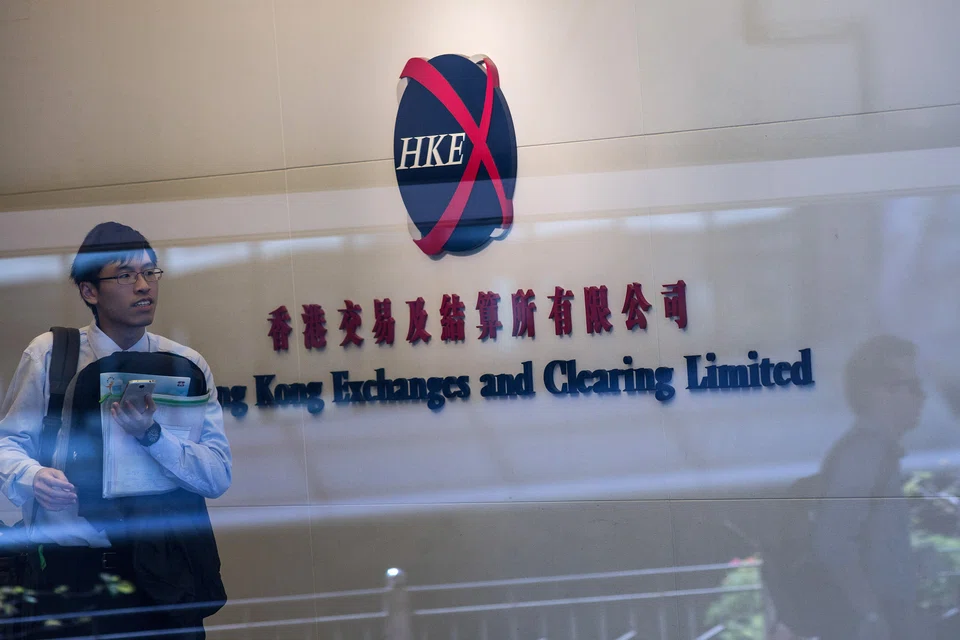
Hong Kong
APRIL was a good month for the Hong Kong taxman as a flood of Chinese money into the city's stocks almost tripled stamp duties on trading.
The taxman collected HK$400 million (S$68.7 million) a day in April from trading duties as daily turnover on Hong Kong Exchanges & Clearing Ltd's equity markets surged to a record HK$291.5 billion, according to calculations by Bloomberg.
That may be just a start as China looks to expand a trading link between Shanghai and Hong Kong this year to include the southern city of Shenzhen. Better-than-expected revenue from stamp duty, including on property sales, has already helped prompt the government to revise its budget and hand out tax rebates for the fiscal year ended in March.
The government tends "to give away cash or other kinds of subsidies in a relatively piecemeal manner", said Ma Ngok, an associate professor of political science at the Chinese University of Hong Kong.
The budget surplus last year was so big that the Inland Revenue Department had said it will be able to return as much as HK$20,000 to every taxpayer.
Hong Kong shares get taxed every time they change hands, so sudden surges in volume lead to spikes in income for the city.
HKEx on Wednesday said that first-quarter profit rose 34 per cent from a year earlier to HK$1.58 billion, as the average daily turnover for equities climbed 17 per cent. Analysts had expected net income of HK$1.74 billion, going by the median of three estimates compiled by Bloomberg.
Hong Kong imposes a 0.1 per cent tax on the purchase or sale of stocks. The levy generated 9 per cent of the city's revenue in the 2013-14 tax year - the most recent for which detailed data are available - about 14 per cent more than in the previous 12 months.
"The stamp duty collected and other government revenues will be pooled together to fund all public services and programmes," Fletch Chan, a spokesman for the government's financial secretary, wrote in an e-mail.
Stamp duty from property transactions and share trading made the biggest contribution to the surplus last year. Greater-than-expected revenue from taxes on corporate profits, incomes and land also helped.
While trading volumes on the Hong Kong bourse had steadily increased in the year through March, they have since exploded. Since the beginning of April, a greater number of mainland investors have used the electronic link to buy Hong Kong equities, following a regulatory change. The territory's Hang Seng Index has extended its rally from the start of the year to 16 per cent.
In addition to stamp duty, investors pay about 0.15 percent - 15 basis points - to brokers, 0.5 basis points to the exchange, excluding settlement costs, and 0.27 basis points to the Securities and Futures Commission, the market regulator, according to Romnesh Lamba, HKEx's co-head of global markets.
Nevertheless, investors are not deterred by the costs of trading in Hong Kong.
"Everyone is looking at costs, but when it comes to China and Hong Kong, investors are more concerned about access and alpha", or profits, said Stephane Loiseau, head of cash equities and global execution in Asia-Pacific at Societe Generale SA. "Costs may become a story in a few years once things start to mature, but at the moment, it's more a story about volume, turnover, valuation and performance."BLOOMBERG
TRENDING NOW

Knight Frank’s Tan Tee Khoon leaves firm, Nicholas Keong takes over auction business
Keppel Energy, Sembcorp Utilities and Tuas Power to supply biomethane in pilot project

GovTech retrenches another 38 staff in second round of layoffs
Take-up of new private homes dives 45% in Q3 as prices accelerate with 1.4% rise

