S Korean markets shrug off tax cuts on bond investments
 Add BT as a preferred source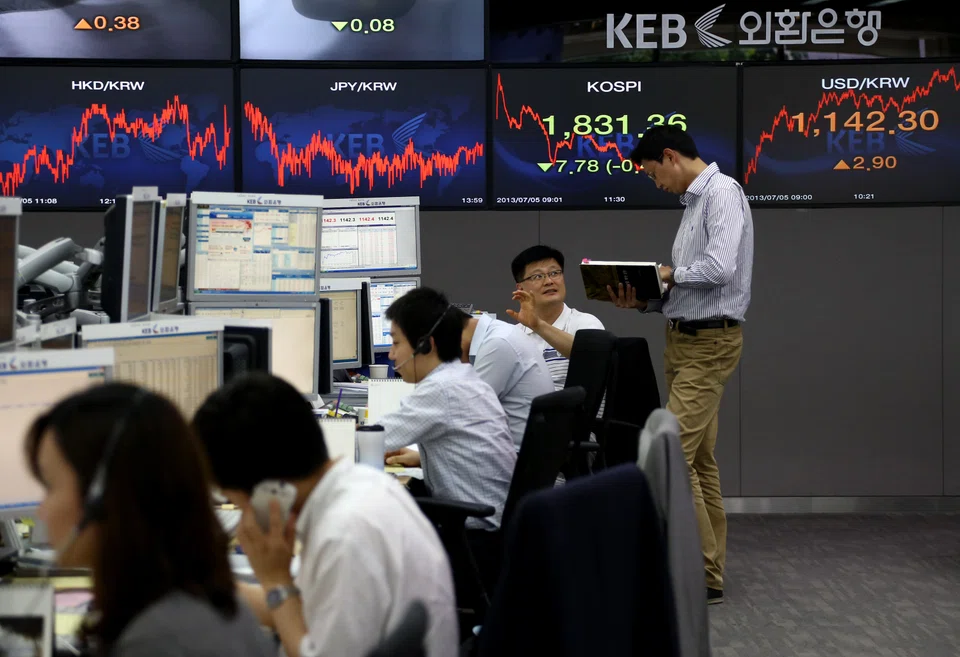
DeeperDive is a beta AI feature. Refer to full articles for the facts.
SOUTH Korea has fast-forwarded a tax cut on foreign investments in its bond market to attract overseas money and defend its weak currency, but initial demand appears hesitant, due to headwinds from rising global yields and volatility.
The sudden announcement from Finance Minister Choo Kyung-ho over the weekend – that foreigners who were paying as much as 15 per cent of tax on interest income from bonds no longer need to do so – was a plan originally meant for 2023.
Analysts say the decision to eliminate taxes on foreign investments with immediate effect reflects a desire to creatively contain the won’s weakness. It is also part of a longer-term goal to meet requirements for inclusion in FTSE Russell’s World Government Bond Index (WGBI), they said.
During the first three days of the week, foreigners purchased nearly 12,000 contracts of three-year bond futures and some 3,500 of 10-year futures.
Yet local investors remained sellers and bonds did not rally. The yield on the most liquid three-year treasury bond has risen further this week to 4.3 per cent, a surge of 250 basis points this year.
“It is difficult to expect a dramatic change right now,” said a dealer at a foreign bank’s Seoul branch. “Most investors are managing global portfolios in a conservative manner these days.”
Navigate Asia in
a new global order
Get the insights delivered to your inbox.
South Korea and other emerging markets are feeling the heat from aggressive Federal Reserve policy tightening and a surging US dollar, and capital flight out of their bond markets. Korean treasury bond yields hit their highest in more than 11 years in September, while the won hit 13-year lows.
Foreign money left the won bond market for a second consecutive month in September, central bank data showed, although the net outflow of US$0.64 billion was smaller than US$1.31 billion in the previous month. Foreigners have made a cumulative US$13.54 billion investment year-to-date.
In the long run, moving toward inclusion in FTSE Russell’s WGBI would bring index-tracking fund flows into the country. The finance ministry estimates that the inclusion could help attract as much as 90 trillion won (S$89.6 billion) of capital inflows. “Any measure that facilitates investment is always welcome, but that will not determine the appetite for market from investors. There are other elements such as valuations and fundamentals that will determine that,” said Fabiana Fedeli, chief investment officer for equities, multi-asset and sustainability at M&G Investments.
“We find more attractive opportunities elsewhere, because of the real yield that we can find in other markets.”
FTSE Russell added South Korea to its list for a possible inclusion in the WGBI last month, acknowledging the government’s efforts, primarily the tax-cut plan, to improve market accessibility for overseas investors.
“The move seems more of government’s efforts and hopes to bring forward inclusion in the WGBI, which usually takes a year after being put on a watch-list, to the next index review in March next year,” said Ahn Jae-kyun, a fixed-income analyst at Shinhan Securities.
“It is a stepping stone and likely a decision made with a long-term perspective,” he said. REUTERS
Decoding Asia newsletter: your guide to navigating Asia in a new global order. Sign up here to get Decoding Asia newsletter. Delivered to your inbox. Free.
Share with us your feedback on BT's products and services