

MAS reviving its electronic know-your-customer project
Singapore's "KYC 2.0" may dovetail into work to be done at new BIS innovation hub here
Singapore
THE Monetary Authority of Singapore (MAS) will have a second go at its failed electronic know-your-customer (e-KYC) project, said MAS managing director Ravi Menon on Wednesday.
The centralised KYC utility idea was first proposed in 2017, and was meant to allow financial institutions to identify and verify potential customers' details in a seamless way.
The e-KYC utility would have created a more efficient way of checking against sanctions and blacklists.
It could have fundamentally changed the way banks labour through documents to block illicit funds from money laundering or terrorism financing activities being channelled through the banking system here.
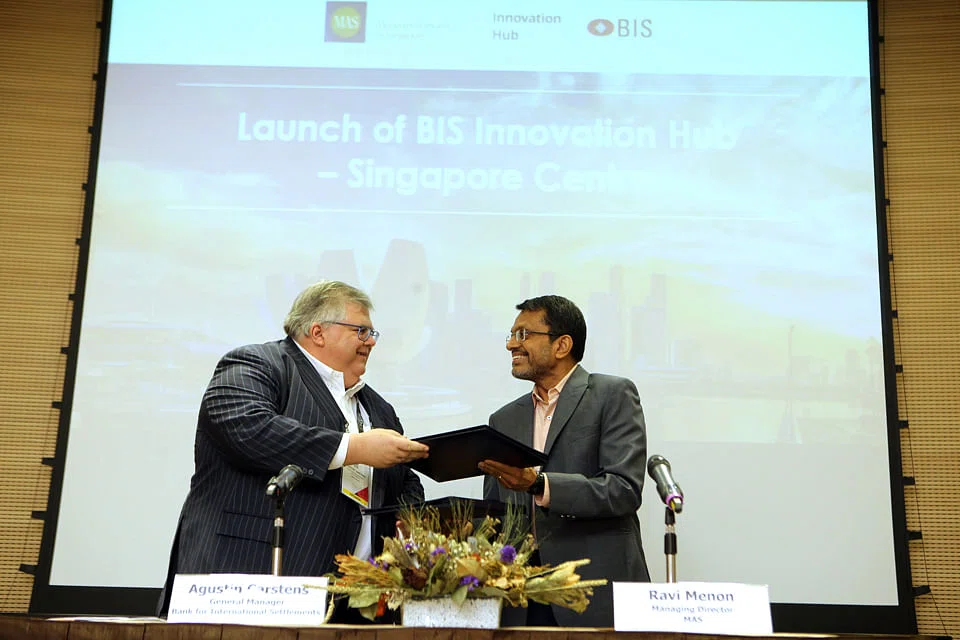
But in 2018, MAS announced it as a failure then. While the technology worked, it was far too expensive to implement, said Mr Menon. "We are taking another crack at it," he said at a press conference to launch the Bank for International Settlements' (BIS) innovation hub in Singapore. This time, MAS will look at a "less costly" technology architecture.
Singapore's plan to resurrect its failed e-KYC project coincides with the setting up in Singapore of one of BIS' first innovation hubs outside of Switzerland. One of the hub's focus will be on public digital infrastructures.
The hub, launched at the sidelines of the Singapore FinTech Festival and Singapore Week of Innovation and TeCHnology (SFF x SWITCH) conference, will work on setting up a framework that is built on digital identity, consent and data sharing.
Its second project is to create a digital platform for supervisory tech, or suptech, solutions. With this platform, central banks can try to solve regulatory problems by sourcing solutions from the fintech community.
The BIS hub's set-up comes amid Singapore's efforts to build new highways for the digital economy against a backdrop of geopolitical risks, anti-globalisation and political polarisation, said Mr Menon.
"The financial system must be similarly modern and technologically savvy, and be able to support the digital economy. There's a lot of work that needs to be done on this front."
Thus, Mr Menon said there is a chance to see how the work on Singapore's "KYC 2.0" can dovetail into work to be done by BIS at its innovation hub here.
The e-KYC project requires a global effort, Mr Menon added, pointing out that at this time, regulators do not allow a straight transfer of accounts across borders - say between a bank in the UK, and a bank in Singapore - even though a customer has passed his or her KYC requirements in the original jurisdiction.
"This (e-KYC) is a concrete example where you need as much of a global approach as possible," he said.
DBS group head of legal, compliance and secretariat Lam Chee Kin told BT that KYC remains one of the big problems that banks have to plug away at. "We want to give our customers a great experience, and yet we must deny access to that fraction of criminals and terrorists intent on abusing the system."
Speaking at the press conference, general manager of BIS Agustín Carstens said that BIS' move of setting up innovation hubs is a "very clear expression" of the concerns that many aspects of central banking are being affected by innovation.
BIS will set up just three hubs for a start - in Singapore, Hong Kong, and Switzerland - but wants to expand this to other markets such as the Americas.
Earlier in the day, Mr Carstens said at the SFF x SWITCH conference that seamless cross-border payments may in good time take off in this region due to the availability of technology solutions.
"I venture to say that very soon, we will have a cross-border experience in Asia that will do what Libra is promising to do, without the need for Libra," said Mr Carstens, pointing to Facebook's brand of stablecoins.
The MAS told BT in October that over the next four years or so, Singapore will work with other Asean countries to link up their real-time payment systems to enable small retail payments using just mobile numbers. The link-up between Singapore and Thailand is expected to be completed by the middle of next year.
Mr Menon said: "The central question that Libra and stablecoins are posing to us is this: central banks and banks need to do a better job at creating the kind of digital infrastructure that will make cross-border payments costless, painless, efficient, and secure," he said.
"The most important thing is that the customer experience must be as good as using WhatsApp. We want to solve this problem within the tried-and-tested banking and central banking channels."
For all of BT's coverage on this year's SFF x SWITCH, go to bt.sg/sffxswitch2019
READ MORE:
TRENDING NOW

Once staunchly pro-China, Malaysian Chinese businesses are now distancing themselves from Beijing

Looking beyond looming CEO succession, should UOB potentially pursue a transformative merger?

Could stablecoins be the future of money?

Grab CEO’s wife Chloe Tong on life with Anthony Tan and finding her purpose

