

Singapore banks had a Goldilocks year in 2023, but 2024 not likely to be as benign amid tepid loan growth

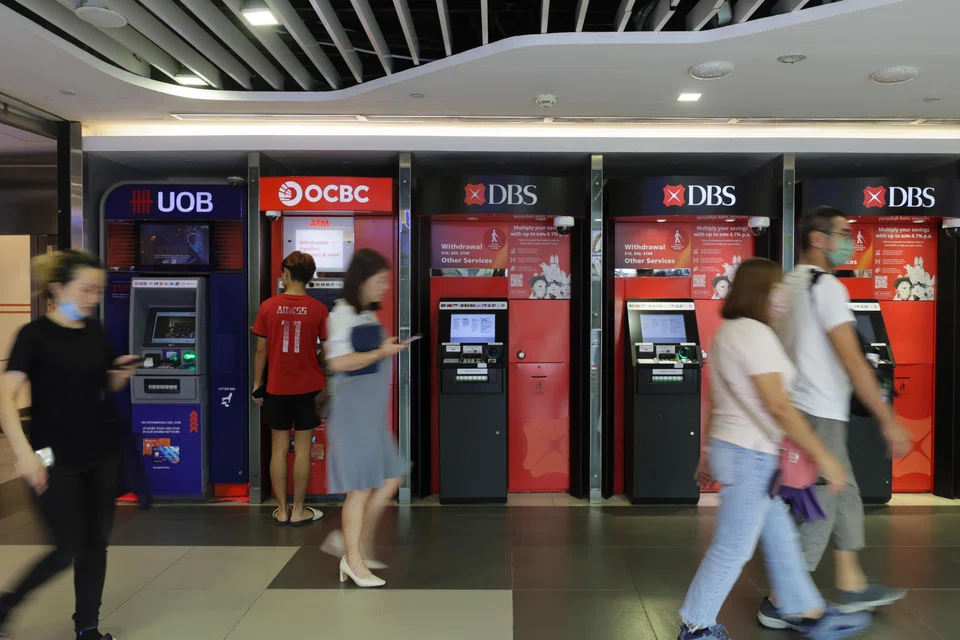
SINGAPORE banks are unlikely to replicate the tremendous year they had in 2023, which saw them report record earnings thanks to Goldilocks conditions. Higher interest rates boosted their interest incomes immediately even as their cost of funds took a while to catch up.
Analysts said the local banking trio is likely to experience limited earnings growth and greater cost pressures. Loan growth will remain tepid as consumers and businesses decline to borrow or refinance at the current high rates.
The three local banks posted record net profits in FY2022: DBS reported S$8.2 billion in net profit, OCBC ’s was S$5.8 billion, and UOB ’s was S$4.8 billion.
As at the nine-month mark, they were on track to beat those numbers.
DBS’ nine-month net profit rose 35 per cent to S$7.9 billion, OCBC’s was up 32 per cent to S$5.4 billion, and UOB’s was up 26 per cent to S$4.3 billion.
As net interest margins (NIMs) peak and loan growth remains soft, however, any earnings upgrades have likely been done for this rate cycle, said the Citi research team in a note.
A stable net interest income into 2024 is likely the best outcome for the Singapore banks, the team said.
NIMs continue to face challenges on both ends – loan repricing and funding costs – said DBS Group Research analyst Lim Rui Wen.
NIMs have peaked given limited upside in the US federal funds rate. The hurdle for another interest rate hike in the US is high, Lim said, requiring incoming growth, jobs or inflation data to surpass expectations.
This results in limited room for loan repricing going forward as the banks are also facing intense competition in mortgage rates, she said.
Banks will also likely want to defend their present current and savings account ratio levels, given that these have fallen to below pre-pandemic levels, she added.
CGS-CIMB expects net interest income growth could be capped by higher funding costs amid stiff deposit-taking competition.
Furthermore, an overall sense of conservatism among the banks can lead to a preference for high-quality – but lower-yielding – corporate credit exposures, it said in a report.
Companies may also be unwilling to borrow given the cloudy macroeconomic climate.
Banks have assumed that loan growth would pick up if the US Federal Reserve cuts rates in the second half of 2024. If the Fed cuts rates due to a slowing economy and heightened macroeconomic risks, however, the outlook for loan growth may be less optimistic, DBS’ Lim said.
Mixed views on non-interest income
The Citi research team expects that fee income at all three local banks may also be at risk if sentiments do not recover.
Investors are bracing for an uncertain 2024, the Citi analysts said, as markets guess how long the economy will hold amid high inflation and the unwinding tight labour market.
The CGS-CIMB team also expects the uncertain US Fed fund rates trajectory to delay the deployment of wealth management inflows and any subsequent pickup in fees.
The Singapore banks were key beneficiaries of the flight to safety amid a global banking sector fallout in the first quarter of 2023, which led to sizeable asset-under-management inflows, the team noted.
DBS’ Lim is projecting mid-to-high single-digit growth in overall non-interest income fees in FY2024, supported by continued momentum in wealth and card fees.
Asset quality still positive
The local banks have turned more cautious in their asset quality outlooks, analysts noted. Their conservative postures should, at least, form a floor for shareholders if macroeconomic conditions worsen.
CGS-CIMB noted that provisioning trends over the past several quarters do not suggest broad-based repayment issues on the back of the elevated interest rates.
DBS’ Lim said that management overlay implemented across the banks over time also serves as an ample buffer to face any potential credit events, which should provide strong support to underlying earnings.
Credit costs could rise in 2024, though, analysts said.
Singapore banks are expected to underperform within Asia, especially when compared against the more domestic-oriented players, said Nomura’s Asia-Pacific equity strategist Chetan Seth.
Banks in Asia are still posting high earnings growth, while the Singapore banks may see negative earnings growth due to a very high base, Seth said.
Within the region, Singapore banks also had the highest sensitivity to rate hikes, he said.
“If we are expecting yields to actually soften because of the slowing economy and potentially a recession, you probably will see the reverse of that.”
The CGS-CIMB team nevertheless expects the Singapore banks to remain attractive as a yield play in the Republic.
Despite limited earnings growth, the banks’ strong return on equity and capitalisation levels provide clarity to sustained dividend payouts, it said.
Nomura’s Seth also noted that the banks might still attract interest as they are among the highest-quality banks in Asia.
“The best of the days are probably behind the Singapore banks. You may want to buy these banks some time in 2024, but probably not now,” he said.
On Tuesday (Jan 2), DBS ended S$0.13 or 0.4 per cent lower at S$33.28, OCBC lost S$0.08 or 0.6 per cent to finish at S$12.92, while UOB rose S$0.05 or 0.2 per cent to S$28.50.
TRENDING NOW

Despite the de-dollarisation debate, demand for dollar liquidity in Asia is growing
URA to review guidelines on floor space to give developers more design flexibility: Chee Hong Tat

He built the Vingroup empire. Now South-east Asia’s richest man is handing some key roles to his sons
Can a first-time homebuyer couple earning S$18,000 a month afford a new EC unit?

