Technology a double-edged sword for financial inclusion
Risks of cyber-fraud, Big-Data discrimination need to be solved with public-private collaboration
Singapore
TECHNOLOGY can both exacerbate and reduce various forms of inequality, which raises an urgent question of how fintech can be effectively wielded as a tool for financial inclusion.
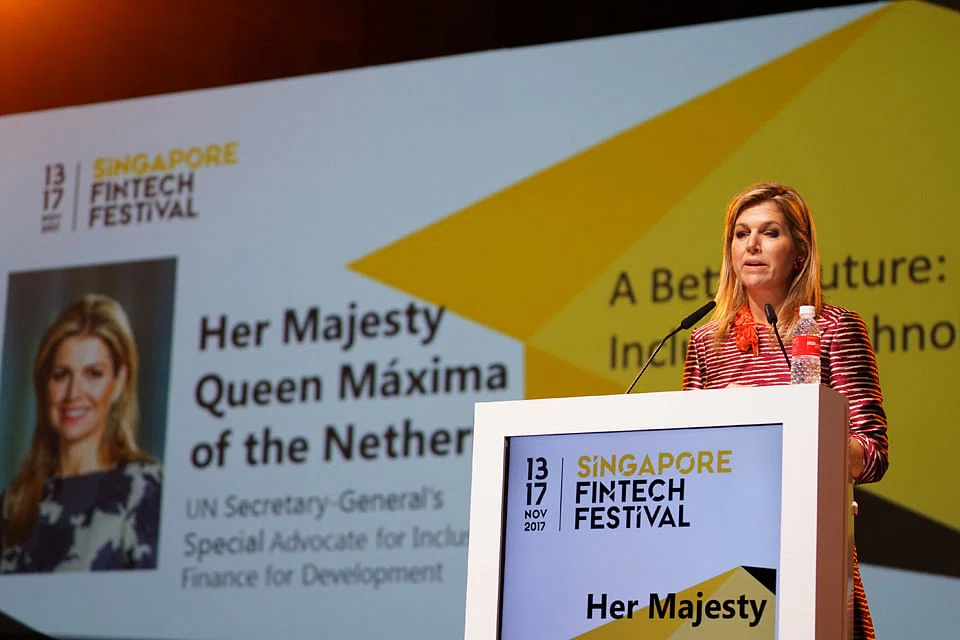
This was highlighted by Queen Maxima of the Netherlands, the UN Secretary-General's special advocate for inclusive finance for development, at the Singapore Fintech Festival on Thursday.
"Let's not forget that technology can be a double-edged sword," she said, noting the risks associated with fintech that should be addressed through close collaboration between regulators and the private sector.
Such risks include cyber-fraud, pyramid scams, and discriminatory activities due to the use of Big Data. While the nature of such risks are diverse, they tend to centre around problems such as the lack of transparency and data privacy, she said.
Queen Maxima was clear that fintech can effectively lift people out of poverty, with 10 per cent of the Kenya population successfully pulling themselves out of it through the use of digital financial services.
But she also warned that the dangers of leaving people behind by technology are just as real, noting that if the technology gap widens between the rich and the poor, between different genders, as well as between the urban and the rural communities, that would translate to a wider gap in opportunity and overall inequality.
There are signs that the gender gap is widening in the area of technology, added Queen Maxima. Indeed, there are statistics showing a reduction of women going into the field of info-communication technology.
Janet Young, head of group channels and digitalisation at UOB, noted in a separate panel session that most coders at the bank are still male.
Broadly, the problems of inequality are worth solving, according to statistics on hand. McKinsey estimated that financial inclusion can add about US$3.7 trillion annually to the GDP of emerging markets by 2025.
Michael Wiegand, director financial services for the poor, Bill & Melinda Gates Foundation, said it can attract 1.6 billion new people into the formal economy.
He noted that digital technology can go further in driving transaction costs down for those in emerging markets that require financial services.
He gave the example of a dairy farmer in Kenya, who switches among three SIM cards to manage different mobile payment networks. Each fund transfer from one network to another bears a transaction cost. The farmer also cannot see his account balances on a consolidated basis.
Mr Wiegand said to truly advance financial inclusion through technology, there has to be a shift to real-time push payments. There should also be a wider range of financing participants that embrace true interoperability, such that customers can easily shift funds from one bank to another without incurring costs.
Deputy Prime Minister Tharman Shanmugaratnam told reporters that Singapore will focus on boosting financial inclusion in Asean, as the city-state takes the chairmanship position for the regional bloc in 2018.
The Monetary Authority of Singapore has tied up with International Finance Corporation to set up the Asean financial innovation network. The digital platform will allow fintechs to more easily sell their services to banks in the region.