Singapore government bonds to retain some popularity despite falling yields

Tan Nai Lun
SINGAPORE government bonds will likely retain some of their popularity in 2024, even as their yields fall to account for changing interest-rate expectations.
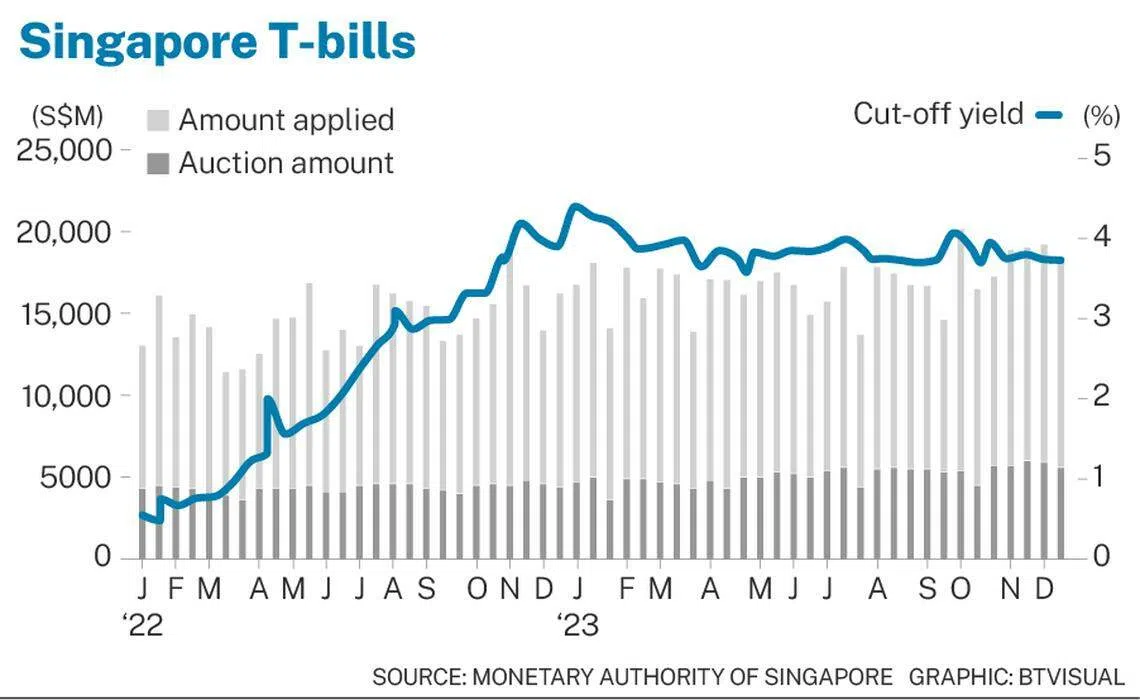
The latest Singapore Treasury bill (T-bill) auction closed with a cut-off yield of 3.73 per cent – slightly lower than the previous auction’s yield of 3.74 per cent.
Demand, too, was still high, at 2.29 times the amount on offer. The previous auction had a bid-to-cover ratio of 2.25.
Singapore government bond yields have been falling as the United States Federal Reserve is no longer raising interest rates.
The market is expecting the Fed to cut interest rates in 2024, which should cause yields to decline and push demand towards other higher-yielding asset classes.
Analysts said government-related securities still have something to offer, though, especially due to their risk-free nature.
In October 2023, banks in Singapore put close to S$400 billion in assets into debt securities issued by government-related entities, according to monthly banking statistics released by the Monetary Authority of Singapore (MAS).
The figure includes debt issued by the Singapore government, public-sector entities and other governments, and is the highest allocation since July 2021. Comparable statistics are not available for earlier periods, following changes in MAS classifications.
Of the debt securities, S$250.3 billion were put in debt issued by the Singapore government – also the highest since July 2021.
Thilan Wickramasinghe, head of Singapore research at Maybank Securities, said this indicates excess liquidity on bank balance sheets, with deposits rising amid high interest rates and safe-haven flows, and loans falling due to high financing costs and slow global growth.
Banks likely kept higher levels of liquidity in these safe government assets – where yields have also gone up – following the US banking crisis in 2023, he said.
Interest in Singapore government bonds has also risen among retail investors.
Applications for each T-bill tranche has largely been above S$10 billion regardless of the amount on offer.
Demand for Singapore Savings Bonds has also exceeded the maximum amount offered since the November tranche, despite a dip in demand in earlier months.
Over the past 18 months, governments worldwide have raised interest rates to fight inflation, causing bonds and treasuries yields to go up.
With T-bills at yields that have not been seen in the last decade or so, many private entities find government debt securities to be good options for their treasury management, said Christopher Tan, founder and chief executive of financial adviser Providend.
Andrew Wong, credit research analyst at OCBC, also noted that government securities became more attractive as they paid a decent return for very low risk in 2023.
Higher interest rates also created a tighter funding environment for non-government debt, he said.
“This impacted risk sentiment for investors and created a gap between what risk premium investors are willing to accept and what risk premium issuers are willing to pay.”
With the Fed indicating the possibility of rate cuts in 2024, Wong expects the popularity of Singapore debt securities may decline.
An improvement in risk sentiment, alongside lower yields and inflation, could drive interest back to non-government related issuers, he added.
The supply of debt issued by government-related entities may still drive demand, though. Wong said he “would not be surprised” to see more government-related issues in the sustainability space, to drive net-zero targets and policies.
Maybank’s Wickramasinghe expects improving regional economies and Singapore growth to result in better demand for loans, which could divert more liquidity to lending activities.
If interest-rate cuts take place, the diversions could accelerate, he said.
Providend’s Tan said debt securities may become less interesting and popular in 2024 if yields were to fall, but he also expects T-bills to still see some demand as long as the yields remain significantly higher than bank deposits.
Meanwhile, DBS senior rates strategist Eugene Leow said government bonds serve as a good recession hedge in case things go awry.
Leow expects yields will stay relatively high for some time, making for a viable investment choice while investors grow more confident now that the Fed has pivoted to become more dovish.