Stable Q2 results for Singapore banks unlikely to beat Q1’s outperformance, but dividend yields remain attractive: analysts
DBS, OCBC and UOB are due to report first-half earnings in early August


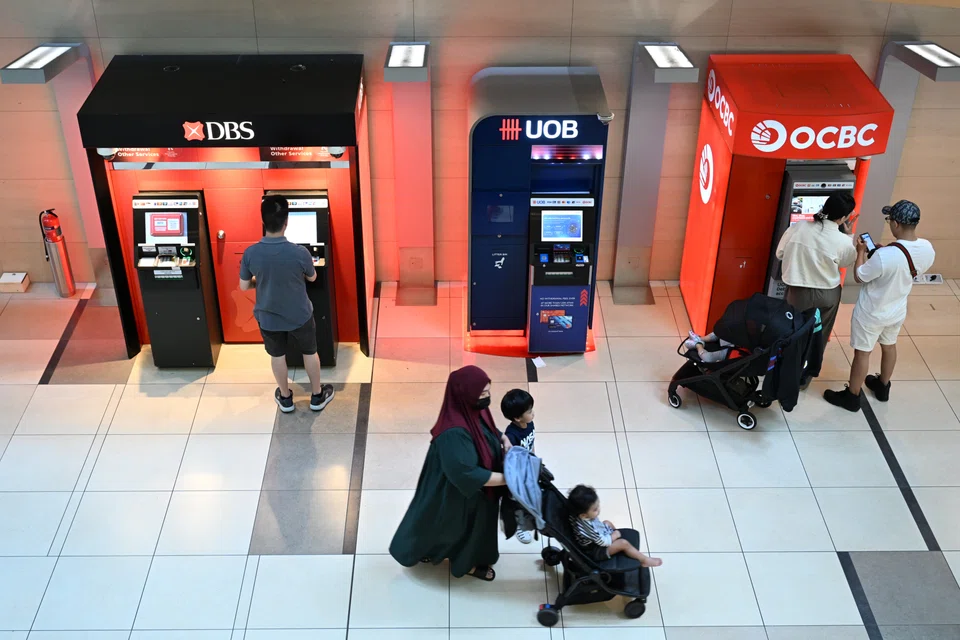
DBS , OCBC and UOB are likely to post resilient, if unspectacular, earnings ahead of impending rate cuts – but it will be difficult to beat the first quarter’s robust results, said analysts.
That said, the trio of local banks are still sporting generally attractive dividend yields, they added.
The three banks are slated to report their Q2 results in early August – UOB is up first on Aug 1, followed by OCBC on Aug 2, and DBS on Aug 7.
Singapore banking counters have enjoyed strong share performances on expectations that the US Federal Reserve will hold rate cuts to later in the year – a positive move for net interest incomes and bottom lines, said RHB analysts in a June note.
In early July, the banks’ share prices surged to record highs ahead of the end-July Federal Open Market Committee’s meeting.
What analysts say about upcoming local banks’ Q2 results:
- Dividend yields to remain attractive;
- Quarter-on-quarter earnings likely to be softer on strong base and seasonality factors;
- Treasury income may benefit amid unclear rate-cut outlook ahead of US election;
- Focus shifts to non-interest income drivers.
These climbs have, however, resulted in the banks’ main near-term thesis – dividend yields – being “compressed”, the analysts added.
“(The yield) is now close to that being offered by the market, making it a challenge for the sector to meaningfully outperform the market in the second half of 2024, especially nearing the rate cut cycle,” said the note.
RHB’s top pick is DBS, as South-east Asia’s biggest bank has committed to an absolute dividend per share, with a potential upside from capital management.
US election implications
US President Joe Biden’s pulling out of re-election on Jul 21 increased the chance of a closer presidential race while lowering the risks of a scenario where Donald Trump governs unopposed, said Mansoor Mohi-uddin, chief economist of Bank of Singapore. He noted that inflation, Treasury yields and the US dollar are expected to rise under Trump’s proposed policy-setting.
Under a Trump scenario, in addition to higher bond yields being positive for banks, UOB Kay Hian (UOBKH) analyst Jonathan Koh expects the US to pivot further away from China. This means that OCBC and UOB can also benefit from an accelerated supply chain reorientation to Asean countries due to their extensive networks within those countries.
CGS International analysts Lock Mun Yee and Lim Siew Khee believe that while Singapore banks can benefit from the potential Trump win in terms of net interest margin sustaining at a higher new normal, the pickup in wealth management and loan growth could slow amid higher-for-longer rates.
“As long as the interest rate outlook remains unclear, we think treasury income may still benefit from the volatility,” said Lock and Lim in a report last Tuesday (Jul 23).
However, UOBKH’s Koh noted that it might be too early to draw a conclusion as Trump’s policy proposals might not be implemented in the end, as politicians might need to compromise to serve the needs of their broader political base. He highlighted that lower interest rates could also be on the agenda as Trump favours a low-rate environment. However, rate cuts may be less pronounced due to sticky inflation.
Koh anticipates one rate cut for the fourth quarter of 2024, and said banks provide attractive value with a low price-to-book ratio of 1.28 times and high dividend yield of 6 per cent in 2025.
He maintains an “overweight” rating on the banking sector. OCBC is his top pick due to the lender’s commitment to a dividend payout ratio of 50 per cent, focus on trade and investment flows within Asean, as well as a “defensively low” estimated FY2025 price-to-book ratio of 1.14 times.
Lower quarterly earnings
CGS International analysts Lim and Andrea Choong noted that the banks are likely to have softer Q2 earnings, compared to Q1, which had been boosted by wealth management and treasury income.
All three bank chief executives had lifted their outlooks for the rest of 2024, after their Q1 earnings beat analyst expectations.
Choong and Lim said net interest margin (NIM) performances in Q2 could be mixed – between subtracting two basis points (bps) to adding two bps – due to the banks’ differing asset repricing and funding cost reduction strategies.
“With the business environment staying conducive, fees should still broadly sustain in Q2 FY2024. Wealth management fees should still hold at relatively high run-rates, in our view, as investors stay risk-on amid the market volatility and interest rate uncertainty,” they said.
Of the three lenders, Choong and Lim prefer UOB, taking into account NIM positivity and more attractive valuations, as well as a “structurally steady growth model”.
Jefferies analysts Sam Wong, Shujin Chen and Calvin Leung also believe that UOB is likely to deliver a “better-than-peer” NIM trend with effective deposit cost management – a sequential improvement of one to two bps versus the first quarter, which was already one to two bps above the quarterly average of 2.02 per cent.
Despite this, they see scarce incremental positive catalysts for the banking sector. In a Jul 17 note, they downgraded UOB and OCBC to “hold”, while keeping a buy call on DBS, noting that DBS’ price-to-book premium is justified by its return on equity.
The Jefferies report added that DBS’ strong momentum in Q1 for fee income has likely continued into Q2. “We could see some moderation quarter on quarter due to seasonality, but overall we still see it as well on track to achieve the high end of mid-to-high-teen guidance,” said the analysts.
Non-interest income key
With the tailwinds from high interest rates ending, earnings growth will largely depend on “franchise improvement”, such as non-interest income execution and the integration of new investments, said the Jefferies analysts.
In particular, “DBS’ mid to high-teen non-interest income growth target underlines the bank’s leading wealth and transaction banking franchise”, they said.
Maybank analyst Thilan Wickramasinghe said non-interest income should be boosted from higher wealth management fees, with credit cards likely to be a “bright spot” amid increased travel and consumer spending.
“We expect the significant safe haven assets under management inflows enjoyed by the domestic banks to be slowly put to higher risk and higher fee products in the second half of FY2024 amid improving market sentiment,” he said in a note.
CGS’ Choong and Lim anticipate that management is likely to elaborate on the sustainability of non-interest income, which could ease off the seasonal high, and outlook on capital and dividends.
As for the new investment integration, Jefferies highlighted that DBS’ integration of Citi Taiwan has resulted in the lender facing “relatively high” first-half cost-growth, but profitability should improve in subsequent years.
Meanwhile, UOB’s integration of Citi’s consumer businesses in four Asean markets will have some cost roll-off, which, along with enhanced credit card franchise, should help offset the rate cuts, said the analysts.
“With rate cuts likely coming, the franchise improvement story already well known, and asymmetric asset quality risk, Singapore banks will likely be in a position to defend earnings rather than drive as strong growth as before,” said Wong, Chen and Leung.