

StanChart sees growth opportunities as firms reduce ‘single points of vulnerability’
The shift is driving demand for cross-border banking in Asia, Africa and the Middle East, says a bank official

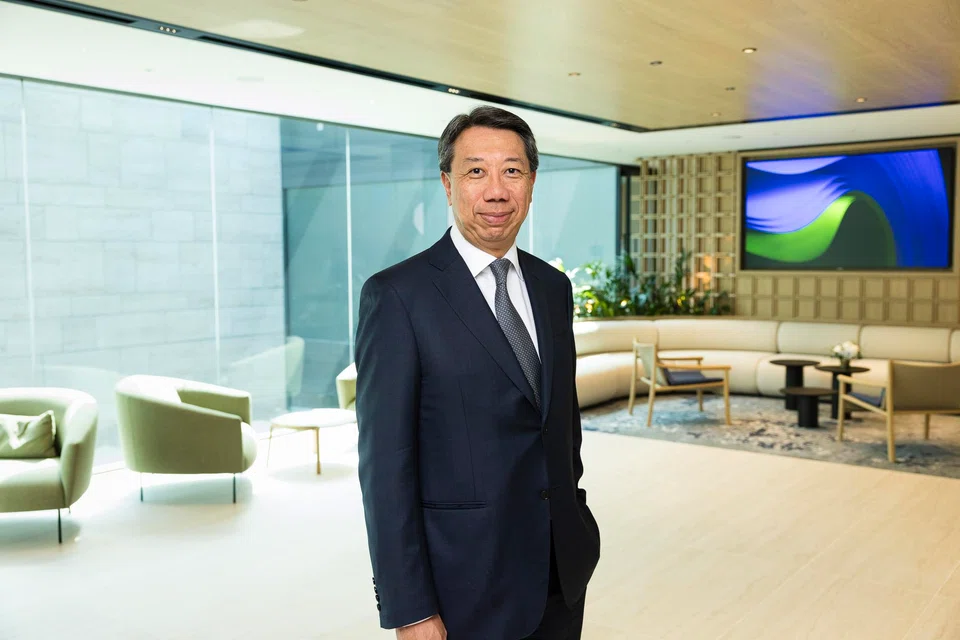
[SINGAPORE] As geopolitical tensions prompt companies to rethink supply chains, financing arrangements and trade routes, Standard Chartered believes the push to reduce “single points of vulnerability” is creating new growth opportunities for the bank.
Governments are increasingly seeking leverage through critical minerals, energy supplies, financial systems and trade routes, the bank’s president for international, Benjamin Hung, told The Business Times, pointing to the Strait of Hormuz as one of the clearest examples today.
“We are seeing this – every single corporate and investor around the world (is) trying to say: How do I make sure I make sense of the world, and ensure that my business is resilient and not subject to potential choke points or chokeholds?” he said in an interview.
For StanChart, which derives the bulk of its income from Asia, Africa and the Middle East, it is also becoming a key growth opportunity as companies seek to navigate rising cross-border complexity.
Hung believes that the bank can capitalise on this given its unique network. “Nobody is as well-positioned as we are in the Global South,” he said.
This strategy underpins the bank’s latest growth ambitions.
At its Investor Day in May, the bank outlined plans to deliver a return on tangible equity (RoTE) of more than 15 per cent by 2028 and around 18 per cent by 2030, alongside high-teens earnings-per-share compound annual growth rate (CAGR) between 2025 and 2028. Its RoTe was about 12 per cent in 2025.
“We should be seen (as) a growth company,” said Hung. “We are in a compounding phase of growth.”
Despite plans to cut more than 7,000 corporate function roles over the next four years through automation and AI adoption, he said that the bank will continue to invest in growth areas in Singapore and Asean, including hiring more relationship managers, accelerating product innovation and launching new client centres.
Asia’s next growth phase
As companies continue to diversify across multiple markets, Hung noted that some of the strongest activity is occurring along trade corridors linking China with Asean, South Asia, the Middle East and Africa.
One of the fastest-growing corridors has been between China and Asean, where income grew at a CAGR of about 25 per cent between 2022 and 2025.
To capture that growth, the bank has doubled its Mandarin-speaking corridor bankers focused on cross-border opportunities between China and the rest of the bank’s network, deploying them in key markets.
Among South-east Asian markets, Vietnam has emerged as one of the biggest beneficiaries of supply chain diversification, due to its ability to attract both labour-intensive manufacturing and higher-value technology production, Hung added.
Singapore will also continue to gain from these structural shifts.
“It’s a centre for both corporate and for wealth flows,” he noted. “There aren’t that many around Asia that can do that.”
On where Singapore and Hong Kong stand in the region’s growth story, Hung argued that both financial centres will benefit from Asia’s growing economic importance.
“What’s the point of competing when the whole world is rebalancing towards Asia?” he said.
He believes that the region is entering a new phase of development, in which growth will increasingly be driven not only by exports to the West, but by rising consumption within Asia itself.
“The next chapter will increasingly be the East manufacturing for the consumption by the East,” he said.
Rising incomes across China, India and South-east Asia are expected to drive both consumption and wealth creation, with Hung estimating that Asia could account for around 60 per cent of global growth over the coming decade.
That should support demand for the two areas StanChart is increasingly prioritising: cross-border corporate banking and wealth management.
The bank had earlier accelerated its wealth ambitions, bringing forward its target of attracting US$200 billion in net new money to 2028 from 2029.
A multipolar financial system
In line with increasing geopolitical fragmentation, Hung expects further development of alternative financing and payment ecosystems, but pushed back against suggestions that the world is moving towards de-dollarisation.
“I don’t believe in de-dollarisation,” he said, adding that the greenback “will remain very, very core”.
Instead, businesses and countries are exploring additional options, including greater use of the renminbi, digital assets and other payment rails, as they seek to improve resilience and reduce dependence on any single system.
The objective is not to replace the US dollar, Hung said, but to create greater optionality in an increasingly multipolar world.
He said that StanChart is “agnostic” in this regard, describing itself as a “super connector” that is “completely neutral”.
“We are actually in the frontier experimenting, if not leading, some of these regulatory changes, so that we can provide the menu of choices to the client,” he added.
For instance, the bank’s joint venture was granted a stablecoin issuer licence by Hong Kong’s financial regulator in April, offering institutional-grade access to digital assets.
Amid a broader shift towards a more multipolar financial system, Hung stressed that while geopolitical fragmentation is creating opportunities for the bank, greater connectivity remains the preferable outcome.
“From a business standpoint, fragmentation makes us more important or more relevant, but that’s besides the point,” he said. “The world needs to do a better job in being together rather than operating on our own separately.”
TRENDING NOW

Once staunchly pro-China, Malaysian Chinese businesses are now distancing themselves from Beijing

Britain’s mansion tax shows the difficulty of targeting wealth

Three hats, one goal: How Ng Kian Swan runs sustainability at NUHS

COE review: The gap between luxury and mass-market cars isn’t the only one worth bridging

