

Private equities and artwork: How investors are diversifying to mitigate risks
An uncertain economic outlook and market volatility are some factors driving interest to alternative assets
 Add BT as a preferred source
Against a backdrop of rising inflation and macroeconomic uncertainty - coupled with prospects of a global recession - interest in alternative investments has grown as investors worldwide seek to mitigate risks and diversify their investments.
What then are alternative investments? To put it simply, an alternative investment is a broad term to describe investments in assets that are considered to be outside of traditional asset classes of equities, bonds and cash. Alternative investments include hedge funds, private equity, private credit, real estate, and structured products as well as physical assets such as precious metals, artwork and even designer handbags (see table below).
What is the difference between traditional assets and alternative assets? Traditional Assets Alternative Assets Generally in public markets Generally in private markets Increasingly more correlation between different types of traditional assets such as equities and fixed income Minimal correlation between different types of alternative investments, such as real estate development versus commodity financing Returns are generally correlated to financial markets Returns are generally uncorrelated or inversely correlated to financial markets Generally lower transaction costs and minimum investment sizes May be more costly in terms of fees, structuring cost and administration Available to the general public Only available to accredited and institutional investors Valuations are generally easy to compute due to availability of information Valuations may be difficult to assess due to characteristics of assets
Alternative investments, which have been used by large institutions and endowment funds for decades, have become more mainstream in recent years.
Mr Derek Goh, CEO of homegrown Starlight Asset Management (Starlight) that specialises in alternative investments, explains that alternative investments are gaining prominence among both high-net-worth and institutional investors because of their general non-correlation to financial assets.
"The investors we work with already have sizeable monies in traditional instruments such as equities, fixed income, and real estate. As their wealth continues to compound, they question if they should continue investing more into these asset classes as they are increasingly more concerned about the heightened volatility exhibited by these instruments," says the 35-year-old.
"We witnessed increased interest from investors towards alternative investments that was driven in part by their holdings of traditional financial instruments that were affected during the pandemic. To us, this is an early-stage paradigm shift," he adds.
Drawing an analogy between the growing interest in alternative investments and trends in the media industry, he says: "Think of the evolution of media beginning from print to radio to television to the Internet. In each progressive evolutionary stage, the former did not diminish overnight. Rather, it became complementary to future technology and retained its charm, albeit in a different dimension and to a more specific and targeted audience.
"We see the same for alternatives, which may one day be equally weighted alongside traditional investments within an investor's portfolio."
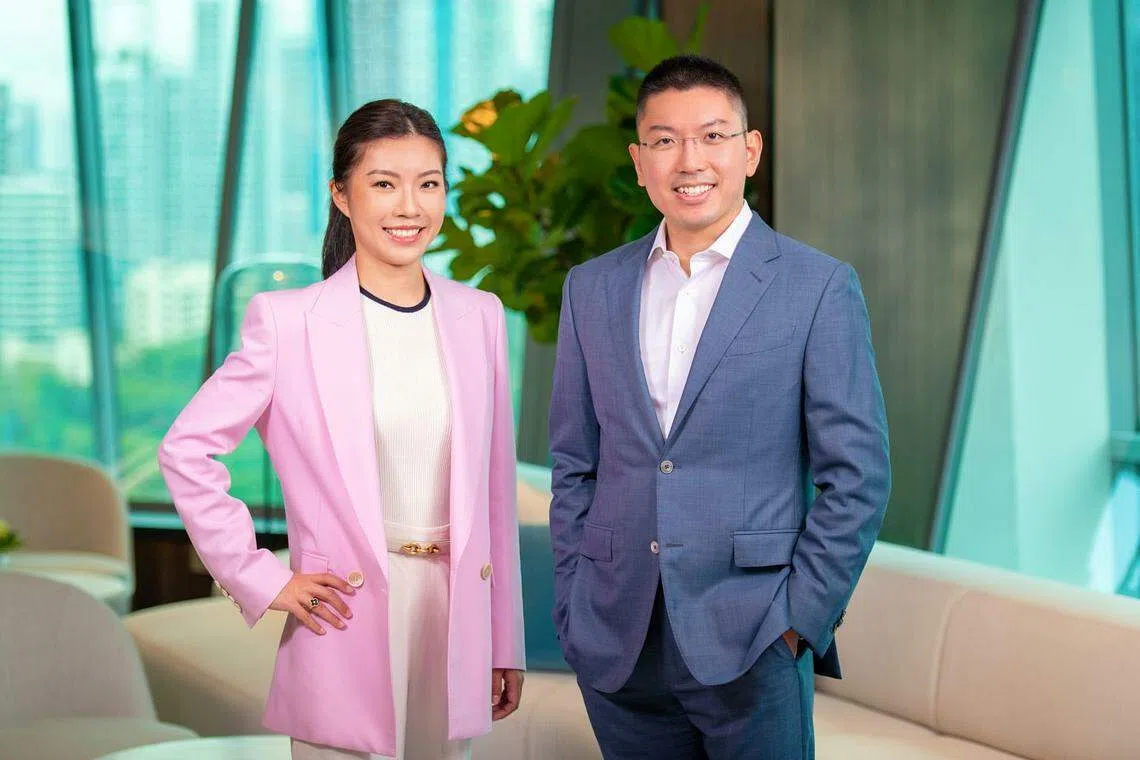
Mr Goh started Starlight with Ms Shirlyn Chew in 2019 with savings and capital accumulated over the years. With over 20 years of experience in the financial markets, the duo specialise in structuring and managing alternative investments for clients.
According to Ms Chew, managing director of the company, while there are no guarantees that alternatives will perform in any given type of macroeconomic environment, some investors take comfort in this non-correlated factor.
Most alternative investment assets are held by institutional investors or accredited, high-net-worth individuals because of their potentially complex nature, and analysing alternative investments require individuals to get out of their comfort zone to review each deal in detail.
Growth of alternative investments
The growing popularity of alternatives has been driven by institutional investors such as pension funds and endowment funds seeking diversification and return opportunities, as well as high-net-worth individuals pursuing additional sources of growth in their investment portfolios.
While traditional instruments are more readily available and are usually the default go-to choice for those looking to build a portfolio, alternatives are climbing in popularity owing to the broader range of investment themes and options available.
Closer to home, alternative assets under management (AUM) expanded 30 per cent year-on-year to reach S$1.23 trillion for all of 2021, according to the Monetary Authority of Singapore's (MAS) annual survey of asset management released in October last year.
The growth outpaced that of the entire asset management industry which registered a 16 per cent growth year-on-year to reach S$5.4 trillion, the MAS report showed.
As global wealth continues to grow, the space for alternatives will continue to expand as investors seek instruments uncorrelated to the macroeconomic environment to diversify their funds.
Weighing the risks
For investors who are new to alternative investments, Mr Goh urges them not to "bet the farm on any alternative investment no matter how sexy it comes across as. It is part and parcel of human nature to be bedazzled by the newest and shiniest object".
He advises investors to examine and understand the logic of how potential returns are generated for any kind of investment, be it traditional or alternative, and to be well aware of the risks involved.
In his experience, investment managers who demonstrate skin-in-the-game through some measure of their personal wealth being invested in their product offerings reveal their commitment and confidence. "It is essentially a positive signal that the operator has conviction in their offering," says Mr Goh.

At the same time, Ms Chew feels that investors should go with their gut feeling and intuition, and dive deeper on the reasons why they feel uncomfortable with their portfolio, or any particular investment, and study what is lacking. There will always be risks that are out of the investors' control.
However, investors can manage them by adjusting the quantum that they are willing to risk, or sort the risks across different buckets instead of just one bucket.
Ms Chew says investors can also analyse their investment decisions by asking themselves the following questions: "Can I afford to lose?", "What is the probability of losing it?", "How will it affect my psychological well-being?" and "How will it affect my lifestyle?".
"As a firm focused on alternatives, Starlight Asset Management is here to help complement and not to compete against traditional investments in an investor's portfolio. Ultimately, we want to offer more options and distinct perspectives to investors.
"What is traditional was once considered alternative. Alternatives are here to complement traditional assets," says Ms Chew.
The rise of VCCs
In Jan 2020, Singapore introduced the Variable Capital Company (VCC) framework, a new corporate structure that aims to encourage more funds to be domiciled locally and help enhance the country's value as an international fund management centre.
The VCC structure can be used for a wide range of investment funds and provides fund managers greater operational flexibility and cost savings. For example, a VCC is treated as a company and single entity for income tax purposes, whether it is set up as a stand-alone or as an umbrella vehicle with sub-funds.
There are over 600 VCCs incorporated or domiciled in Singapore as of Oct 14, 2022, representing over 1,300 sub-funds and managed by 420 regulated fund management companies, according to the Monetary Authority of Singapore's data.
Mr Goh says Starlight, too, has leveraged the VCC structure to better service clients. It established its own VCC in 2020, a year after the Covid-19 pandemic struck.
Having joined the company in 2022 as a business development associate, Ms Erica Goh uses her interest in VCC to help investors understand the VCC structure and funds available under Starlight Asset Management.

The 27-year-old says: "The beauty of the VCC structure lies in its seamless synchronicity with the robust regulatory and legal framework for fund and wealth management activities in Singapore. Investors should take comfort in these key infrastructures that have been meticulously developed to be highly supportive of their desired investment activities."
Visit this website for more information, or WhatsApp Starlight Investor Relations for assistance at +65 8533 3889.
Starlight Asset Management Pte Ltd is a Registered Fund Management Company (RFMC) with the Monetary Authority of Singapore (MAS). We are restricted to serving only Qualified Investors as defined under the Securities and Futures (Licensing and Conduct of Business) Regulations.
Decoding Asia newsletter: your guide to navigating Asia in a new global order. Sign up here to get Decoding Asia newsletter. Delivered to your inbox. Free.
Share with us your feedback on BT's products and services
TRENDING NOW

On the board but frozen out: The Taib family feud tearing Sarawak construction giant apart
Government to roll out more support measures should need arise amid Middle East situation: PM Wong
Seatrium surge leads Singapore stocks slightly higher on Tuesday; STI up 0.1%
Not retirement, but a rewiring and fresh perspectives post-DBS, says Piyush Gupta

