No profit, no problem: Singapore’s digital banks in six charts
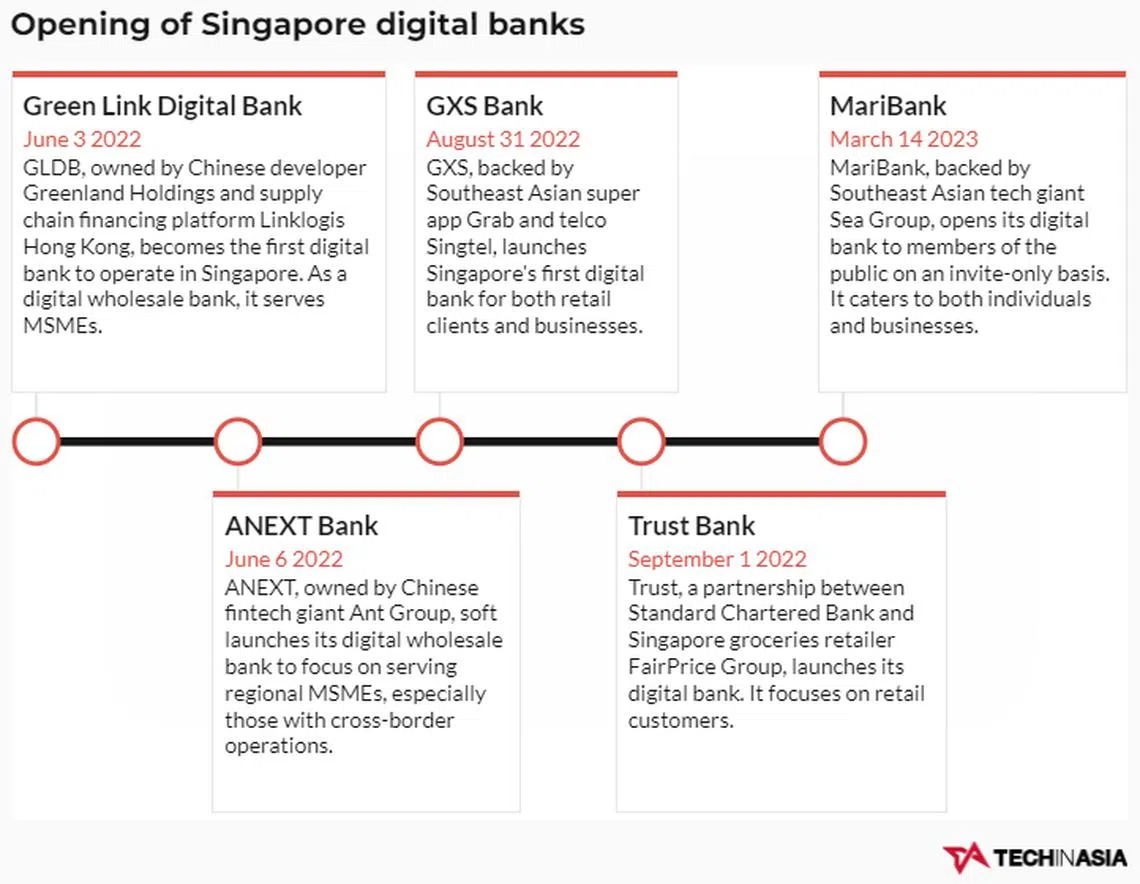
IT’S been just over two years since Green Link Digital Bank (GLDB) became the first digital bank to start operations in Singapore.
This was followed in quick succession by ANEXT, GXS Bank, and Trust Bank, with MariBank being the last to enter the game.
With at least a full year of operations under their belt – apart from MariBank – it’s a good time to evaluate how these digital banks are faring, with the caveat that they are still in their infancy.
For comparison, we have included the performance of South Korea’s KakaoBank. Founded in 2016, the bank provides a benchmark as to how a successful digital bank in a developed market might perform over time.
It’s also worth noting that as digital wholesale banks, GLDB and ANEXT bank serve businesses exclusively, while GXS Bank, MariBank, and Trust Bank can serve both retail customers and businesses. Trust Bank, however, appears to be offering banking products to only consumers for now.
Combined revenue a fraction of KakaoBank’s
For 2023, the five Singapore-based digital banks recorded a combined total revenue of US$72 million, 6 per cent of what KakaoBank achieved that year. Bear in mind, however, that the Singapore players are much newer, and the Singapore economy is around a quarter the size of South Korea’s.
Of the five, Trust Bank had the highest revenue, while GXS Bank suffered the biggest loss.
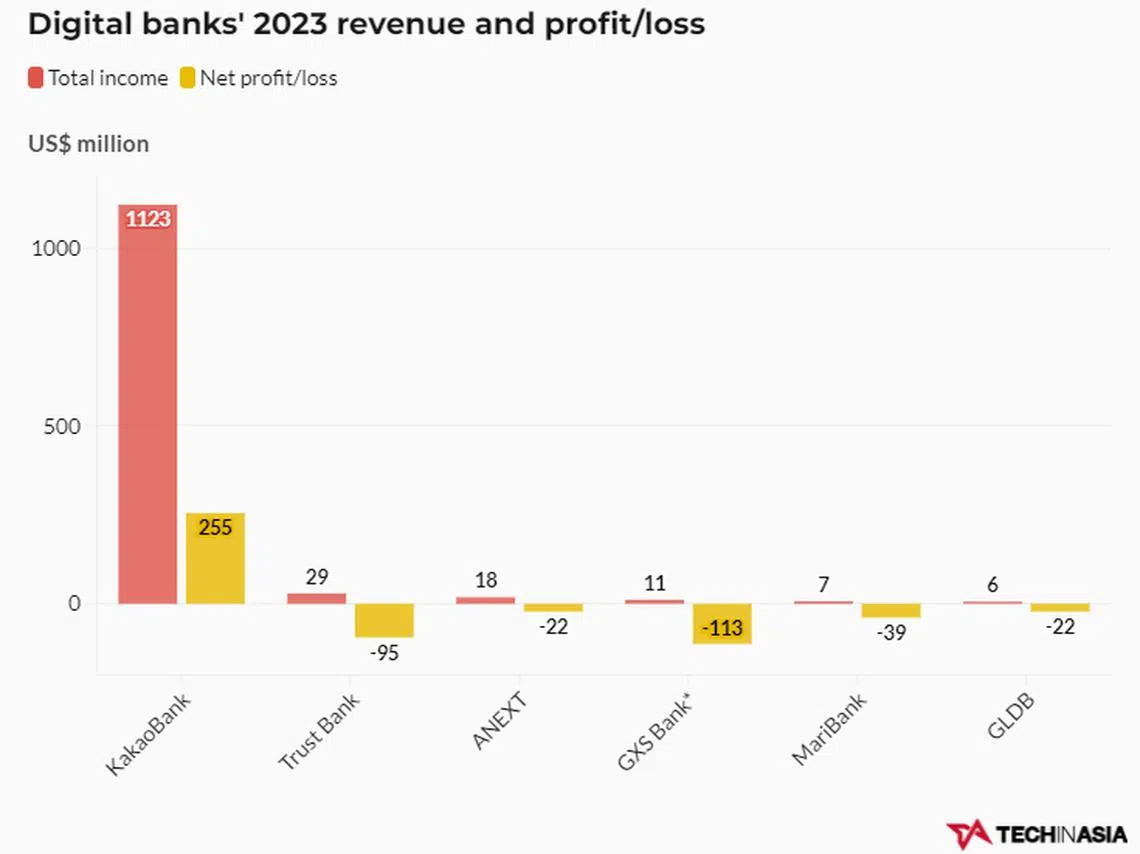
Unlike KakaoBank, none of Singapore’s digital banks are yet profitable. To achieve that, they will have to lower their cost-to-income ratio.
KakaoBank’s cost-to-income ratio of 53 per cent in 2023 is in line what is considered “acceptable” for traditional retail banks, which typically have a ratio of around 50 to 60 per cent.
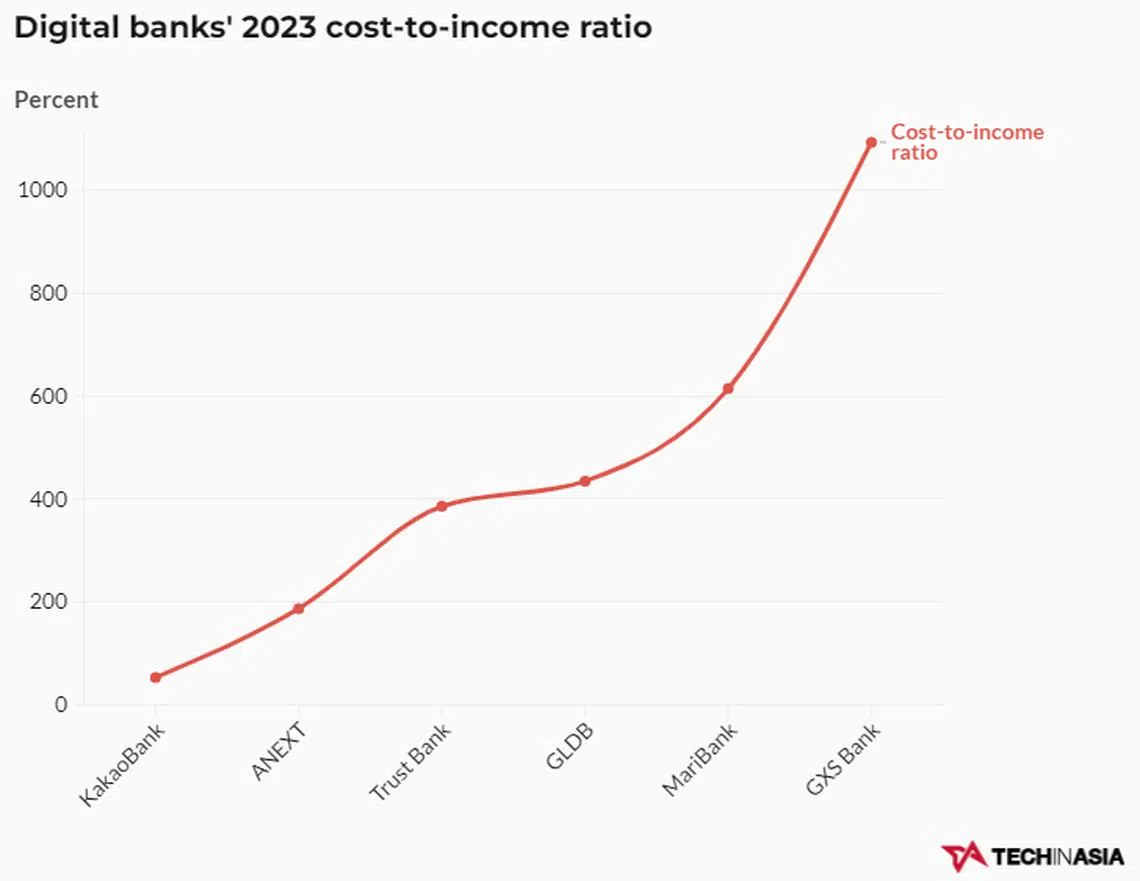
Any figure above 100 per cent indicates that the bank’s operating expenses exceed its operating income.
Loan way to go
The bread and butter of banking is taking in deposits from customers and using these deposits to extend loans. In order to run a profitable business, the interest charged on loans must be higher than the interest it pays on deposits.
Given their infancy and Singapore’s small market size, it’s no surprise that the Singapore players still have small deposit bases compared to KakaoBank. Of the five, Trust Bank has attracted the most deposits.
This might be expected since unlike the other banks, Trust was riding off Standard Chartered’s banking license and so was not subject to the initial S$50 million deposit cap initially placed on GXS Bank and MariBank by the Monetary Authority of Singapore (MAS) – this limit was lifted in mid-2023.
GLDB and ANEXT, the digital wholesale banks which do not take deposits from retail consumers, placed fourth and fifth among the Singapore banks.
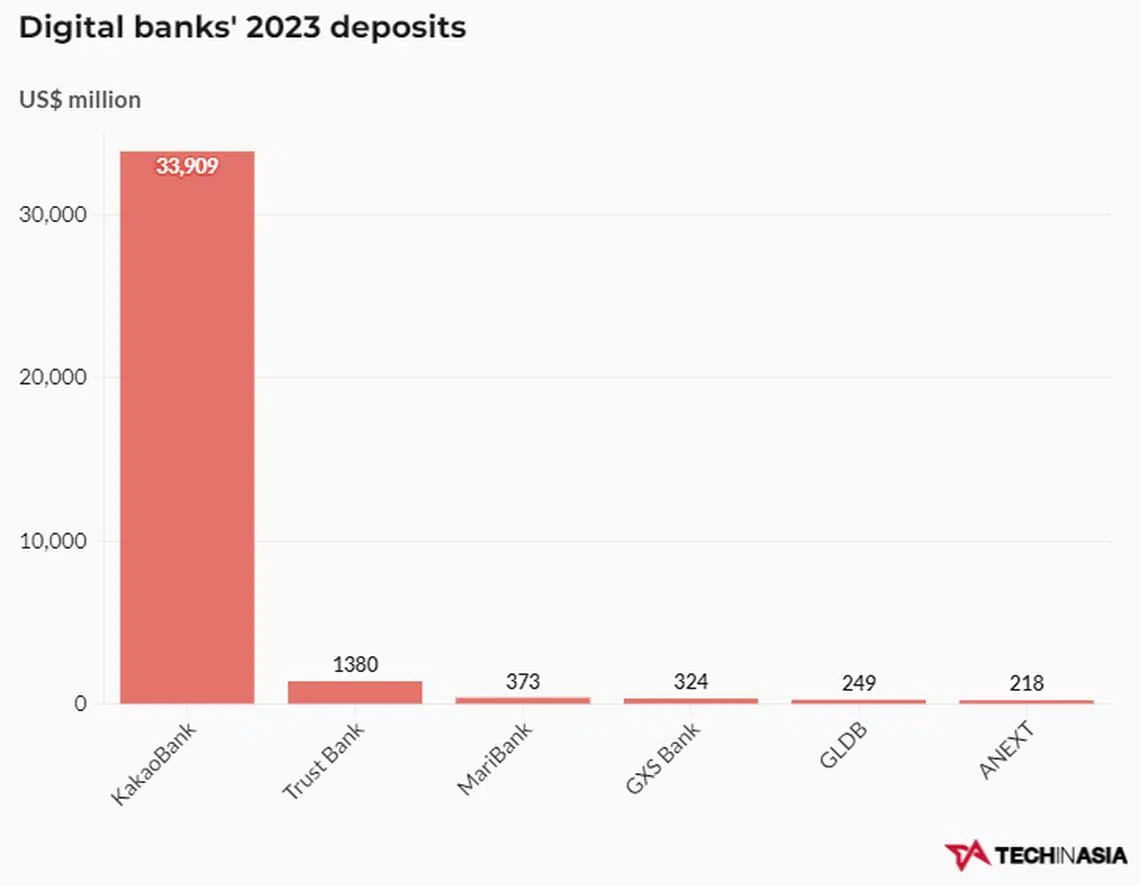
Similarly, when it comes to loans disbursed, Trust Bank comes out ahead, although it is the wholesale digital banks – ANEXT and GLDB – which take silver and bronze. This may partly be because they had a headstart on the others, launching their loan products in November and September 2022, respectively.
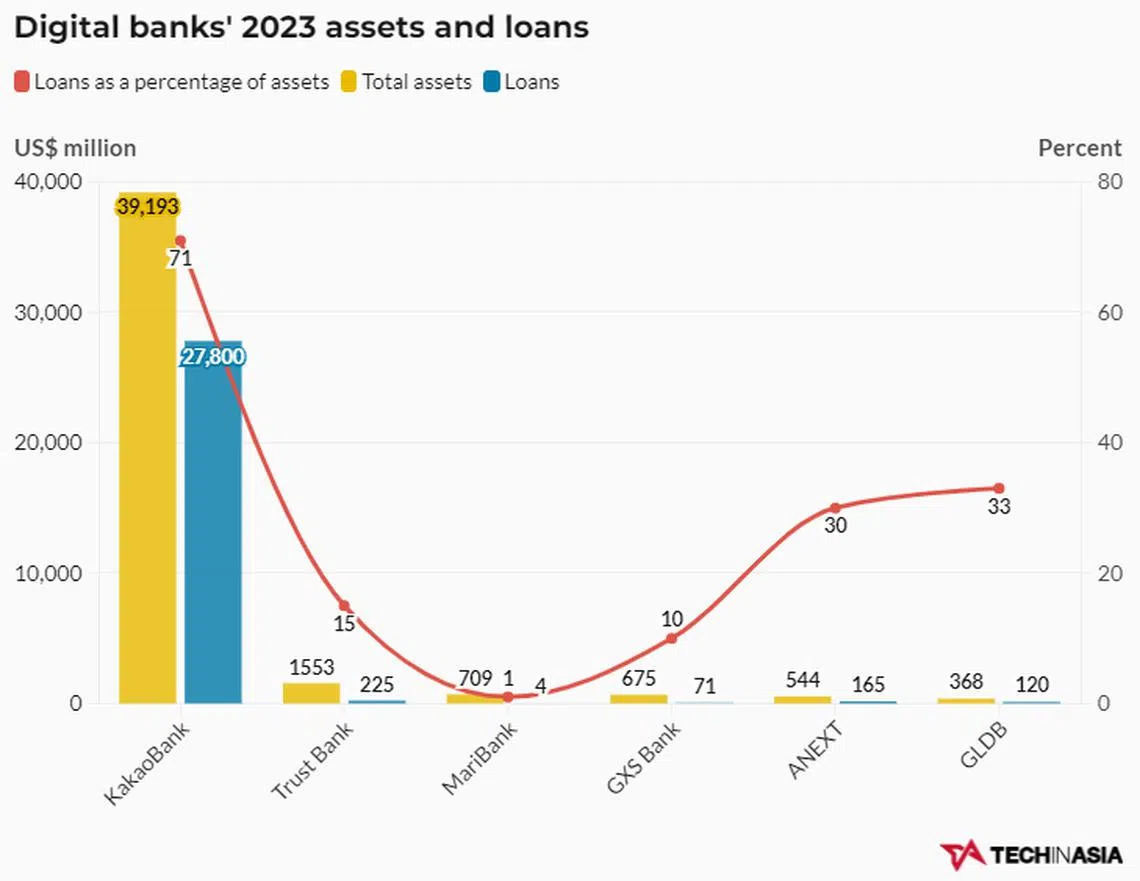
Loans are only one type of asset that banks have on their balance sheets. Other assets include government securities, and cash placed with the central bank or other financial institutions. However, for most banks, their main asset should take the form of loans.
In South Korea, 71 per cent of KakaoBank’s assets are loans, while the percentage of loans to total assets among the Singapore digital banks ranges from 4 per cent for MariBank to 33 per cent for GLDB.
Over time, we should expect this number to rise to levels that are more in line with KakaoBank’s since making loans is the main way these banks will make money.
Impairment versus NPL
Sometimes, borrowers may be unable to pay back some or all of their loans, and this shows up in a bank’s financial statements as an impairment.
KakaoBank’s impairment levels as a percentage of loans was 0.6 per cent in 2023. GXS Bank is at the other end of the scale, with impairments accounting for 10.4 per cent of total loan amount.
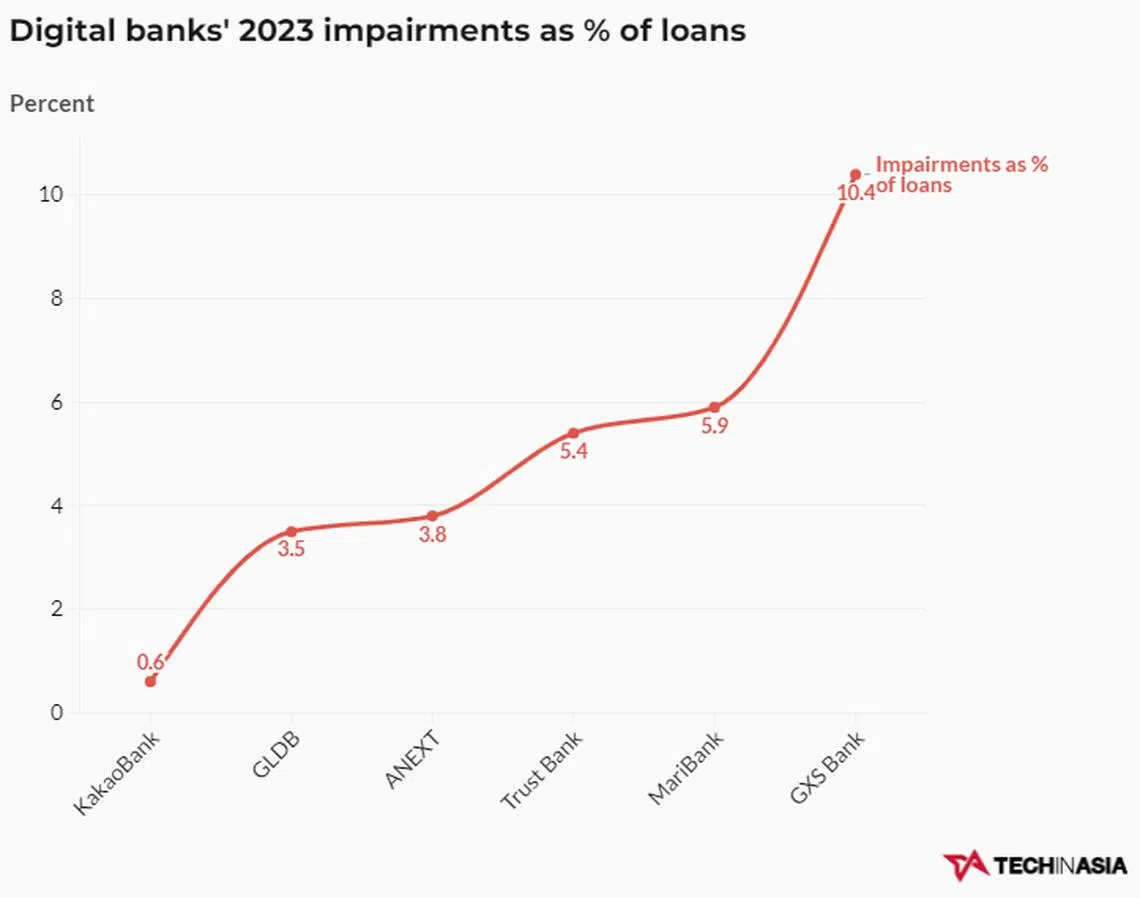
Note that in Grab’s first-quarter results for 2024, the firm said that GXS Bank’s non-performing loans (NPLs) were 2 per cent of its loan portfolio.
Why the discrepancy? This is because impairments and NPLs are two different concepts, with impairment being an accounting term and NPLs a regulatory one. As an accounting measure, a loan could be marked as impaired if it is deemed not likely to be repaid in full, even if payments have not been missed.
As such, the difference is one of degree, with impaired loans still having a chance of recovery, whereas NPLs are more serious.
The making of loans is one example of how banks support consumers and businesses. The flipside of this is that banks’ failure may present a systemic threat to a country’s financial system and wider economy.
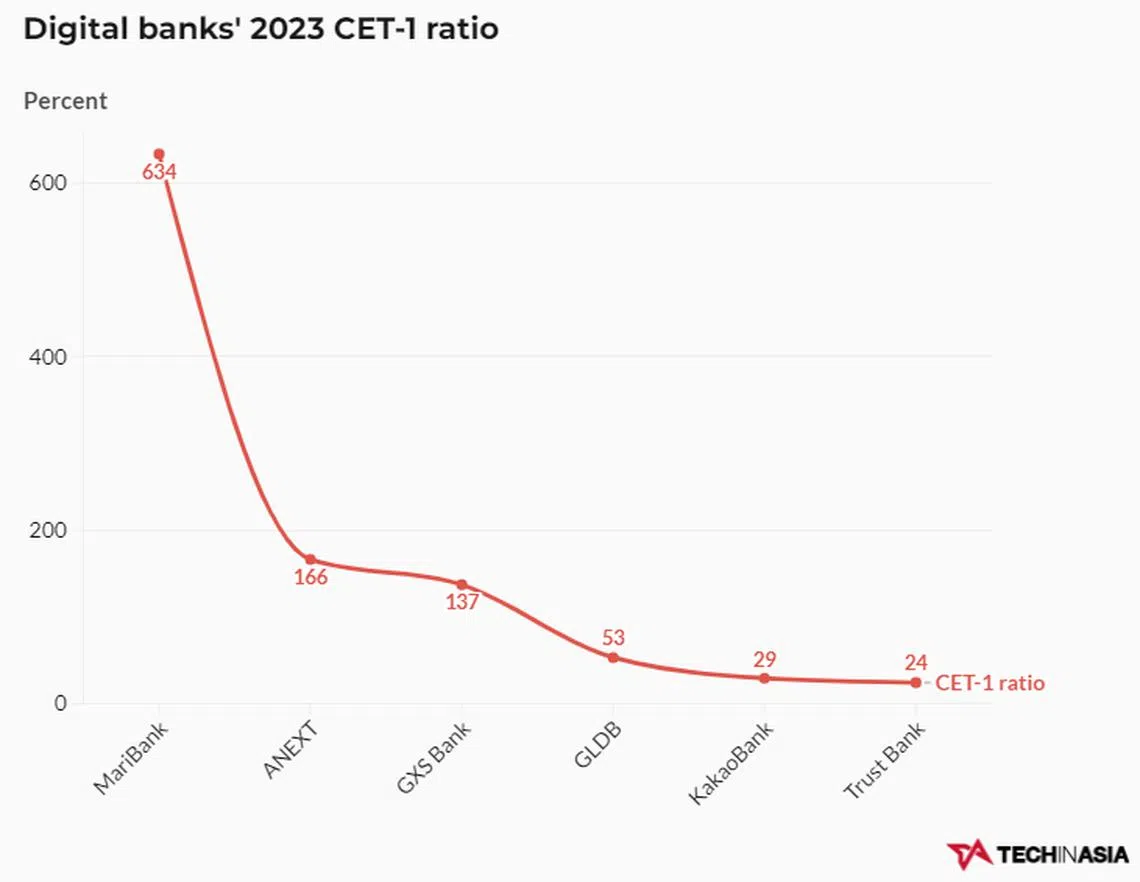
In order to protect the economy from a banking crisis, banking regulators introduced Common Equity Tier 1 (CET-1) requirements in 2014. Under the rules, banks are expected to hold a certain percentage of liquid assets (such as cash and stock) against their total assets, which are weighted by risk.
Currently, the MAS requires banks to have a minimum CET-1 of 6.5 per cent. However, in practice, banks typically maintain far higher CET-1 ratios.
For example, DBS, Singapore’s biggest bank by assets, had a CET-1 ratio of 14.7 per cent as at March 2024.
Singapore’s digital banks far exceed the minimum requirements, with ratios ranging from 24 per cent to 634 per cent. Of course, this can be expected to decrease over time as they start to make more loans and develop their businesses.
Given the importance of fintech to the overall businesses of South-east Asia’s tech giants, we can expect more developments in the space, such as last week’s news that GXS Bank secured an additional S$229.5 million in capital from Singtel and Grab.
One thing’s for sure – 2024’s numbers will look very different from last year’s. TECH IN ASIA