

Yen softens past 150 per US dollar for first time since 1990
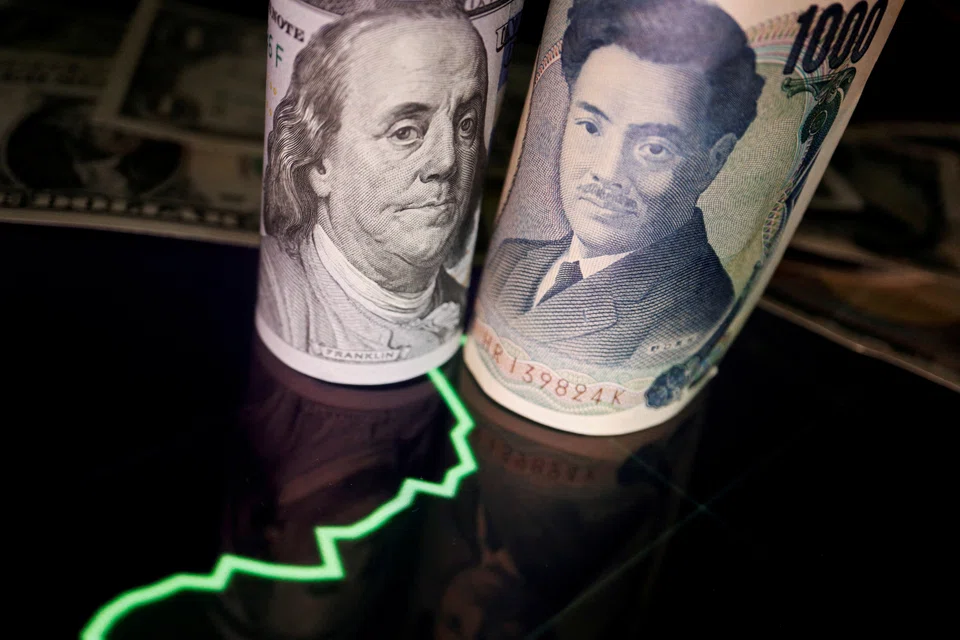
THE US dollar hit the symbolic level of 150 yen for the first time since 1990 on Thursday (Oct 20) as the greenback was supported by Treasury yields trading at multi-year highs, keeping markets on high alert for intervention from Japanese authorities.
Moves among other major currencies were muted by recent standards. The euro up 0.5 per cent at US$0.9826, regaining a little of the ground it lost during a US dollar surge the day before, while turmoil in British politics meant sterling stayed soft.
The fragile yen briefly weakened past 150 per US dollar in early European trading for the first time since August 1990. It was last trading a touch below that level, at 149.7 yen per US dollar.
The Japanese currency has been on a losing streak for 11 straight sessions as of Wednesday’s close, and has renewed 32-year lows for six sessions now.
“As long as the terminal point of the US interest rate remains unclear, US dollar strength will not subside. 150 was just a pass point, and the focus now is on if it tops 160,” said Takumi Tsunoda, senior economist, Shinkin Central Bank Research Institute in Tokyo.
The Federal Reserve is expected to continue raising interest rates as inflation remains stubbornly hot in the United States, with some forecasting a peak above 5 per cent.
This has sent US yields and the US dollar higher, particularly against the yen, as the Bank of Japan is committed to keeping interest rates near zero.
The benchmark US 10-year Treasury yield rose to 4.18 per cent on Thursday, its highest level since mid-2008, while the two-year Treasury yields touched a 15-year high of 4.614 per cent.
Traders were also watching to see whether the breach of the 150 level would cause Japanese authorities to repeat last month’s intervention in currency markets, their first time doing so to support the battered currency since 1998.
“The (Ministry of Finance) has been very clear that they are ready to intervene if there is any disorderly price action, so the markets are priced for that coming at some point in time,” said Derek Halpenny, head of research, global markets Emea at MUFG.
“Obviously, if we break clearly above 150 we may see some disorderly price action and that could be the catalyst for some action so it’s just basically all eyes on MOF,” he added, though emphasising it would take a sharp move in the pair to trigger intervention.
But, in a reflection of Japanese authorities’ competing desires, earlier on Thursday the Bank of Japan ramped up efforts to defend its 0 per cent bond yield cap earlier with offers of emergency bond buying.
In Europe, the euro climbed 0.4 per cent on the pound amid political turmoil in the United Kingdom, with the departure of the interior minister putting further pressure on Prime Minister Liz Truss.
“Political infighting and the uncertainty of policy continue to demand a risk premium for sterling, where GBP/USD could easily slip back to the bottom end of its wide 1.10-1.15 range,” said ING analysts in a note.
“The wild card is what happens to the top job.”
Sterling was last flat versus the US dollar at US$1.1231.
The surging greenback also pushed the Chinese offshore yuan to a record low in Asia of 7.2794 early in the session, its weakest level since such data first became available in 2011.
It later trimmed intraday losses on a Bloomberg report that China is considering a cut in the duration of quarantine for inbound visitors from 10 days to seven days.
Other currencies including the Australian and Canadian dollars and the Swiss franc, regained a little of their losses against the US dollar from the previous day. REUTERS
Decoding Asia newsletter: your guide to navigating Asia in a new global order. Sign up here to get Decoding Asia newsletter. Delivered to your inbox. Free.
Share with us your feedback on BT's products and services
TRENDING NOW
Trump welcomes China’s Xi at airport to kick off three-day state visit
As the Fed hikes interest rates, S-Reits sector could be overdue for consolidation

He built the Vingroup empire. Now South-east Asia’s richest man is handing some key roles to his sons

Simba admits exceeding spectrum limits amid failed M1 deal; parent company Tuas’ full-year profit surges 277%

